



 Chat with AI
Exam 8: Conservation of Energy

Exam 1: Physics and Measurement25 Questions
Exam 2: Motion in One Dimension66 Questions
Exam 3: Vectors47 Questions
Exam 4: Motion in Two Dimensions79 Questions
Exam 5: The Laws of Motion113 Questions
Exam 6: Circular Motion and Other Applications of Newtons Laws55 Questions
Exam 7: Energy of a System74 Questions
Exam 8: Conservation of Energy84 Questions
Exam 9: Linear Momentum and Collisions89 Questions
Exam 10: Rotation of a Rigid Object About a Fixed Axis82 Questions
Exam 11: Angular Momentum46 Questions
Exam 12: Static Equilibrium and Elasticity34 Questions
Exam 13: Universal Gravitation47 Questions
Exam 14: Fluid Mechanics53 Questions
Exam 15: Oscillatory Motion41 Questions
Exam 16: Wave Motion82 Questions
Exam 18: Superposition and Standing Waves72 Questions
Exam 19: Temperature47 Questions
Exam 20: The First Law of Thermodynamics61 Questions
Exam 21: The Kinetic Theory of Gases38 Questions
Exam 22: Heat Engines, Entropy, and the Second Law of Thermodynamics55 Questions
Exam 23: Electric Fields67 Questions
Exam 24: Gausss Law82 Questions
Exam 25: Electric Potential111 Questions
Exam 26: Capacitance and Dielectrics63 Questions
Exam 27: Current and Resistance34 Questions
Exam 28: Direct-Current Circuits84 Questions
Exam 29: Magnetic Fields80 Questions
Exam 30: Sources of the Magnetic Field95 Questions
Exam 31: Faradays Law62 Questions
Exam 32: Inductance23 Questions
Exam 33: Alternating-Current Circuits65 Questions
Exam 34: Electromagnetic Waves40 Questions
Exam 35: The Nature of Light and the Principles of Ray Optics37 Questions
Exam 36: Image Formation43 Questions
Exam 37: Wave Optics48 Questions
Exam 38: Diffraction Patterns and Polarization47 Questions
Exam 39: Relativity34 Questions
Exam 40: Introduction to Quantum Physics48 Questions
Exam 41: Quantum Mechanics33 Questions
Exam 42: Atomic Physics59 Questions
Exam 43: Molecules and Solids46 Questions
Exam 44: Nuclear Structure89 Questions
Exam 46: Particle Physics and Cosmology34 Questions
Select questions type


A 7.0-kg block on a horizontal frictionless surface is attached to a light spring (force constant = 1.2 kN/m). The block is initially at rest at its equilibrium position when a force of magnitude P acting parallel to the surface is applied to the block, as shown. When the block is 8.0 cm from the equilibrium position, it has a speed of 0.80 m/s. How much work is done on the block by the force P as the block moves the 8.0 cm? 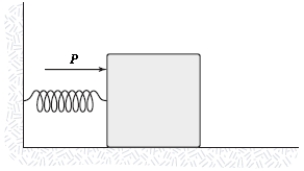
(Multiple Choice)
4.9/5  (86)
(86) Jane and Jake are looking at what happens to body 1 of mass m and body 2 of mass 2m, initially at rest, when equal forces are applied separately to the two bodies. Jake says that equal forces applied for equal times do equal amounts of work on the two bodies. Jane says that the two forces do equal amounts of work only if the two bodies move equal distances in the direction of the forces. Which one, if either, is correct?
(Multiple Choice)
4.7/5 (82)
(82) A 2.5-kg object suspended from the ceiling by a string that has a length of 2.5 m is released from rest with the string 40° below the horizontal position. What is the tension in the string at the instant when the object passes through its lowest position?
(Multiple Choice)
4.8/5 (86)
(86) The force a spring exerts on a body is a conservative force because
(Multiple Choice)
4.8/5 (71)
(71) A 10-kg object is dropped from rest. After falling a distance of 50 m, it has a speed of 26 m/s. What is the change in mechanical energy caused by the dissipative (air) resistive force on the object during this descent?
(Multiple Choice)
4.7/5 (82)
(82) A 2.0-kg block slides down a plane (inclined at 40° with the horizontal) at a constant speed of 5.0 m/s. At what rate is the gravitational force on the block doing work?
(Multiple Choice)
4.8/5 (84)
(84) A 3.50 kg block is pulled along a moving conveyor belt at a constant speed of 0.500 m/s relative to a stationary observer while the belt moves at a constant speed of 0.200 m/s in the same direction. If the coefficient of kinetic friction is 0.400, the magnitude of the mechanical energy dissipated, in J, caused by the force of friction on the block in 8.00 s is
(Multiple Choice)
4.8/5 (74)
(74) A rain cloud contains 2.66 × 10⁷ kg of water vapor. How long would it take for a 2.0 kW pump to lift the same amount of water to an altitude of 2 000 m?
(Short Answer)
4.9/5 (81)
(81) Which of the following is a conservative force? (All refer to a car on a slope.)
(Multiple Choice)
4.8/5 (74)
(74) The solution to a problem is the equation below. Which description best fits this solution? 

(Multiple Choice)
4.9/5 (81)
(81) A 70-kg high jumper leaves the ground with a vertical velocity of 6.0 m/s. How high can he jump?
(Short Answer)
4.9/5 (78)
(78) Cubical blocks of mass m and side l are piled up in a vertical column. The total gravitational potential energy of a column of three blocks is
(Multiple Choice)
4.9/5 (78)
(78) A 2.0-kg mass swings at the end of a light string (length = 3.0 m). Its speed at the lowest point on its circular path is 6.0 m/s. What is its kinetic energy at an instant when the string makes an angle of 50° with the vertical?
(Multiple Choice)
4.8/5 (72)
(72) A spring (k = 600 N/m) is placed in a vertical position with its lower end supported by a horizontal surface. A 2.0-kg block that is initially 0.40 m above the upper end of the spring is dropped from rest onto the spring. What is the kinetic energy of the block at the instant it has fallen 0.50 m (compressing the spring 0.10 m)?
(Multiple Choice)
4.7/5 (78)
(78) As an object moves from point A to point B only two forces act on it: one force is conservative and does −70 J of work, the other force is nonconservative and does +50 J of work. Between A and B,
(Multiple Choice)
4.7/5 (83)
(83) Two masses, MA and MB, with MB = 2MA, are released at the same time and allowed to fall straight down. Neglect air resistance. When we compare their kinetic energies after they have fallen equal distances, we find that
(Multiple Choice)
4.9/5 (69)
(69) A 0.60-kg object is suspended from the ceiling at the end of a 2.0-m string. When pulled to the side and released, it has a speed of 4.0 m/s at the lowest point of its path. What maximum angle does the string make with the vertical as the object swings up?
(Multiple Choice)
4.8/5 (82)
(82) A 12-kg block on a horizontal frictionless surface is attached to a light spring (force constant = 0.80 kN/m). The block is initially at rest at its equilibrium position when a force (magnitude P = 80 N) acting parallel to the surface is applied to the block, as shown. What is the speed of the block when it is 13 cm from its equilibrium position? 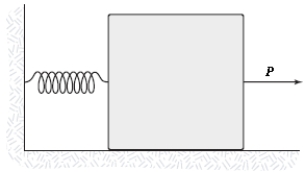
(Multiple Choice)
4.8/5 (81)
(81) A 20-kg mass is fastened to a light spring (k = 380 N/m) that passes over a pulley as shown. The pulley is frictionless, and the mass is released from rest when the spring is unstretched. After the mass has dropped 0.40 m, what is its speed? 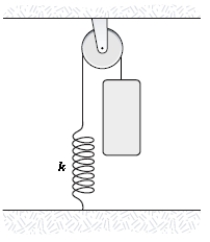
(Multiple Choice)
4.9/5 (76)
(76) A champion athlete can produce one horsepower (746 W) for a short period of time. If a 70-kg athlete were to bicycle to the summit of a 500-m high mountain while expending power at this rate, she would reach the summit in ____ seconds.
(Multiple Choice)
4.9/5 (73)
(73) 
Filters
- Essay(0)
- Multiple Choice(0)
- Short Answer(0)
- True False(0)
- Matching(0)