



 Chat with AI
Exam 44: Osmoregulation and Excretion

Exam 1: Introduction: Themes in the Study of Life64 Questions
Exam 2: The Chemical Context of Life83 Questions
Exam 3: Water and Life70 Questions
Exam 4: Carbon and the Molecular Diversity of Life71 Questions
Exam 5: The Structure and Function of Large Biological Molecules109 Questions
Exam 6: A Tour of the Cell80 Questions
Exam 7: Membrane Structure and Function80 Questions
Exam 8: An Introduction to Metabolism80 Questions
Exam 9: Cellular Respiration and Fermentation107 Questions
Exam 10: Photosynthesis81 Questions
Exam 11: Cell Communication69 Questions
Exam 12: The Cell Cycle79 Questions
Exam 13: Meiosis and Sexual Life Cycles70 Questions
Exam 14: Mendel and the Gene Idea73 Questions
Exam 15: The Chromosomal Basis of Inheritance61 Questions
Exam 16: The Molecular Basis of Inheritance57 Questions
Exam 17: From Gene to Protein83 Questions
Exam 18: Regulation of Gene Expression99 Questions
Exam 19: Viruses47 Questions
Exam 20: Biotechnology72 Questions
Exam 21: Genomes and Their Evolution42 Questions
Exam 22: Descent with Modification: A Darwinian View of Life55 Questions
Exam 23: The Evolution of Populations78 Questions
Exam 24: The Origin of Species63 Questions
Exam 25: The History of Life on Earth75 Questions
Exam 26: Phylogeny and the Tree of Life73 Questions
Exam 27: Bacteria and Archaea78 Questions
Exam 28: Protists76 Questions
Exam 29: Plant Diversity I: How Plants Colonized Land74 Questions
Exam 30: Plant Diversity II: The Evolution of Seed Plants102 Questions
Exam 31: Fungi89 Questions
Exam 32: An Overview of Animal Diversity74 Questions
Exam 33: An Introduction to Invertebrates93 Questions
Exam 34: The Origin and Evolution of Vertebrates109 Questions
Exam 35: Plant Structure, Growth, and Development67 Questions
Exam 36: Resource Acquisition and Transport in Vascular Plants82 Questions
Exam 37: Soil and Plant Nutrition83 Questions
Exam 38: Angiosperm Reproduction and Biotechnology86 Questions
Exam 39: Plant Responses to Internal and External Signals108 Questions
Exam 40: Basic Principles of Animal Form and Function77 Questions
Exam 41: Animal Nutrition64 Questions
Exam 42: Circulation and Gas Exchange90 Questions
Exam 43: The Immune System100 Questions
Exam 44: Osmoregulation and Excretion69 Questions
Exam 45: Hormones and the Endocrine System72 Questions
Exam 46: Animal Reproduction94 Questions
Exam 47: Animal Development92 Questions
Exam 48: Neurons, Synapses, and Signaling73 Questions
Exam 49: Nervous Systems65 Questions
Exam 50: Sensory and Motor Mechanisms82 Questions
Exam 51: Animal Behavior69 Questions
Exam 52: An Introduction to Ecology and the Biosphere73 Questions
Exam 53: Population Ecology79 Questions
Exam 54: Community Ecology77 Questions
Exam 55: Ecosystems and Restoration Ecology81 Questions
Exam 56: Conservation Biology and Global Change67 Questions
Select questions type


Unlike most bony fishes, sharks maintain body fluids that are isoosmotic to seawater, so they are considered by many to be osmoconformers. Nonetheless, these sharks osmoregulate at least partially by
(Multiple Choice)
4.9/5  (81)
(81) Osmoregulatory adjustment via the renin-angiotensin-aldosterone system can be triggered by
(Multiple Choice)
4.9/5 (96)
(96) A necropsy (postmortem analysis)of a marine sea star that died after it was mistakenly placed in fresh water would likely show that it died because
(Multiple Choice)
4.8/5 (79)
(79) In humans, the transport epithelial cells in the ascending loop of Henle
(Multiple Choice)
4.7/5 (76)
(76) Compared to the seawater around them, most marine invertebrates are
(Multiple Choice)
4.7/5 (72)
(72) Use the following structural formulas to identify the following items.
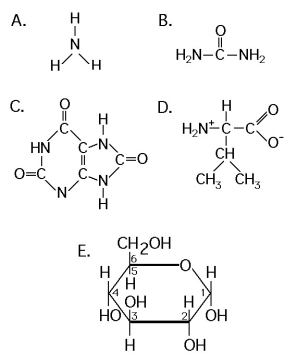 -Which of the following is synthesized by mammals, most amphibians, sharks, and some bony fishes, and has lower toxicity than its nitrogenous substrate?
 (Multiple Choice)
4.7/5 (95)
(95) Compared to wetland mammals, water conservation in mammals of arid regions is enhanced by having more
(Multiple Choice)
4.8/5 (75)
(75) If ATP production in a human kidney was suddenly halted, urine production would
(Multiple Choice)
4.9/5 (78)
(78) ADH and RAAS work together in maintaining osmoregulatory homeostasis through which of the following ways?
(Multiple Choice)
4.9/5 (96)
(96) Juxtamedullary nephrons can concentrate salt effectively in the renal medulla because of their long
(Multiple Choice)
4.8/5 (93)
(93) The advantage of excreting nitrogenous wastes as urea rather than as ammonia is that
(Multiple Choice)
4.8/5 (79)
(79) After blood flow is artificially reduced at one kidney, you would expect that kidney to secrete more of the hormone known as
(Multiple Choice)
4.9/5 (70)
(70) In animals, nitrogenous wastes are produced mostly from the catabolism of
(Multiple Choice)
4.8/5 (77)
(77) Excessive formation of uric acid crystals in humans leads to
(Multiple Choice)
4.8/5 (74)
(74) The osmoregulatory/excretory system of a freshwater flatworm is based on the operation of
(Multiple Choice)
4.8/5 (68)
(68) The body fluids of an osmoconformer would be ________ with its ________ environment.
(Multiple Choice)
4.7/5 (81)
(81) 
Filters
- Essay(0)
- Multiple Choice(0)
- Short Answer(0)
- True False(0)
- Matching(0)