



 Chat with AI
Exam 37: Soil and Plant Nutrition

Exam 1: Introduction: Themes in the Study of Life64 Questions
Exam 2: The Chemical Context of Life83 Questions
Exam 3: Water and Life70 Questions
Exam 4: Carbon and the Molecular Diversity of Life71 Questions
Exam 5: The Structure and Function of Large Biological Molecules109 Questions
Exam 6: A Tour of the Cell80 Questions
Exam 7: Membrane Structure and Function80 Questions
Exam 8: An Introduction to Metabolism80 Questions
Exam 9: Cellular Respiration and Fermentation107 Questions
Exam 10: Photosynthesis81 Questions
Exam 11: Cell Communication69 Questions
Exam 12: The Cell Cycle79 Questions
Exam 13: Meiosis and Sexual Life Cycles70 Questions
Exam 14: Mendel and the Gene Idea73 Questions
Exam 15: The Chromosomal Basis of Inheritance61 Questions
Exam 16: The Molecular Basis of Inheritance57 Questions
Exam 17: From Gene to Protein83 Questions
Exam 18: Regulation of Gene Expression99 Questions
Exam 19: Viruses47 Questions
Exam 20: Biotechnology72 Questions
Exam 21: Genomes and Their Evolution42 Questions
Exam 22: Descent with Modification: A Darwinian View of Life55 Questions
Exam 23: The Evolution of Populations78 Questions
Exam 24: The Origin of Species63 Questions
Exam 25: The History of Life on Earth75 Questions
Exam 26: Phylogeny and the Tree of Life73 Questions
Exam 27: Bacteria and Archaea78 Questions
Exam 28: Protists76 Questions
Exam 29: Plant Diversity I: How Plants Colonized Land74 Questions
Exam 30: Plant Diversity II: The Evolution of Seed Plants102 Questions
Exam 31: Fungi89 Questions
Exam 32: An Overview of Animal Diversity74 Questions
Exam 33: An Introduction to Invertebrates93 Questions
Exam 34: The Origin and Evolution of Vertebrates109 Questions
Exam 35: Plant Structure, Growth, and Development67 Questions
Exam 36: Resource Acquisition and Transport in Vascular Plants82 Questions
Exam 37: Soil and Plant Nutrition83 Questions
Exam 38: Angiosperm Reproduction and Biotechnology86 Questions
Exam 39: Plant Responses to Internal and External Signals108 Questions
Exam 40: Basic Principles of Animal Form and Function77 Questions
Exam 41: Animal Nutrition64 Questions
Exam 42: Circulation and Gas Exchange90 Questions
Exam 43: The Immune System100 Questions
Exam 44: Osmoregulation and Excretion69 Questions
Exam 45: Hormones and the Endocrine System72 Questions
Exam 46: Animal Reproduction94 Questions
Exam 47: Animal Development92 Questions
Exam 48: Neurons, Synapses, and Signaling73 Questions
Exam 49: Nervous Systems65 Questions
Exam 50: Sensory and Motor Mechanisms82 Questions
Exam 51: Animal Behavior69 Questions
Exam 52: An Introduction to Ecology and the Biosphere73 Questions
Exam 53: Population Ecology79 Questions
Exam 54: Community Ecology77 Questions
Exam 55: Ecosystems and Restoration Ecology81 Questions
Exam 56: Conservation Biology and Global Change67 Questions
Select questions type


All of the following contributed to the dust bowl in the American southwest during the 1930s except
(Multiple Choice)
4.8/5  (92)
(92) A growing plant exhibits chlorosis of the leaves, especially the older, more mature ones. The chlorosis is probably due to a deficiency of which of the following macronutrients?
(Multiple Choice)
4.9/5 (79)
(79) Figure 37.1 shows the results of a study to determine the effect of soil air spaces on plant growth.
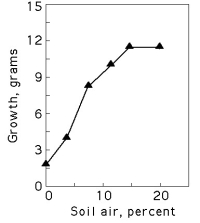 Figure 37.1
-The data in Figure 37.1 indicate that the plant
Figure 37.1
-The data in Figure 37.1 indicate that the plant (Multiple Choice)
4.9/5 (79)
(79) A group of 10 tomato plants are germinated and maintained in a large tray with no drainage. After several weeks they all begin to wilt and die despite repeated watering and fertilization. The most likely cause of this die-off is
(Multiple Choice)
4.8/5 (83)
(83) Which of the following soil minerals is most likely leached away during a hard rain?
(Multiple Choice)
4.8/5 (82)
(82) Which two elements make up more than 90% of the dry weight of plants?
(Multiple Choice)
4.7/5 (83)
(83) Rhizobia and mycorrhizae share all of the following features except
(Multiple Choice)
4.7/5 (76)
(76) Rhizobia, actinomycetes, and cyanobacteria all share the common feature that they can
(Multiple Choice)
4.8/5 (77)
(77) Which of the following would be the most effective strategy to remove toxic heavy metals from a soil?
(Multiple Choice)
4.7/5 (84)
(84) For this pair of items, choose the option that best describes their relationship.
(A)The average size of particles that constitute silt
(B)The average size of particles that constitute clay
(Multiple Choice)
4.9/5 (96)
(96) A soil well suited for the growth of most plants would have all of the following properties except
(Multiple Choice)
4.7/5 (76)
(76) A woodlot was sprayed with a fungicide. What would be the most serious effect of such spraying?
(Multiple Choice)
4.9/5 (89)
(89) A mineral deficiency is likely to affect older leaves more than younger leaves if
(Multiple Choice)
4.9/5 (84)
(84) Which of the following habitats would most likely have a high proportion of species of plants that are in symbiotic association with nitrogen-fixing bacteria?
(Multiple Choice)
4.9/5 (94)
(94) Which of the following is of least concern to a researcher in a mineral nutrition experiment?
(Multiple Choice)
4.8/5 (93)
(93) Upregulation of leghemoglobin biosynthesis in a leguminous species would most likely indicate
(Multiple Choice)
5.0/5 (86)
(86) A soil can be amended to reduce minerals from leaching into the water table by adding
(Multiple Choice)
4.9/5 (73)
(73) Which of the following best describes the general role of micronutrients in plants?
(Multiple Choice)
4.8/5 (75)
(75) 
Filters
- Essay(0)
- Multiple Choice(0)
- Short Answer(0)
- True False(0)
- Matching(0)