



 Chat with AI
Exam 37: Soil and Plant Nutrition

Exam 1: Introduction: Themes in the Study of Life64 Questions
Exam 2: The Chemical Context of Life83 Questions
Exam 3: Water and Life70 Questions
Exam 4: Carbon and the Molecular Diversity of Life71 Questions
Exam 5: The Structure and Function of Large Biological Molecules109 Questions
Exam 6: A Tour of the Cell80 Questions
Exam 7: Membrane Structure and Function80 Questions
Exam 8: An Introduction to Metabolism80 Questions
Exam 9: Cellular Respiration and Fermentation107 Questions
Exam 10: Photosynthesis81 Questions
Exam 11: Cell Communication69 Questions
Exam 12: The Cell Cycle79 Questions
Exam 13: Meiosis and Sexual Life Cycles70 Questions
Exam 14: Mendel and the Gene Idea73 Questions
Exam 15: The Chromosomal Basis of Inheritance61 Questions
Exam 16: The Molecular Basis of Inheritance57 Questions
Exam 17: From Gene to Protein83 Questions
Exam 18: Regulation of Gene Expression99 Questions
Exam 19: Viruses47 Questions
Exam 20: Biotechnology72 Questions
Exam 21: Genomes and Their Evolution42 Questions
Exam 22: Descent with Modification: A Darwinian View of Life55 Questions
Exam 23: The Evolution of Populations78 Questions
Exam 24: The Origin of Species63 Questions
Exam 25: The History of Life on Earth75 Questions
Exam 26: Phylogeny and the Tree of Life73 Questions
Exam 27: Bacteria and Archaea78 Questions
Exam 28: Protists76 Questions
Exam 29: Plant Diversity I: How Plants Colonized Land74 Questions
Exam 30: Plant Diversity II: The Evolution of Seed Plants102 Questions
Exam 31: Fungi89 Questions
Exam 32: An Overview of Animal Diversity74 Questions
Exam 33: An Introduction to Invertebrates93 Questions
Exam 34: The Origin and Evolution of Vertebrates109 Questions
Exam 35: Plant Structure, Growth, and Development67 Questions
Exam 36: Resource Acquisition and Transport in Vascular Plants82 Questions
Exam 37: Soil and Plant Nutrition83 Questions
Exam 38: Angiosperm Reproduction and Biotechnology86 Questions
Exam 39: Plant Responses to Internal and External Signals108 Questions
Exam 40: Basic Principles of Animal Form and Function77 Questions
Exam 41: Animal Nutrition64 Questions
Exam 42: Circulation and Gas Exchange90 Questions
Exam 43: The Immune System100 Questions
Exam 44: Osmoregulation and Excretion69 Questions
Exam 45: Hormones and the Endocrine System72 Questions
Exam 46: Animal Reproduction94 Questions
Exam 47: Animal Development92 Questions
Exam 48: Neurons, Synapses, and Signaling73 Questions
Exam 49: Nervous Systems65 Questions
Exam 50: Sensory and Motor Mechanisms82 Questions
Exam 51: Animal Behavior69 Questions
Exam 52: An Introduction to Ecology and the Biosphere73 Questions
Exam 53: Population Ecology79 Questions
Exam 54: Community Ecology77 Questions
Exam 55: Ecosystems and Restoration Ecology81 Questions
Exam 56: Conservation Biology and Global Change67 Questions
Select questions type


For this pair of items, choose the option that best describes their relationship.
(A)The amount of nitrogen in a fertilizer marked "15-10-5"
(B)The amount of nitrogen in a fertilizer marked "15-5-5"
(Multiple Choice)
4.8/5  (74)
(74) Some of the problems associated with intensive irrigation include all but
(Multiple Choice)
4.8/5 (95)
(95) Hyphae form a covering over roots. These hyphae create a large surface area that helps to do which of the following?
(Multiple Choice)
4.8/5 (70)
(70) An example of a mutualistic association between a plant and a fungus would be
(Multiple Choice)
4.8/5 (87)
(87) Iron deficiency is often indicated by yellowing in newly formed leaves. This suggests that iron
(Multiple Choice)
5.0/5 (93)
(93) In what way do nitrogen compounds differ from other minerals needed by plants?
(Multiple Choice)
4.8/5 (86)
(86) In west Texas, cotton has become an important crop in the last several decades. However, in this hot, dry part of the country there is little rainfall, so farmers irrigate their cotton fields. They must also regularly fertilize the cotton fields because the soil is very sandy. Figure 37.2 shows the record of annual productivity (measured in kilograms of cotton per hectare of land) since 1960 in a west Texas cotton field. Use these data to answer the following questions.
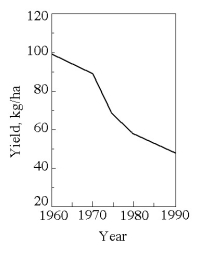 Figure 37.2
-If you were the county agriculture agent, what would be the best advice you could give the farmer who owns the field under study in Figure 37.2?
Figure 37.2
-If you were the county agriculture agent, what would be the best advice you could give the farmer who owns the field under study in Figure 37.2? (Multiple Choice)
4.8/5 (86)
(86) You are weeding your garden when you accidentally expose some roots of your pea plants. You notice swellings (root nodules)on the roots and there is a reddish tinge to the ones you accidentally damaged. Most likely your peas plants
(Multiple Choice)
4.7/5 (75)
(75) The earliest vascular plants on land had underground stems (rhizomes)but no roots. Water and mineral nutrients were most likely obtained by
(Multiple Choice)
4.7/5 (77)
(77) A greenhouse experiment to test growth rates in tomato cultivars was conducted using sterile soil mix and watering with sterile solutions of water and fertilizer. Following germination, half of the plants in each group were transplanted into soil that was obtained from a nearby agricultural field (nonsterile), the other half into sterile soil. After several weeks the plants that were transplanted into nonsterile soil exhibited a much higher growth rate compared to the plants transplanted into sterile soil. The most likely explanation for this result is
(Multiple Choice)
4.9/5 (84)
(84) For this pair of items, choose the option that best describes their relationship.
(A)The amount of molybdenum in a gram of dried plant material
(B)The amount of sulfur in a gram of dried plant material
(Multiple Choice)
4.8/5 (75)
(75) Two groups of tomatoes were grown under laboratory conditions, one with humus added to the soil and one a control without humus. The leaves of the plants grown without humus were yellowish (less green)compared with those of the plants grown in humus-enriched soil. The best explanation for this difference is that
(Multiple Choice)
4.9/5 (87)
(87) When comparing a developing leaf with a fully mature leaf, the developing leaf will have
(Multiple Choice)
4.9/5 (72)
(72) The most efficient way to increase essential amino acids in crop plants for human consumption would be to
(Multiple Choice)
4.9/5 (69)
(69) In the 1640s Jan Baptista van Helmont planted a small willow in a pot that contained 90.9 kg of soil. After five years, the plant weighed 76.8 kg, but only 0.06 kg of soil had disappeared from the pot. What did van Helmont conclude from this experiment?
(Multiple Choice)
4.7/5 (73)
(73) A farmer noted that many of his tomato fruits turned brown at the base as they ripened. The following spring when he replanted, seedlings only grew for a few weeks before the apical tips of many of the plants turned brown and the plants ultimately died. The most likely explanation for this observation is a soil deficiency in
(Multiple Choice)
4.9/5 (74)
(74) Which of the following, if used as a fertilizer, would be most immediately available for plant uptake?
(Multiple Choice)
5.0/5 (80)
(80) Plant roots can enhance the availability of mineral nutrients for uptake by
(Multiple Choice)
4.8/5 (69)
(69) 
Filters
- Essay(0)
- Multiple Choice(0)
- Short Answer(0)
- True False(0)
- Matching(0)