



 Chat with AI
Exam 37: Soil and Plant Nutrition

Exam 1: Introduction: Themes in the Study of Life64 Questions
Exam 2: The Chemical Context of Life83 Questions
Exam 3: Water and Life70 Questions
Exam 4: Carbon and the Molecular Diversity of Life71 Questions
Exam 5: The Structure and Function of Large Biological Molecules109 Questions
Exam 6: A Tour of the Cell80 Questions
Exam 7: Membrane Structure and Function80 Questions
Exam 8: An Introduction to Metabolism80 Questions
Exam 9: Cellular Respiration and Fermentation107 Questions
Exam 10: Photosynthesis81 Questions
Exam 11: Cell Communication69 Questions
Exam 12: The Cell Cycle79 Questions
Exam 13: Meiosis and Sexual Life Cycles70 Questions
Exam 14: Mendel and the Gene Idea73 Questions
Exam 15: The Chromosomal Basis of Inheritance61 Questions
Exam 16: The Molecular Basis of Inheritance57 Questions
Exam 17: From Gene to Protein83 Questions
Exam 18: Regulation of Gene Expression99 Questions
Exam 19: Viruses47 Questions
Exam 20: Biotechnology72 Questions
Exam 21: Genomes and Their Evolution42 Questions
Exam 22: Descent with Modification: A Darwinian View of Life55 Questions
Exam 23: The Evolution of Populations78 Questions
Exam 24: The Origin of Species63 Questions
Exam 25: The History of Life on Earth75 Questions
Exam 26: Phylogeny and the Tree of Life73 Questions
Exam 27: Bacteria and Archaea78 Questions
Exam 28: Protists76 Questions
Exam 29: Plant Diversity I: How Plants Colonized Land74 Questions
Exam 30: Plant Diversity II: The Evolution of Seed Plants102 Questions
Exam 31: Fungi89 Questions
Exam 32: An Overview of Animal Diversity74 Questions
Exam 33: An Introduction to Invertebrates93 Questions
Exam 34: The Origin and Evolution of Vertebrates109 Questions
Exam 35: Plant Structure, Growth, and Development67 Questions
Exam 36: Resource Acquisition and Transport in Vascular Plants82 Questions
Exam 37: Soil and Plant Nutrition83 Questions
Exam 38: Angiosperm Reproduction and Biotechnology86 Questions
Exam 39: Plant Responses to Internal and External Signals108 Questions
Exam 40: Basic Principles of Animal Form and Function77 Questions
Exam 41: Animal Nutrition64 Questions
Exam 42: Circulation and Gas Exchange90 Questions
Exam 43: The Immune System100 Questions
Exam 44: Osmoregulation and Excretion69 Questions
Exam 45: Hormones and the Endocrine System72 Questions
Exam 46: Animal Reproduction94 Questions
Exam 47: Animal Development92 Questions
Exam 48: Neurons, Synapses, and Signaling73 Questions
Exam 49: Nervous Systems65 Questions
Exam 50: Sensory and Motor Mechanisms82 Questions
Exam 51: Animal Behavior69 Questions
Exam 52: An Introduction to Ecology and the Biosphere73 Questions
Exam 53: Population Ecology79 Questions
Exam 54: Community Ecology77 Questions
Exam 55: Ecosystems and Restoration Ecology81 Questions
Exam 56: Conservation Biology and Global Change67 Questions
Select questions type


The specific relationship between a legume and its mutualistic Rhizobium strain probably depends on
(Multiple Choice)
4.9/5  (77)
(77) In west Texas, cotton has become an important crop in the last several decades. However, in this hot, dry part of the country there is little rainfall, so farmers irrigate their cotton fields. They must also regularly fertilize the cotton fields because the soil is very sandy. Figure 37.2 shows the record of annual productivity (measured in kilograms of cotton per hectare of land) since 1960 in a west Texas cotton field. Use these data to answer the following questions.
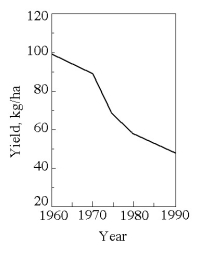 Figure 37.2
-Based on the information provided in Figure 37.2, what is the most likely cause of the decline in productivity?
Figure 37.2
-Based on the information provided in Figure 37.2, what is the most likely cause of the decline in productivity? (Multiple Choice)
4.9/5 (80)
(80) A corn (Zea mays)mutant is developed that is deficient in magnesium uptake. The most likely phenotypic expression would be
(Multiple Choice)
4.9/5 (81)
(81) There are several properties that are characteristic of a soil in which typical plants would grow well. Of the following, which would be the least conducive to plant growth?
(Multiple Choice)
4.8/5 (83)
(83) Which of the following elements is incorrectly paired with its function in a plant?
(Multiple Choice)
4.9/5 (77)
(77) If an African violet has chlorosis, which of the following elements might be a useful addition to the soil?
(Multiple Choice)
4.9/5 (75)
(75) If you wanted to increase the cation exchange and water retention capacity of loamy soil, what should you do?
(Multiple Choice)
4.8/5 (74)
(74) Figure 37.1 shows the results of a study to determine the effect of soil air spaces on plant growth.
 Figure 37.1
-The best explanation for the shape of the growth response curve in Figure 37.1 is that
Figure 37.1
-The best explanation for the shape of the growth response curve in Figure 37.1 is that (Multiple Choice)
4.8/5 (84)
(84) Which of the following is not true of micronutrients in plants?
(Multiple Choice)
4.7/5 (84)
(84) The NPK percentages on a package of fertilizer refer to the
(Multiple Choice)
4.9/5 (92)
(92) Which of the following essential nutrients plays an essential role in the opening and closing of the stomatal aperture?
(Multiple Choice)
4.8/5 (82)
(82) Which of the following elements, if increased in concentration, would increase the stability of cell walls?
(Multiple Choice)
4.8/5 (99)
(99) A researcher analyzes the mineral content of a particular grass and is surprised to find substantial levels of uranium in both leaf and root tissues. The most likely explanation for this finding is that
(Multiple Choice)
4.8/5 (79)
(79) When performing a mineral nutrition experiment, researchers use water from a glass still. Why is it not a good idea to use regular distilled water from a stainless steel still?
(Multiple Choice)
4.8/5 (78)
(78) You are conducting an experiment on plant growth. You take a plant fresh from the soil that weighs 5 kg. Then you dry the plant overnight and determine the dry weight to be 1 kg. Of this dry weight, how much would you expect to be made up of organic molecules?
(Multiple Choice)
4.8/5 (77)
(77) Which of the following is a primary difference between ectomycorrhizae and endomycorrhizae?
(Multiple Choice)
4.8/5 (86)
(86) Which of the following is a true statement about nitrogen fixation in root nodules?
(Multiple Choice)
4.9/5 (73)
(73) 
Filters
- Essay(0)
- Multiple Choice(0)
- Short Answer(0)
- True False(0)
- Matching(0)