



 Chat with AI
Exam 29: Plant Diversity I: How Plants Colonized Land

Exam 1: Introduction: Themes in the Study of Life64 Questions
Exam 2: The Chemical Context of Life83 Questions
Exam 3: Water and Life70 Questions
Exam 4: Carbon and the Molecular Diversity of Life71 Questions
Exam 5: The Structure and Function of Large Biological Molecules109 Questions
Exam 6: A Tour of the Cell80 Questions
Exam 7: Membrane Structure and Function80 Questions
Exam 8: An Introduction to Metabolism80 Questions
Exam 9: Cellular Respiration and Fermentation107 Questions
Exam 10: Photosynthesis81 Questions
Exam 11: Cell Communication69 Questions
Exam 12: The Cell Cycle79 Questions
Exam 13: Meiosis and Sexual Life Cycles70 Questions
Exam 14: Mendel and the Gene Idea73 Questions
Exam 15: The Chromosomal Basis of Inheritance61 Questions
Exam 16: The Molecular Basis of Inheritance57 Questions
Exam 17: From Gene to Protein83 Questions
Exam 18: Regulation of Gene Expression99 Questions
Exam 19: Viruses47 Questions
Exam 20: Biotechnology72 Questions
Exam 21: Genomes and Their Evolution42 Questions
Exam 22: Descent with Modification: A Darwinian View of Life55 Questions
Exam 23: The Evolution of Populations78 Questions
Exam 24: The Origin of Species63 Questions
Exam 25: The History of Life on Earth75 Questions
Exam 26: Phylogeny and the Tree of Life73 Questions
Exam 27: Bacteria and Archaea78 Questions
Exam 28: Protists76 Questions
Exam 29: Plant Diversity I: How Plants Colonized Land74 Questions
Exam 30: Plant Diversity II: The Evolution of Seed Plants102 Questions
Exam 31: Fungi89 Questions
Exam 32: An Overview of Animal Diversity74 Questions
Exam 33: An Introduction to Invertebrates93 Questions
Exam 34: The Origin and Evolution of Vertebrates109 Questions
Exam 35: Plant Structure, Growth, and Development67 Questions
Exam 36: Resource Acquisition and Transport in Vascular Plants82 Questions
Exam 37: Soil and Plant Nutrition83 Questions
Exam 38: Angiosperm Reproduction and Biotechnology86 Questions
Exam 39: Plant Responses to Internal and External Signals108 Questions
Exam 40: Basic Principles of Animal Form and Function77 Questions
Exam 41: Animal Nutrition64 Questions
Exam 42: Circulation and Gas Exchange90 Questions
Exam 43: The Immune System100 Questions
Exam 44: Osmoregulation and Excretion69 Questions
Exam 45: Hormones and the Endocrine System72 Questions
Exam 46: Animal Reproduction94 Questions
Exam 47: Animal Development92 Questions
Exam 48: Neurons, Synapses, and Signaling73 Questions
Exam 49: Nervous Systems65 Questions
Exam 50: Sensory and Motor Mechanisms82 Questions
Exam 51: Animal Behavior69 Questions
Exam 52: An Introduction to Ecology and the Biosphere73 Questions
Exam 53: Population Ecology79 Questions
Exam 54: Community Ecology77 Questions
Exam 55: Ecosystems and Restoration Ecology81 Questions
Exam 56: Conservation Biology and Global Change67 Questions
Select questions type


What is thought to be the correct sequence of the following events during the Carboniferous period?
1)vascular plants become more prevalent
2)megaphylls with large surface areas become more prevalent
3)atmospheric CO₂ levels decline by a factor of five
4)global cooling occurs, leading to widespread glaciations
(Multiple Choice)
4.8/5  (85)
(85) Big Bend National Park in Texas is mostly Chihuahuan desert, where rainfall averages about 10 inches per year. Yet, it is not uncommon when hiking in this bone-dry desert to encounter mosses and ferns. One such plant is called "flower of stone." It is not a flowering plant, nor does it produce seeds. Under arid conditions, its leaflike structures curl up. However, when it rains, it unfurls its leaves, which form a bright green rosette on the desert floor. Consequently, it is sometimes called the "resurrection plant." At first glance, it could be a fern, a true moss, or a spike moss.
-Upon closer inspection of the leaves of flower of stone, one can observe tiny, cone-like structures. Each cone-like structure emits spores of two different sizes. Consequently, flower of stone should be expected to possess which other characteristics?
1)a gametophyte generation that is dominant
2)lignified vascular tissues
3)microphylls
4)filamentous rhizoids, but not true roots
5)spores that are diploid when mature
(Multiple Choice)
4.9/5 (74)
(74) Big Bend National Park in Texas is mostly Chihuahuan desert, where rainfall averages about 10 inches per year. Yet, it is not uncommon when hiking in this bone-dry desert to encounter mosses and ferns. One such plant is called "flower of stone." It is not a flowering plant, nor does it produce seeds. Under arid conditions, its leaflike structures curl up. However, when it rains, it unfurls its leaves, which form a bright green rosette on the desert floor. Consequently, it is sometimes called the "resurrection plant." At first glance, it could be a fern, a true moss, or a spike moss.
-In which combination of locations would one who is searching for the gametophytes of flower of stone have the best chance of finding them?
1)moist soil
2)underground, nourished there by symbiotic fungi
3)south- or west-facing slopes
4)permanently shady places
5)far from any flower of stone sporophytes
(Multiple Choice)
4.8/5 (82)
(82)  Figure 29.3
-Which of the following should be most helpful in distinguishing the clades depicted on the tree in Figure 29.3 from each other?
Figure 29.3
-Which of the following should be most helpful in distinguishing the clades depicted on the tree in Figure 29.3 from each other? (Multiple Choice)
4.8/5 (84)
(84) Some green algae exhibit alternation of generations. All land plants exhibit alternation of generations. No charophytes exhibit alternation of generations. Keeping in mind the recent evidence from molecular systematics, the correct interpretation of these observations is that
(Multiple Choice)
4.8/5 (85)
(85) If you are looking for structures that transfer water and nutrients from a bryophyte gametophyte to a bryophyte sporophyte, then on which part of the sporophyte should you focus your attention?
(Multiple Choice)
4.9/5 (74)
(74) Considering that the mature sporophytes of true mosses get their nutrition from the gametophytes on which they grow, and considering these generations as individual plants, what is true of the relationship between true moss sporophytes and gametophytes?
(Multiple Choice)
4.8/5 (84)
(84) A botanist discovers a new species of plant in a tropical rain forest. After observing its anatomy and life cycle, he notes the following characteristics: flagellated sperm, xylem with tracheids, separate gametophyte and sporophyte generations with the sporophyte dominant, and no seeds. This plant is probably most closely related to
(Multiple Choice)
4.7/5 (80)
(80) Which of the following were probably factors that permitted early plants to successfully colonize land?
1)the relative number of potential predators (herbivores)
2)the relative number of competitors
3)the relative availability of symbiotic partners
4)air's relative lack of support, compared to water's support
(Multiple Choice)
5.0/5 (80)
(80) Which of these potential results of applying a metabolic poison to the rhizoids of Polytrichum should interfere the least with the ability to draw valid conclusions from this experiment?
(Multiple Choice)
4.9/5 (80)
(80) Big Bend National Park in Texas is mostly Chihuahuan desert, where rainfall averages about 10 inches per year. Yet, it is not uncommon when hiking in this bone-dry desert to encounter mosses and ferns. One such plant is called "flower of stone." It is not a flowering plant, nor does it produce seeds. Under arid conditions, its leaflike structures curl up. However, when it rains, it unfurls its leaves, which form a bright green rosette on the desert floor. Consequently, it is sometimes called the "resurrection plant." At first glance, it could be a fern, a true moss, or a spike moss.
-Upon closer inspection of the leaves of flower of stone, one can observe tiny, cone-like structures. Each cone-like structure emits spores of two different sizes. Based on this information, which of the following can be properly inferred about flower of stone?
1)It is heterosporous.
2)It is a fern.
3)The cone-like structures are sori.
4)It is a lycophyte.
5)It has separate male and female gametophytes.
(Multiple Choice)
4.9/5 (83)
(83) Big Bend National Park in Texas is mostly Chihuahuan desert, where rainfall averages about 10 inches per year. Yet, it is not uncommon when hiking in this bone-dry desert to encounter mosses and ferns. One such plant is called "flower of stone." It is not a flowering plant, nor does it produce seeds. Under arid conditions, its leaflike structures curl up. However, when it rains, it unfurls its leaves, which form a bright green rosette on the desert floor. Consequently, it is sometimes called the "resurrection plant." At first glance, it could be a fern, a true moss, or a spike moss.
-What feature of both true mosses and ferns makes it most surprising that they can survive for many generations in dry deserts?
(Multiple Choice)
4.8/5 (58)
(58) Refer to the following information to answer the next few questions.
Researchers decided to test the hypothesis that if the 2-m tall Polytrichum gametophyte-sporophyte plants had acted as a physical buffer, then they would have reduced water's ability to erode the soil and carry away its nitrogen. They began with four equal-sized areas where Polytrichum mosses grew to a height of 2 m above the soil surface. One of the four areas was not modified. In the second area, the mosses were trimmed to a height of 1 m above the soil surface. In the third area, the mosses were trimmed to a height of 0.5 m above the soil surface. In the fourth area, the mosses were trimmed all the way to the ground, leaving only the rhizoids. Water, simulating rainfall, was then added in a controlled fashion to all plots over the course of one year. Figure 29.2 presents four graphs that depict potential results of this experiment.
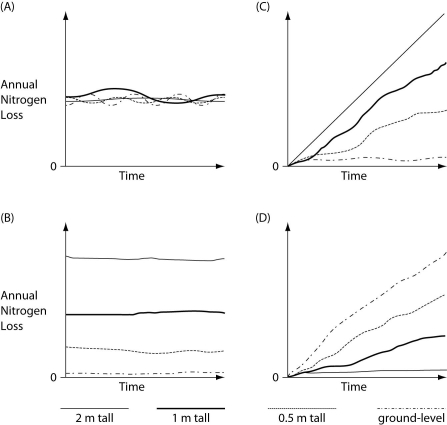 Figure 29.2
-Which graph of soil nitrogen loss over time in Figure 29.2 most strongly supports the hypothesis that if the 2-m tall Polytrichum gametophyte-sporophyte plants had acted as a physical buffer, then they would have reduced water's ability to erode the soil and carry away its nitrogen?
Figure 29.2
-Which graph of soil nitrogen loss over time in Figure 29.2 most strongly supports the hypothesis that if the 2-m tall Polytrichum gametophyte-sporophyte plants had acted as a physical buffer, then they would have reduced water's ability to erode the soil and carry away its nitrogen? (Multiple Choice)
4.7/5 (78)
(78) 
Filters
- Essay(0)
- Multiple Choice(0)
- Short Answer(0)
- True False(0)
- Matching(0)