



 Chat with AI
Exam 29: Plant Diversity I: How Plants Colonized Land

Exam 1: Introduction: Themes in the Study of Life64 Questions
Exam 2: The Chemical Context of Life83 Questions
Exam 3: Water and Life70 Questions
Exam 4: Carbon and the Molecular Diversity of Life71 Questions
Exam 5: The Structure and Function of Large Biological Molecules109 Questions
Exam 6: A Tour of the Cell80 Questions
Exam 7: Membrane Structure and Function80 Questions
Exam 8: An Introduction to Metabolism80 Questions
Exam 9: Cellular Respiration and Fermentation107 Questions
Exam 10: Photosynthesis81 Questions
Exam 11: Cell Communication69 Questions
Exam 12: The Cell Cycle79 Questions
Exam 13: Meiosis and Sexual Life Cycles70 Questions
Exam 14: Mendel and the Gene Idea73 Questions
Exam 15: The Chromosomal Basis of Inheritance61 Questions
Exam 16: The Molecular Basis of Inheritance57 Questions
Exam 17: From Gene to Protein83 Questions
Exam 18: Regulation of Gene Expression99 Questions
Exam 19: Viruses47 Questions
Exam 20: Biotechnology72 Questions
Exam 21: Genomes and Their Evolution42 Questions
Exam 22: Descent with Modification: A Darwinian View of Life55 Questions
Exam 23: The Evolution of Populations78 Questions
Exam 24: The Origin of Species63 Questions
Exam 25: The History of Life on Earth75 Questions
Exam 26: Phylogeny and the Tree of Life73 Questions
Exam 27: Bacteria and Archaea78 Questions
Exam 28: Protists76 Questions
Exam 29: Plant Diversity I: How Plants Colonized Land74 Questions
Exam 30: Plant Diversity II: The Evolution of Seed Plants102 Questions
Exam 31: Fungi89 Questions
Exam 32: An Overview of Animal Diversity74 Questions
Exam 33: An Introduction to Invertebrates93 Questions
Exam 34: The Origin and Evolution of Vertebrates109 Questions
Exam 35: Plant Structure, Growth, and Development67 Questions
Exam 36: Resource Acquisition and Transport in Vascular Plants82 Questions
Exam 37: Soil and Plant Nutrition83 Questions
Exam 38: Angiosperm Reproduction and Biotechnology86 Questions
Exam 39: Plant Responses to Internal and External Signals108 Questions
Exam 40: Basic Principles of Animal Form and Function77 Questions
Exam 41: Animal Nutrition64 Questions
Exam 42: Circulation and Gas Exchange90 Questions
Exam 43: The Immune System100 Questions
Exam 44: Osmoregulation and Excretion69 Questions
Exam 45: Hormones and the Endocrine System72 Questions
Exam 46: Animal Reproduction94 Questions
Exam 47: Animal Development92 Questions
Exam 48: Neurons, Synapses, and Signaling73 Questions
Exam 49: Nervous Systems65 Questions
Exam 50: Sensory and Motor Mechanisms82 Questions
Exam 51: Animal Behavior69 Questions
Exam 52: An Introduction to Ecology and the Biosphere73 Questions
Exam 53: Population Ecology79 Questions
Exam 54: Community Ecology77 Questions
Exam 55: Ecosystems and Restoration Ecology81 Questions
Exam 56: Conservation Biology and Global Change67 Questions
Select questions type


Which of the following is true of seedless vascular plants?
(Multiple Choice)
4.7/5  (74)
(74) Two small, poorly drained lakes lie close to each other in a northern forest. The basins of both lakes are composed of the same geologic substratum. One lake is surrounded by a dense Sphagnum mat; the other is not. Compared to the pond with Sphagnum, the pond lacking the moss mat should have
(Multiple Choice)
4.8/5 (89)
(89) Which event during the evolution of land plants probably made the synthesis of secondary compounds most beneficial?
(Multiple Choice)
4.8/5 (77)
(77) At some time during their existence, bryophytes may feature
(Multiple Choice)
4.9/5 (74)
(74) Which taxon is essentially equivalent to the "embryophytes"?
(Multiple Choice)
4.8/5 (84)
(84)  Figure 29.3
-What is true of the phylogenetic tree in Figure 29.3?
1)It depicts uncertainty about whether the bryophytes or the vascular plants evolved first.
2)It is hypothetical.
3)It includes polytomies.
4)It shows that ferns (phylum Pterophyta)are the closest living relatives to the seed plants.
5)It indicates that seeds are a shared ancestral character of all vascular plants.
Figure 29.3
-What is true of the phylogenetic tree in Figure 29.3?
1)It depicts uncertainty about whether the bryophytes or the vascular plants evolved first.
2)It is hypothetical.
3)It includes polytomies.
4)It shows that ferns (phylum Pterophyta)are the closest living relatives to the seed plants.
5)It indicates that seeds are a shared ancestral character of all vascular plants. (Multiple Choice)
5.0/5 (82)
(82) The next question is based on the following description and Figure 29.1, which is the same as Figure 29.10 in the textbook.
Art Questions
Researchers tested nitrogen loss from soil where the moss Polytrichum was growing, and compared it to soil from which Polytrichum had been removed. The data are presented below.
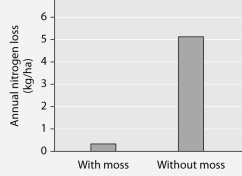 Figure 29.1
-Loss of soil nitrogen via "gaseous emission" was found to be negligible. Rather, most loss of soil nitrogen was due to water erosion of the soil. Which of these hypotheses is least likely to account for the observed results?
Figure 29.1
-Loss of soil nitrogen via "gaseous emission" was found to be negligible. Rather, most loss of soil nitrogen was due to water erosion of the soil. Which of these hypotheses is least likely to account for the observed results? (Multiple Choice)
4.8/5 (76)
(76) Which of the following was not a challenge for survival of the first land plants?
(Multiple Choice)
4.9/5 (79)
(79) Arrange the following terms from most inclusive to least inclusive.
1)embryophytes
2)green plants
3)seedless vascular plants
4)ferns
5)tracheophytes
(Multiple Choice)
4.9/5 (85)
(85) As is true of the gametophytes of all land plants, the gametophytes of true mosses lack stomata. Yet, the feather moss Pleurozium harbors nitrogen-fixing cyanobacteria. Which of the following is a feature of moss gametophytes that is most important for the continued survival of these cyanobacteria in the tissues of the feather moss gametophyte?
(Multiple Choice)
4.8/5 (84)
(84) Refer to the following information to answer the next few questions.
Researchers decided to test the hypothesis that if the 2-m tall Polytrichum gametophyte-sporophyte plants had acted as a physical buffer, then they would have reduced water's ability to erode the soil and carry away its nitrogen. They began with four equal-sized areas where Polytrichum mosses grew to a height of 2 m above the soil surface. One of the four areas was not modified. In the second area, the mosses were trimmed to a height of 1 m above the soil surface. In the third area, the mosses were trimmed to a height of 0.5 m above the soil surface. In the fourth area, the mosses were trimmed all the way to the ground, leaving only the rhizoids. Water, simulating rainfall, was then added in a controlled fashion to all plots over the course of one year. Figure 29.2 presents four graphs that depict potential results of this experiment.
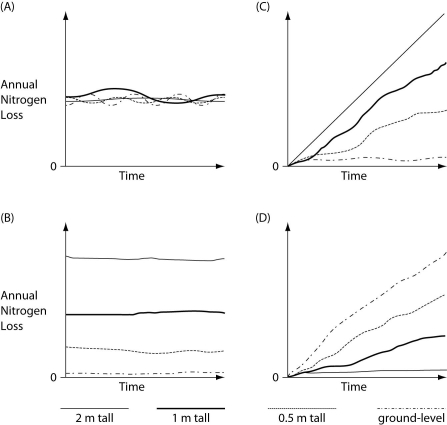 Figure 29.2
-If the actual results most closely resembled those in Figure 29.2(A), then a further question arising from these data is: "Do the Polytrichum rhizoids have to be alive in order to reduce soil nitrogen loss, or do dead rhizoids have the same effect?" Arrange the following steps in the correct sequence to test this hypothesis.
1)Add metabolic poison to the soil of the experimental plot of mosses.
2)Apply water equally to the experimental and control plots.
3)Measure initial soil nitrogen contents of control and experimental plots.
4)Determine nitrogen loss from soil of control and experimental plots.
5)Establish two identical plots of Polytrichum mosses; one as a control, the other as the experimental treatment.
Figure 29.2
-If the actual results most closely resembled those in Figure 29.2(A), then a further question arising from these data is: "Do the Polytrichum rhizoids have to be alive in order to reduce soil nitrogen loss, or do dead rhizoids have the same effect?" Arrange the following steps in the correct sequence to test this hypothesis.
1)Add metabolic poison to the soil of the experimental plot of mosses.
2)Apply water equally to the experimental and control plots.
3)Measure initial soil nitrogen contents of control and experimental plots.
4)Determine nitrogen loss from soil of control and experimental plots.
5)Establish two identical plots of Polytrichum mosses; one as a control, the other as the experimental treatment. (Multiple Choice)
5.0/5 (70)
(70) During glacial periods in the early evolution of land plants, which of the following would have been a beneficial adaptation regarding the number of stomata per unit surface area, and what accounts for it?
(Multiple Choice)
4.9/5 (86)
(86) Beginning with the germination of a moss spore, what is the sequence of structures that develop after germination?
1)embryo
2)gametes
3)sporophyte
4)protonema
5)gametophore
(Multiple Choice)
5.0/5 (59)
(59) Big Bend National Park in Texas is mostly Chihuahuan desert, where rainfall averages about 10 inches per year. Yet, it is not uncommon when hiking in this bone-dry desert to encounter mosses and ferns. One such plant is called "flower of stone." It is not a flowering plant, nor does it produce seeds. Under arid conditions, its leaflike structures curl up. However, when it rains, it unfurls its leaves, which form a bright green rosette on the desert floor. Consequently, it is sometimes called the "resurrection plant." At first glance, it could be a fern, a true moss, or a spike moss.
-Upon closer inspection of the leaves of flower of stone, one can observe tiny, cone-like structures. Each cone-like structure emits spores of two different sizes. Consequently, which of the following is the closest living relative of flower of stone?
(Multiple Choice)
4.9/5 (90)
(90) Which of the following are land plants that use the same means of getting sperm to egg that algae use?
(Multiple Choice)
4.9/5 (96)
(96) Evidence indicates that plants increase the number of stomata in their leaves as atmospheric CO₂ levels decline. Increasing the number of stomata per unit surface area should have the effect of doing which of the following?
1)increasing dehydration of leaf tissues
2)decreasing dehydration of leaf tissues
3)countering the effect of declining CO₂ on photosynthesis
4)reinforcing the effect of declining CO₂ on photosynthesis
5)decreasing the O₂ content of air next to the leaves lower than it would otherwise be
6)increasing the O₂ content of air next to the leaves higher than it would otherwise be
(Multiple Choice)
4.8/5 (79)
(79) If you were faced with the choice of eliminating all mutualistic symbioses involving plants and other organisms (besides humans), with the goal being to preserve the most plant biomass, which of the following would you save from elimination?
(Multiple Choice)
4.9/5 (80)
(80) Which of the following is a land plant that has flagellated sperm and a sporophyte-dominated life cycle?
(Multiple Choice)
4.9/5 (74)
(74) Which of the following is not evidence that charophytes are the closest algal relatives of plants?
(Multiple Choice)
4.9/5 (82)
(82) All of the following are common to both charophytes and land plants except
(Multiple Choice)
4.8/5 (81)
(81) 
Filters
- Essay(0)
- Multiple Choice(0)
- Short Answer(0)
- True False(0)
- Matching(0)