



 Chat with AI
Exam 25: The History of Life on Earth

Exam 1: Introduction: Themes in the Study of Life64 Questions
Exam 2: The Chemical Context of Life83 Questions
Exam 3: Water and Life70 Questions
Exam 4: Carbon and the Molecular Diversity of Life71 Questions
Exam 5: The Structure and Function of Large Biological Molecules109 Questions
Exam 6: A Tour of the Cell80 Questions
Exam 7: Membrane Structure and Function80 Questions
Exam 8: An Introduction to Metabolism80 Questions
Exam 9: Cellular Respiration and Fermentation107 Questions
Exam 10: Photosynthesis81 Questions
Exam 11: Cell Communication69 Questions
Exam 12: The Cell Cycle79 Questions
Exam 13: Meiosis and Sexual Life Cycles70 Questions
Exam 14: Mendel and the Gene Idea73 Questions
Exam 15: The Chromosomal Basis of Inheritance61 Questions
Exam 16: The Molecular Basis of Inheritance57 Questions
Exam 17: From Gene to Protein83 Questions
Exam 18: Regulation of Gene Expression99 Questions
Exam 19: Viruses47 Questions
Exam 20: Biotechnology72 Questions
Exam 21: Genomes and Their Evolution42 Questions
Exam 22: Descent with Modification: A Darwinian View of Life55 Questions
Exam 23: The Evolution of Populations78 Questions
Exam 24: The Origin of Species63 Questions
Exam 25: The History of Life on Earth75 Questions
Exam 26: Phylogeny and the Tree of Life73 Questions
Exam 27: Bacteria and Archaea78 Questions
Exam 28: Protists76 Questions
Exam 29: Plant Diversity I: How Plants Colonized Land74 Questions
Exam 30: Plant Diversity II: The Evolution of Seed Plants102 Questions
Exam 31: Fungi89 Questions
Exam 32: An Overview of Animal Diversity74 Questions
Exam 33: An Introduction to Invertebrates93 Questions
Exam 34: The Origin and Evolution of Vertebrates109 Questions
Exam 35: Plant Structure, Growth, and Development67 Questions
Exam 36: Resource Acquisition and Transport in Vascular Plants82 Questions
Exam 37: Soil and Plant Nutrition83 Questions
Exam 38: Angiosperm Reproduction and Biotechnology86 Questions
Exam 39: Plant Responses to Internal and External Signals108 Questions
Exam 40: Basic Principles of Animal Form and Function77 Questions
Exam 41: Animal Nutrition64 Questions
Exam 42: Circulation and Gas Exchange90 Questions
Exam 43: The Immune System100 Questions
Exam 44: Osmoregulation and Excretion69 Questions
Exam 45: Hormones and the Endocrine System72 Questions
Exam 46: Animal Reproduction94 Questions
Exam 47: Animal Development92 Questions
Exam 48: Neurons, Synapses, and Signaling73 Questions
Exam 49: Nervous Systems65 Questions
Exam 50: Sensory and Motor Mechanisms82 Questions
Exam 51: Animal Behavior69 Questions
Exam 52: An Introduction to Ecology and the Biosphere73 Questions
Exam 53: Population Ecology79 Questions
Exam 54: Community Ecology77 Questions
Exam 55: Ecosystems and Restoration Ecology81 Questions
Exam 56: Conservation Biology and Global Change67 Questions
Select questions type


If a fossil is encased in a stratum of sedimentary rock without any strata of igneous rock (for example, lava, volcanic ash)nearby, then it should be
(Multiple Choice)
4.8/5  (94)
(94) In the 5-7 million years that the hominid lineage has been diverging from its common ancestor with the great apes, dozens of hominid species have arisen, often with several species coexisting in time and space. As recently as 30,000 years ago, Homo sapiens coexisted with Homo neanderthalensis. Both species had large brains and advanced intellects. The fact that these traits were common to both species is most easily explained by which of the following?
(Multiple Choice)
4.9/5 (75)
(75) If it were possible to conduct sophisticated microscopic and chemical analyses of microfossils found in 3.2-billion-year-old stromatolites, then one should be surprised to observe evidence of which of the following within such microfossils?
I.double-stranded DNA
II.a nuclear envelope
III.a nucleoid
IV.a nucleolus
V.ribosomes
(Multiple Choice)
4.7/5 (78)
(78) Which of the following factors weaken(s)the hypothesis of abiotic synthesis of organic monomers in early Earth's atmosphere?
1)the relatively short time between intense meteor bombardment and the appearance of the first life-forms
2)the lack of experimental evidence that organic monomers can form by abiotic synthesis
3)uncertainty about which gases comprised early Earth's atmosphere
(Multiple Choice)
4.8/5 (75)
(75) The following questions refer to the description and figure below.
The figure represents a cross section of the sea floor through a mid-ocean rift valley, with alternating patches of black and white indicating sea floor with reversed magnetic polarities. At the arrow labeled "I" (the rift valley), the igneous rock of the sea floor is so young that it can be accurately dated using carbon-14 dating. At the arrow labeled "III," however, the igneous rock is about 1 million years old, and potassium-40 dating is typically used to date such rocks. Note: The horizontal arrows indicate the direction of sea-floor spreading, away from the rift valley.
 Figure 25.1
-Assuming that the rate of sea-floor spreading was constant during the 1-million-year period depicted above, Earth's magnetic field has undergone reversal at an average rate of once every
Figure 25.1
-Assuming that the rate of sea-floor spreading was constant during the 1-million-year period depicted above, Earth's magnetic field has undergone reversal at an average rate of once every (Multiple Choice)
4.8/5 (87)
(87) 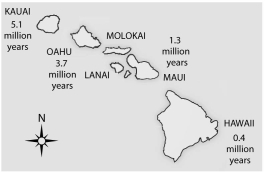 Figure 25.3
-Hawaii is the most southeastern of the seven islands and is also closest to the sea-floor spreading center from which the Pacific plate originates, which lies about 5,600 km further to the southeast. Assuming equal sedimentation rates, what should be the location of the thickest sediment layer and, thus, the area with the greatest diversity of fossils above the oceanic crust?
Figure 25.3
-Hawaii is the most southeastern of the seven islands and is also closest to the sea-floor spreading center from which the Pacific plate originates, which lies about 5,600 km further to the southeast. Assuming equal sedimentation rates, what should be the location of the thickest sediment layer and, thus, the area with the greatest diversity of fossils above the oceanic crust? (Multiple Choice)
4.8/5 (86)
(86) The following questions refer to the paragraph below.
A sediment core is removed from the floor of an inland sea. The sea has been in existence, off and on, throughout the entire time that terrestrial life has existed. Researchers wish to locate and study the terrestrial organisms fossilized in this core. The core is illustrated as a vertical column, with the top of the column representing the most recent strata and the bottom representing the time when land was first colonized by life.
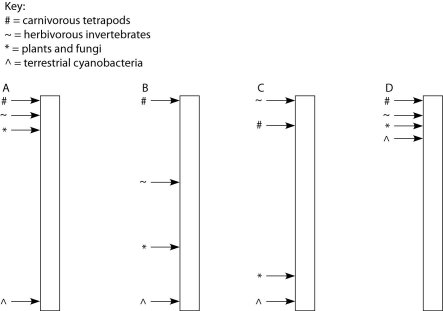 Figure 25.2
-If arrows indicate locations in the column where fossils of a particular type (see key above)first appear, then which core in Figure 25.2 has the most accurate arrangement of fossils?
Figure 25.2
-If arrows indicate locations in the column where fossils of a particular type (see key above)first appear, then which core in Figure 25.2 has the most accurate arrangement of fossils? (Multiple Choice)
4.8/5 (80)
(80) What is true of the amino acids that might have been delivered to Earth within carbonaceous chondrites?
(Multiple Choice)
4.9/5 (78)
(78) Larval flies (maggots)express the Ubx gene in all of their segments, and thereby lack appendages. If this same gene continued to be expressed throughout subsequent developmental stages, except in the head region, and if the result was a fit, sexually mature organism that still strongly resembled a maggot, this would be an example of
(Multiple Choice)
4.9/5 (80)
(80) One explanation for the evolution of insect wings suggests that wings began as lateral extensions of the body that were used as heat dissipaters for thermoregulation. When they had become sufficiently large, these extensions became useful for gliding through the air, and selection later refined them as flight-producing wings. If this hypothesis is correct, modern insect wings could best be described as
(Multiple Choice)
5.0/5 (70)
(70) The following questions refer to the description and figure below.
The figure represents a cross section of the sea floor through a mid-ocean rift valley, with alternating patches of black and white indicating sea floor with reversed magnetic polarities. At the arrow labeled "I" (the rift valley), the igneous rock of the sea floor is so young that it can be accurately dated using carbon-14 dating. At the arrow labeled "III," however, the igneous rock is about 1 million years old, and potassium-40 dating is typically used to date such rocks. Note: The horizontal arrows indicate the direction of sea-floor spreading, away from the rift valley.
Figure 25.1
-Assuming that the rate of sea-floor spreading was constant during the 1-million-year period depicted above, what should be the approximate age of marine fossils found in undisturbed sedimentary rock immediately overlying the igneous rock at the arrow labeled "II"?
Figure 25.1
-Assuming that the rate of sea-floor spreading was constant during the 1-million-year period depicted above, what should be the approximate age of marine fossils found in undisturbed sedimentary rock immediately overlying the igneous rock at the arrow labeled "II"? (Multiple Choice)
4.8/5 (73)
(73) If one organ is an exaptation of another organ, then what must be true of these two organs?
(Multiple Choice)
4.8/5 (79)
(79) Several scientific laboratories across the globe are involved in research concerning the origin of life on Earth. Which of these questions is currently the most problematic and would have the greatest impact on our understanding if we were able to answer it?
(Multiple Choice)
4.8/5 (73)
(73) The following questions refer to the paragraph below.
A sediment core is removed from the floor of an inland sea. The sea has been in existence, off and on, throughout the entire time that terrestrial life has existed. Researchers wish to locate and study the terrestrial organisms fossilized in this core. The core is illustrated as a vertical column, with the top of the column representing the most recent strata and the bottom representing the time when land was first colonized by life.
Figure 25.2
-Which of the following reasons may explain why the sediment core lacks fossils of dragonflies with 3-feet wingspans?
1)This particular sediment core includes the correct stratum, but the part of the stratum captured by the core lacks such fossils.
2)The sea was not present at this site during the time that 3-feet dragonflies existed.
3)Dragonflies have no hard parts, such as exoskeletons, to fossilize.
4)The sediments containing these fossils at this site may have been eroded away during a time when the sea had receded from this site.
5)Dragonflies are terrestrial; therefore, fossils of terrestrial organisms should not be expected in the sediments of seas.
Figure 25.2
-Which of the following reasons may explain why the sediment core lacks fossils of dragonflies with 3-feet wingspans?
1)This particular sediment core includes the correct stratum, but the part of the stratum captured by the core lacks such fossils.
2)The sea was not present at this site during the time that 3-feet dragonflies existed.
3)Dragonflies have no hard parts, such as exoskeletons, to fossilize.
4)The sediments containing these fossils at this site may have been eroded away during a time when the sea had receded from this site.
5)Dragonflies are terrestrial; therefore, fossils of terrestrial organisms should not be expected in the sediments of seas. (Multiple Choice)
4.9/5 (80)
(80) 
Filters
- Essay(0)
- Multiple Choice(0)
- Short Answer(0)
- True False(0)
- Matching(0)