



 Chat with AI
Exam 25: The History of Life on Earth

Exam 1: Introduction: Themes in the Study of Life64 Questions
Exam 2: The Chemical Context of Life83 Questions
Exam 3: Water and Life70 Questions
Exam 4: Carbon and the Molecular Diversity of Life71 Questions
Exam 5: The Structure and Function of Large Biological Molecules109 Questions
Exam 6: A Tour of the Cell80 Questions
Exam 7: Membrane Structure and Function80 Questions
Exam 8: An Introduction to Metabolism80 Questions
Exam 9: Cellular Respiration and Fermentation107 Questions
Exam 10: Photosynthesis81 Questions
Exam 11: Cell Communication69 Questions
Exam 12: The Cell Cycle79 Questions
Exam 13: Meiosis and Sexual Life Cycles70 Questions
Exam 14: Mendel and the Gene Idea73 Questions
Exam 15: The Chromosomal Basis of Inheritance61 Questions
Exam 16: The Molecular Basis of Inheritance57 Questions
Exam 17: From Gene to Protein83 Questions
Exam 18: Regulation of Gene Expression99 Questions
Exam 19: Viruses47 Questions
Exam 20: Biotechnology72 Questions
Exam 21: Genomes and Their Evolution42 Questions
Exam 22: Descent with Modification: A Darwinian View of Life55 Questions
Exam 23: The Evolution of Populations78 Questions
Exam 24: The Origin of Species63 Questions
Exam 25: The History of Life on Earth75 Questions
Exam 26: Phylogeny and the Tree of Life73 Questions
Exam 27: Bacteria and Archaea78 Questions
Exam 28: Protists76 Questions
Exam 29: Plant Diversity I: How Plants Colonized Land74 Questions
Exam 30: Plant Diversity II: The Evolution of Seed Plants102 Questions
Exam 31: Fungi89 Questions
Exam 32: An Overview of Animal Diversity74 Questions
Exam 33: An Introduction to Invertebrates93 Questions
Exam 34: The Origin and Evolution of Vertebrates109 Questions
Exam 35: Plant Structure, Growth, and Development67 Questions
Exam 36: Resource Acquisition and Transport in Vascular Plants82 Questions
Exam 37: Soil and Plant Nutrition83 Questions
Exam 38: Angiosperm Reproduction and Biotechnology86 Questions
Exam 39: Plant Responses to Internal and External Signals108 Questions
Exam 40: Basic Principles of Animal Form and Function77 Questions
Exam 41: Animal Nutrition64 Questions
Exam 42: Circulation and Gas Exchange90 Questions
Exam 43: The Immune System100 Questions
Exam 44: Osmoregulation and Excretion69 Questions
Exam 45: Hormones and the Endocrine System72 Questions
Exam 46: Animal Reproduction94 Questions
Exam 47: Animal Development92 Questions
Exam 48: Neurons, Synapses, and Signaling73 Questions
Exam 49: Nervous Systems65 Questions
Exam 50: Sensory and Motor Mechanisms82 Questions
Exam 51: Animal Behavior69 Questions
Exam 52: An Introduction to Ecology and the Biosphere73 Questions
Exam 53: Population Ecology79 Questions
Exam 54: Community Ecology77 Questions
Exam 55: Ecosystems and Restoration Ecology81 Questions
Exam 56: Conservation Biology and Global Change67 Questions
Select questions type


The following questions refer to the description and figure below.
The figure represents a cross section of the sea floor through a mid-ocean rift valley, with alternating patches of black and white indicating sea floor with reversed magnetic polarities. At the arrow labeled "I" (the rift valley), the igneous rock of the sea floor is so young that it can be accurately dated using carbon-14 dating. At the arrow labeled "III," however, the igneous rock is about 1 million years old, and potassium-40 dating is typically used to date such rocks. Note: The horizontal arrows indicate the direction of sea-floor spreading, away from the rift valley.
 Figure 25.1
-Which section of sea-floor crust should have the thickest layer of overlying sediment, assuming a continuous rate of sediment deposition?
Figure 25.1
-Which section of sea-floor crust should have the thickest layer of overlying sediment, assuming a continuous rate of sediment deposition? (Multiple Choice)
4.9/5  (73)
(73) Which of the following steps has not yet been accomplished by scientists studying the origin of life?
(Multiple Choice)
4.7/5 (83)
(83) The following questions refer to the description and figure below.
The figure represents a cross section of the sea floor through a mid-ocean rift valley, with alternating patches of black and white indicating sea floor with reversed magnetic polarities. At the arrow labeled "I" (the rift valley), the igneous rock of the sea floor is so young that it can be accurately dated using carbon-14 dating. At the arrow labeled "III," however, the igneous rock is about 1 million years old, and potassium-40 dating is typically used to date such rocks. Note: The horizontal arrows indicate the direction of sea-floor spreading, away from the rift valley.
Figure 25.1
-If a particular marine organism is fossilized in the sediments immediately overlying the igneous rock at the arrow labeled "II," at which other location, labeled A-E, would a search be most likely to find more fossils of this organism?
Figure 25.1
-If a particular marine organism is fossilized in the sediments immediately overlying the igneous rock at the arrow labeled "II," at which other location, labeled A-E, would a search be most likely to find more fossils of this organism? (Multiple Choice)
4.8/5 (79)
(79) The synthesis of new DNA requires the prior existence of oligonucleotides to serve as primers. On Earth, these primers are small RNA molecules. This latter observation is evidence in support of the hypothesized existence of
(Multiple Choice)
4.9/5 (63)
(63) Many species of snakes lay eggs. However, in the forests of northern Minnesota where growing seasons are short, only live-bearing snake species are present. This trend toward species that perform live birth in a particular environment is an example of
(Multiple Choice)
4.9/5 (94)
(94) If natural selection in a particular environment favored genetic systems that permitted the production of daughter "cells" that were genetically dissimilar from the mother "cells," then one should expect selection for which of the following?
I.polynucleotide polymerase with low mismatch error rates
II.polynucleotide polymerases without proofreading capability
III.batteries of efficient polynucleotide repair enzymes
IV.polynucleotide polymerases with proofreading capability
V.polynucleotide polymerases with high mismatch error rates
(Multiple Choice)
4.9/5 (80)
(80) An early consequence of the release of oxygen gas by plant and bacterial photosynthesis was to
(Multiple Choice)
4.7/5 (78)
(78) How were conditions on the early Earth of more than 3 billion years ago different from those on today's Earth?
(Multiple Choice)
4.7/5 (87)
(87) 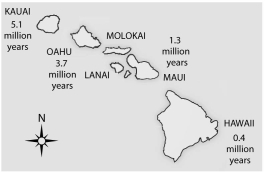 Figure 25.3
-According to the theory of sea-floor spreading, oceanic islands, such as the Hawaiian Islands depicted in Figure 25.3, form as oceanic crustal plates move over a stationary "hot spot" in the mantle. Currently, the big island of Hawaii is thought to be over a hot spot, which is why it is the only one of the seven islands that has active volcanoes. What should be true of the island of Hawaii?
1)Scientists in search of ongoing speciation events are more likely to find them here than on the other six islands.
2)Its species should be more closely related to those of nearer islands than to those of farther islands.
3)It should have a rich fossil record of terrestrial organisms.
4)There is a good chance of finding endemic species on this island.
5)On average, it should have fewer species per unit surface area than the other six islands.
Figure 25.3
-According to the theory of sea-floor spreading, oceanic islands, such as the Hawaiian Islands depicted in Figure 25.3, form as oceanic crustal plates move over a stationary "hot spot" in the mantle. Currently, the big island of Hawaii is thought to be over a hot spot, which is why it is the only one of the seven islands that has active volcanoes. What should be true of the island of Hawaii?
1)Scientists in search of ongoing speciation events are more likely to find them here than on the other six islands.
2)Its species should be more closely related to those of nearer islands than to those of farther islands.
3)It should have a rich fossil record of terrestrial organisms.
4)There is a good chance of finding endemic species on this island.
5)On average, it should have fewer species per unit surface area than the other six islands. (Multiple Choice)
4.8/5 (79)
(79) Several scientific laboratories across the globe are involved in research concerning the origin of life on Earth. Which graph below, if the results were produced abiotically, would have the greatest promise for revealing important information about the origin of Earth's first genetic system?
(Multiple Choice)
4.8/5 (89)
(89) The following questions refer to this hypothetical situation.
A female fly, full of fertilized eggs, is swept by high winds to an island far out to sea. She is the first fly to arrive on this island, and the only fly to arrive in this way. Thousands of years later, her numerous offspring occupy the island, but none of them resembles her. There are, instead, several species, each of which eats only a certain type of food. None of the species can fly, for their flight wings are absent, and their balancing organs (in other words, halteres) are now used in courtship displays. The male members of each species bear modified halteres that are unique in appearance to their species. Females bear vestigial halteres. The ranges of all of the daughter species overlap.
-Fly species W, found in a certain part of the island, produces fertile offspring with species Y. Species W does not produce fertile offspring with species X or Z. If no other species can hybridize, then species W and Y
(Multiple Choice)
4.8/5 (85)
(85) A swim bladder is a gas-filled sac that helps fish maintain buoyancy. The evolution of the swim bladder from lungs of an ancestral fish is an example of
(Multiple Choice)
4.7/5 (71)
(71) The following questions are based on the observation that several dozen different proteins comprise the prokaryotic flagellum and its attachment to the prokaryotic cell, producing a highly complex structure.
-If the complex protein assemblage of the prokaryotic flagellum arose by the same general processes as those of the complex eyes of molluscs (such as squids and octopi), then
(Multiple Choice)
4.8/5 (72)
(72) Adaptive radiations can be a direct consequence of four of the following five factors. Select the exception.
(Multiple Choice)
4.8/5 (80)
(80) Which of these fly organs, as they exist in current fly populations, best fits the description of an exaptation?
(Multiple Choice)
4.9/5 (83)
(83) An organism has a relatively large number of Hox genes in its genome. Which of the following is true of this organism?
(Multiple Choice)
4.9/5 (79)
(79) If an increase in dicynodont species diversity (in other words, number of species)occurred soon after the Permian extinction, and if it occurred for the same general reason usually given for the increase in mammalian diversity following the Cretaceous extinction, then it should be attributed to
(Multiple Choice)
4.7/5 (81)
(81) Which of the following is a defining characteristic that all protobionts had in common?
(Multiple Choice)
4.8/5 (89)
(89) Bagworm moth caterpillars feed on evergreens and carry a silken case or bag around with them in which they eventually pupate. Adult female bagworm moths are larval in appearance; they lack the wings and other structures of the adult male and instead retain the appearance of a caterpillar even though they are sexually mature and can lay eggs within the bag. This is a good example of
(Multiple Choice)
4.9/5 (75)
(75) 
Filters
- Essay(0)
- Multiple Choice(0)
- Short Answer(0)
- True False(0)
- Matching(0)