



 Chat with AI
Exam 25: The History of Life on Earth

Exam 1: Introduction: Themes in the Study of Life64 Questions
Exam 2: The Chemical Context of Life83 Questions
Exam 3: Water and Life70 Questions
Exam 4: Carbon and the Molecular Diversity of Life71 Questions
Exam 5: The Structure and Function of Large Biological Molecules109 Questions
Exam 6: A Tour of the Cell80 Questions
Exam 7: Membrane Structure and Function80 Questions
Exam 8: An Introduction to Metabolism80 Questions
Exam 9: Cellular Respiration and Fermentation107 Questions
Exam 10: Photosynthesis81 Questions
Exam 11: Cell Communication69 Questions
Exam 12: The Cell Cycle79 Questions
Exam 13: Meiosis and Sexual Life Cycles70 Questions
Exam 14: Mendel and the Gene Idea73 Questions
Exam 15: The Chromosomal Basis of Inheritance61 Questions
Exam 16: The Molecular Basis of Inheritance57 Questions
Exam 17: From Gene to Protein83 Questions
Exam 18: Regulation of Gene Expression99 Questions
Exam 19: Viruses47 Questions
Exam 20: Biotechnology72 Questions
Exam 21: Genomes and Their Evolution42 Questions
Exam 22: Descent with Modification: A Darwinian View of Life55 Questions
Exam 23: The Evolution of Populations78 Questions
Exam 24: The Origin of Species63 Questions
Exam 25: The History of Life on Earth75 Questions
Exam 26: Phylogeny and the Tree of Life73 Questions
Exam 27: Bacteria and Archaea78 Questions
Exam 28: Protists76 Questions
Exam 29: Plant Diversity I: How Plants Colonized Land74 Questions
Exam 30: Plant Diversity II: The Evolution of Seed Plants102 Questions
Exam 31: Fungi89 Questions
Exam 32: An Overview of Animal Diversity74 Questions
Exam 33: An Introduction to Invertebrates93 Questions
Exam 34: The Origin and Evolution of Vertebrates109 Questions
Exam 35: Plant Structure, Growth, and Development67 Questions
Exam 36: Resource Acquisition and Transport in Vascular Plants82 Questions
Exam 37: Soil and Plant Nutrition83 Questions
Exam 38: Angiosperm Reproduction and Biotechnology86 Questions
Exam 39: Plant Responses to Internal and External Signals108 Questions
Exam 40: Basic Principles of Animal Form and Function77 Questions
Exam 41: Animal Nutrition64 Questions
Exam 42: Circulation and Gas Exchange90 Questions
Exam 43: The Immune System100 Questions
Exam 44: Osmoregulation and Excretion69 Questions
Exam 45: Hormones and the Endocrine System72 Questions
Exam 46: Animal Reproduction94 Questions
Exam 47: Animal Development92 Questions
Exam 48: Neurons, Synapses, and Signaling73 Questions
Exam 49: Nervous Systems65 Questions
Exam 50: Sensory and Motor Mechanisms82 Questions
Exam 51: Animal Behavior69 Questions
Exam 52: An Introduction to Ecology and the Biosphere73 Questions
Exam 53: Population Ecology79 Questions
Exam 54: Community Ecology77 Questions
Exam 55: Ecosystems and Restoration Ecology81 Questions
Exam 56: Conservation Biology and Global Change67 Questions
Select questions type


Pax-6 usually causes the production of a type of light-receptor pigment. In vertebrate eyes, though, a different gene (the rh gene family)is responsible for the light-receptor pigments of the retina. The rh gene, like Pax-6, is ancient. In the marine ragworm, for example, the rh gene causes production of c-opsin, which helps regulate the worm's biological clock. Which of these most likely accounts for vertebrate vision?
(Multiple Choice)
4.8/5  (75)
(75) The existence of evolutionary trends, such as increasing body sizes among horse species, is evidence that
(Multiple Choice)
4.8/5 (66)
(66) The following questions refer to the description and figure below.
The figure represents a cross section of the sea floor through a mid-ocean rift valley, with alternating patches of black and white indicating sea floor with reversed magnetic polarities. At the arrow labeled "I" (the rift valley), the igneous rock of the sea floor is so young that it can be accurately dated using carbon-14 dating. At the arrow labeled "III," however, the igneous rock is about 1 million years old, and potassium-40 dating is typically used to date such rocks. Note: The horizontal arrows indicate the direction of sea-floor spreading, away from the rift valley.
 Figure 25.1
-How many other bands of sea-floor crust in Figure 25.1 have the same magnetic polarity as the crust that directly straddles the rift valley?
Figure 25.1
-How many other bands of sea-floor crust in Figure 25.1 have the same magnetic polarity as the crust that directly straddles the rift valley? (Multiple Choice)
4.9/5 (60)
(60) 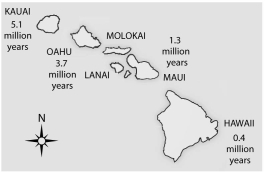 Figure 25.3
-Soon after the island of Hawaii rose above the sea surface (somewhat less than 1 million years ago), the evolution of life on this new island should have been most strongly influenced by
Figure 25.3
-Soon after the island of Hawaii rose above the sea surface (somewhat less than 1 million years ago), the evolution of life on this new island should have been most strongly influenced by (Multiple Choice)
4.7/5 (75)
(75) The snowball Earth hypothesis provides a possible explanation for the
(Multiple Choice)
4.9/5 (77)
(77) Approximately how far back in time does the fossil record extend?
(Multiple Choice)
4.8/5 (67)
(67) The following questions refer to this hypothetical situation.
A female fly, full of fertilized eggs, is swept by high winds to an island far out to sea. She is the first fly to arrive on this island, and the only fly to arrive in this way. Thousands of years later, her numerous offspring occupy the island, but none of them resembles her. There are, instead, several species, each of which eats only a certain type of food. None of the species can fly, for their flight wings are absent, and their balancing organs (in other words, halteres) are now used in courtship displays. The male members of each species bear modified halteres that are unique in appearance to their species. Females bear vestigial halteres. The ranges of all of the daughter species overlap.
-In each fly species, the entire body segment that gave rise to the original flight wings is missing. The mutation(s)that led to the flightless condition could have
(Multiple Choice)
4.9/5 (72)
(72) Recent evidence indicates that the first major diversification of multicellular eukaryotes may have coincided in time with the
(Multiple Choice)
4.9/5 (87)
(87) The following questions refer to the paragraph below.
A sediment core is removed from the floor of an inland sea. The sea has been in existence, off and on, throughout the entire time that terrestrial life has existed. Researchers wish to locate and study the terrestrial organisms fossilized in this core. The core is illustrated as a vertical column, with the top of the column representing the most recent strata and the bottom representing the time when land was first colonized by life.
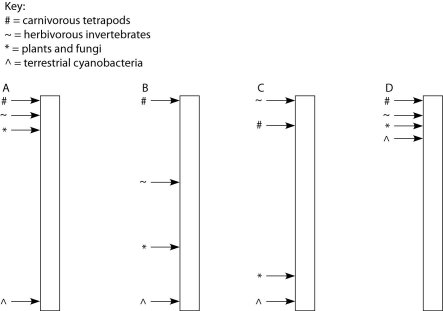 Figure 25.2
-Assuming the existence of fossilized markers for each of the following chemicals, what is the sequence in which they should be found in this sediment core, working from ancient sediments to recent sediments?
1)chitin coupled with protein
2)chlorophyll
3)bone
4)cellulose
Figure 25.2
-Assuming the existence of fossilized markers for each of the following chemicals, what is the sequence in which they should be found in this sediment core, working from ancient sediments to recent sediments?
1)chitin coupled with protein
2)chlorophyll
3)bone
4)cellulose (Multiple Choice)
4.9/5 (90)
(90) The existence of the phenomenon of exaptation is most closely associated with which of the following observations that natural selection cannot fashion perfect organisms?
(Multiple Choice)
4.7/5 (75)
(75) All animals with eyes or eyespots that have been studied so far share a gene in common. When mutated, the gene Pax-6 causes lack of eyes in fruit flies, tiny eyes in mice, and missing irises (and other eye parts) in humans. The sequence of Pax-6 in humans and mice is identical. There are so few sequence differences with fruit fly Pax-6 that the human/mouse version can cause eye formation in eyeless fruit flies, even though vertebrates and invertebrates last shared a common ancestor more than 500 million years ago.
-The appearance of Pax-6 in all animals with eyes can be explained in multiple ways. Based on the information above, which explanation is most likely?
(Multiple Choice)
4.8/5 (80)
(80) The following questions refer to the paragraph below.
A sediment core is removed from the floor of an inland sea. The sea has been in existence, off and on, throughout the entire time that terrestrial life has existed. Researchers wish to locate and study the terrestrial organisms fossilized in this core. The core is illustrated as a vertical column, with the top of the column representing the most recent strata and the bottom representing the time when land was first colonized by life.
Figure 25.2
-In order to properly interpret sediment cores, it is necessary to apply the principle of
Figure 25.2
-In order to properly interpret sediment cores, it is necessary to apply the principle of (Multiple Choice)
4.9/5 (85)
(85) Which measurement(s)would help determine absolute dates by radiometric means?
(Multiple Choice)
4.9/5 (83)
(83) Which of the following is the most likely explanation for the modern-day distribution of dicynodont fossils?
(Multiple Choice)
4.9/5 (83)
(83) If two continents converge and are united, then the collision should cause
(Multiple Choice)
4.8/5 (82)
(82) Which event is nearest in time to the end of the period known as snowball Earth?
(Multiple Choice)
4.9/5 (76)
(76) A genetic change that caused a certain Hox gene to be expressed along the tip of a vertebrate limb bud instead of farther back helped make possible the evolution of the tetrapod limb. This type of change is illustrative of
(Multiple Choice)
4.8/5 (74)
(74) What is thought to be the correct sequence of these events, from earliest to most recent, in the evolution of life on Earth?
1)origin of mitochondria
2)origin of multicellular eukaryotes
3)origin of chloroplasts
4)origin of cyanobacteria
5)origin of fungal-plant symbioses
(Multiple Choice)
5.0/5 (77)
(77) Which factor most likely caused animals and plants in India to differ greatly from species in nearby southeast Asia?
(Multiple Choice)
4.9/5 (85)
(85) 
Filters
- Essay(0)
- Multiple Choice(0)
- Short Answer(0)
- True False(0)
- Matching(0)