



 Chat with AI
Exam 20: Biotechnology

Exam 1: Introduction: Themes in the Study of Life64 Questions
Exam 2: The Chemical Context of Life83 Questions
Exam 3: Water and Life70 Questions
Exam 4: Carbon and the Molecular Diversity of Life71 Questions
Exam 5: The Structure and Function of Large Biological Molecules109 Questions
Exam 6: A Tour of the Cell80 Questions
Exam 7: Membrane Structure and Function80 Questions
Exam 8: An Introduction to Metabolism80 Questions
Exam 9: Cellular Respiration and Fermentation107 Questions
Exam 10: Photosynthesis81 Questions
Exam 11: Cell Communication69 Questions
Exam 12: The Cell Cycle79 Questions
Exam 13: Meiosis and Sexual Life Cycles70 Questions
Exam 14: Mendel and the Gene Idea73 Questions
Exam 15: The Chromosomal Basis of Inheritance61 Questions
Exam 16: The Molecular Basis of Inheritance57 Questions
Exam 17: From Gene to Protein83 Questions
Exam 18: Regulation of Gene Expression99 Questions
Exam 19: Viruses47 Questions
Exam 20: Biotechnology72 Questions
Exam 21: Genomes and Their Evolution42 Questions
Exam 22: Descent with Modification: A Darwinian View of Life55 Questions
Exam 23: The Evolution of Populations78 Questions
Exam 24: The Origin of Species63 Questions
Exam 25: The History of Life on Earth75 Questions
Exam 26: Phylogeny and the Tree of Life73 Questions
Exam 27: Bacteria and Archaea78 Questions
Exam 28: Protists76 Questions
Exam 29: Plant Diversity I: How Plants Colonized Land74 Questions
Exam 30: Plant Diversity II: The Evolution of Seed Plants102 Questions
Exam 31: Fungi89 Questions
Exam 32: An Overview of Animal Diversity74 Questions
Exam 33: An Introduction to Invertebrates93 Questions
Exam 34: The Origin and Evolution of Vertebrates109 Questions
Exam 35: Plant Structure, Growth, and Development67 Questions
Exam 36: Resource Acquisition and Transport in Vascular Plants82 Questions
Exam 37: Soil and Plant Nutrition83 Questions
Exam 38: Angiosperm Reproduction and Biotechnology86 Questions
Exam 39: Plant Responses to Internal and External Signals108 Questions
Exam 40: Basic Principles of Animal Form and Function77 Questions
Exam 41: Animal Nutrition64 Questions
Exam 42: Circulation and Gas Exchange90 Questions
Exam 43: The Immune System100 Questions
Exam 44: Osmoregulation and Excretion69 Questions
Exam 45: Hormones and the Endocrine System72 Questions
Exam 46: Animal Reproduction94 Questions
Exam 47: Animal Development92 Questions
Exam 48: Neurons, Synapses, and Signaling73 Questions
Exam 49: Nervous Systems65 Questions
Exam 50: Sensory and Motor Mechanisms82 Questions
Exam 51: Animal Behavior69 Questions
Exam 52: An Introduction to Ecology and the Biosphere73 Questions
Exam 53: Population Ecology79 Questions
Exam 54: Community Ecology77 Questions
Exam 55: Ecosystems and Restoration Ecology81 Questions
Exam 56: Conservation Biology and Global Change67 Questions
Select questions type


Use the following information to answer the next few questions.
CML (chronic myelogenous leukemia) results from a translocation between human chromosomes 9 and 22. The resulting chromosome 22 is significantly shorter than usual, and it is known as a Philadelphia (Ph') chromosome. The junction at the site of the translocation causes overexpression of a thymine kinase receptor. A new drug (Gleevec or imatinib) has been found to inhibit the disease if the patient is treated early.
-Why would Gleevec most probably cause remission of the disease?
(Multiple Choice)
4.9/5  (83)
(83) Yeast artificial chromosomes contain which of the following elements?
(Multiple Choice)
4.7/5 (87)
(87) A researcher has used in vitro mutagenesis to mutate a cloned gene and then has reinserted this into a cell. In order to have the mutated sequence disable the function of the gene, what must then occur?
(Multiple Choice)
4.9/5 (90)
(90) For a particular microarray assay (DNA chip), cDNA has been made from the mRNAs of a dozen patients' breast tumor biopsies. The researchers will be looking for
(Multiple Choice)
4.9/5 (81)
(81) RNAi methodology uses double-stranded pieces of RNA to trigger a breakdown or blocking of mRNA. For which of the following might it more possibly be useful?
(Multiple Choice)
4.7/5 (87)
(87) Which of the following is most closely identical to the formation of twins?
(Multiple Choice)
4.8/5 (72)
(72) Which of the following techniques used to analyze gene function depends on the specificity of DNA base complementarity?
(Multiple Choice)
4.9/5 (76)
(76) Use Figure 20.3 to answer the following questions. The DNA profiles that follow represent four different individuals.
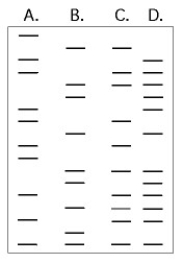 Figure 20.3
-Which of the following statements is consistent with the results?
Figure 20.3
-Which of the following statements is consistent with the results? (Multiple Choice)
4.8/5 (89)
(89) Expression of a cloned eukaryotic gene in a bacterial cell involves many challenges. The use of mRNA and reverse transcriptase is part of a strategy to solve the problem of
(Multiple Choice)
4.8/5 (74)
(74) Which of the following problems with animal cloning might result in premature death of the clones?
(Multiple Choice)
4.8/5 (81)
(81) DNA fragments from a gel are transferred to a nitrocellulose paper during the procedure called Southern blotting. What is the purpose of transferring the DNA from a gel to a nitrocellulose paper?
(Multiple Choice)
4.8/5 (77)
(77) Which of the following is one of the technical reasons why gene therapy is problematic?
(Multiple Choice)
4.9/5 (88)
(88) Use the following information to answer the next few questions.
CML (chronic myelogenous leukemia) results from a translocation between human chromosomes 9 and 22. The resulting chromosome 22 is significantly shorter than usual, and it is known as a Philadelphia (Ph') chromosome. The junction at the site of the translocation causes overexpression of a thymine kinase receptor. A new drug (Gleevec or imatinib) has been found to inhibit the disease if the patient is treated early.
-One possible use of transgenic plants is in the production of human proteins, such as vaccines. Which of the following is a possible hindrance that must be overcome?
(Multiple Choice)
4.8/5 (92)
(92) A student wishes to clone a sequence of DNA of ~200 kb. Which vector would be appropriate?
(Multiple Choice)
4.8/5 (82)
(82) Genetic engineering is being used by the pharmaceutical industry. Which of the following is not currently one of the uses?
(Multiple Choice)
4.9/5 (73)
(73) Which of the following modifications is least likely to alter the rate at which a DNA fragment moves through a gel during electrophoresis?
(Multiple Choice)
4.8/5 (83)
(83) In order to identify a specific restriction fragment using a probe, what must be done?
(Multiple Choice)
4.9/5 (67)
(67) How does a bacterial cell protect its own DNA from restriction enzymes?
(Multiple Choice)
4.9/5 (82)
(82) 
Filters
- Essay(0)
- Multiple Choice(0)
- Short Answer(0)
- True False(0)
- Matching(0)