



 Chat with AI
Exam 20: Biotechnology

Exam 1: Introduction: Themes in the Study of Life64 Questions
Exam 2: The Chemical Context of Life83 Questions
Exam 3: Water and Life70 Questions
Exam 4: Carbon and the Molecular Diversity of Life71 Questions
Exam 5: The Structure and Function of Large Biological Molecules109 Questions
Exam 6: A Tour of the Cell80 Questions
Exam 7: Membrane Structure and Function80 Questions
Exam 8: An Introduction to Metabolism80 Questions
Exam 9: Cellular Respiration and Fermentation107 Questions
Exam 10: Photosynthesis81 Questions
Exam 11: Cell Communication69 Questions
Exam 12: The Cell Cycle79 Questions
Exam 13: Meiosis and Sexual Life Cycles70 Questions
Exam 14: Mendel and the Gene Idea73 Questions
Exam 15: The Chromosomal Basis of Inheritance61 Questions
Exam 16: The Molecular Basis of Inheritance57 Questions
Exam 17: From Gene to Protein83 Questions
Exam 18: Regulation of Gene Expression99 Questions
Exam 19: Viruses47 Questions
Exam 20: Biotechnology72 Questions
Exam 21: Genomes and Their Evolution42 Questions
Exam 22: Descent with Modification: A Darwinian View of Life55 Questions
Exam 23: The Evolution of Populations78 Questions
Exam 24: The Origin of Species63 Questions
Exam 25: The History of Life on Earth75 Questions
Exam 26: Phylogeny and the Tree of Life73 Questions
Exam 27: Bacteria and Archaea78 Questions
Exam 28: Protists76 Questions
Exam 29: Plant Diversity I: How Plants Colonized Land74 Questions
Exam 30: Plant Diversity II: The Evolution of Seed Plants102 Questions
Exam 31: Fungi89 Questions
Exam 32: An Overview of Animal Diversity74 Questions
Exam 33: An Introduction to Invertebrates93 Questions
Exam 34: The Origin and Evolution of Vertebrates109 Questions
Exam 35: Plant Structure, Growth, and Development67 Questions
Exam 36: Resource Acquisition and Transport in Vascular Plants82 Questions
Exam 37: Soil and Plant Nutrition83 Questions
Exam 38: Angiosperm Reproduction and Biotechnology86 Questions
Exam 39: Plant Responses to Internal and External Signals108 Questions
Exam 40: Basic Principles of Animal Form and Function77 Questions
Exam 41: Animal Nutrition64 Questions
Exam 42: Circulation and Gas Exchange90 Questions
Exam 43: The Immune System100 Questions
Exam 44: Osmoregulation and Excretion69 Questions
Exam 45: Hormones and the Endocrine System72 Questions
Exam 46: Animal Reproduction94 Questions
Exam 47: Animal Development92 Questions
Exam 48: Neurons, Synapses, and Signaling73 Questions
Exam 49: Nervous Systems65 Questions
Exam 50: Sensory and Motor Mechanisms82 Questions
Exam 51: Animal Behavior69 Questions
Exam 52: An Introduction to Ecology and the Biosphere73 Questions
Exam 53: Population Ecology79 Questions
Exam 54: Community Ecology77 Questions
Exam 55: Ecosystems and Restoration Ecology81 Questions
Exam 56: Conservation Biology and Global Change67 Questions
Select questions type


As genetic technology makes testing for a wide variety of genotypes possible, which of the following is likely to be an increasingly troublesome issue?
(Multiple Choice)
4.9/5  (67)
(67) Which of the following best describes the complete sequence of steps occurring during every cycle of PCR?
1)The primers hybridize to the target DNA.
2)The mixture is heated to a high temperature to denature the double-stranded target DNA.
3)Fresh DNA polymerase is added.
4)DNA polymerase extends the primers to make a copy of the target DNA.
(Multiple Choice)
4.9/5 (81)
(81) Use Figure 20.1 to answer the following question.
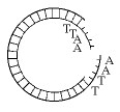 Figure 20.1
-Which enzyme was used to produce the molecule in Figure 20.1?
Figure 20.1
-Which enzyme was used to produce the molecule in Figure 20.1? (Multiple Choice)
4.9/5 (84)
(84) DNA technology has many medical applications. Which of the following is not done routinely at present?
(Multiple Choice)
4.8/5 (84)
(84) The first cloned cat, called Carbon Copy, was a calico, but she looked significantly different from her female parent. Why?
(Multiple Choice)
4.9/5 (83)
(83) In large scale, genome-wide association studies in humans, correlation is sought between
(Multiple Choice)
4.8/5 (74)
(74) Which of the following describes the transfer of polypeptide sequences to a membrane to analyze gene expression?
(Multiple Choice)
4.8/5 (84)
(84) Which of the following sequences in double-stranded DNA is most likely to be recognized as a cutting site for a restriction enzyme?
(Multiple Choice)
4.7/5 (81)
(81) Silencing of selected genes is often done using RNA interference (RNAi). Which of the following questions would not be answered with this process?
(Multiple Choice)
4.9/5 (75)
(75) In 1997, Dolly the sheep was cloned. Which of the following processes was used?
(Multiple Choice)
4.8/5 (88)
(88) A researcher needs to clone a sequence of part of a eukaryotic genome in order to express the sequence and to modify the polypeptide product. She would be able to satisfy these requirements by using which of the following vectors?
(Multiple Choice)
4.8/5 (86)
(86) Which of the following would not be true of cDNA produced using human brain tissue as the starting material?
(Multiple Choice)
4.8/5 (96)
(96) Use the following information to answer the next few questions.
Pharmacogenetics is an increasingly important discipline that uses genetic information to tailor the prescription of drug treatments to individuals. In the case of chemotherapy for breast cancer, for example, different patients need and/or respond to different treatments.
-Breast tumor biopsy specimens can be typed for a number of gene expression patterns. Together, these can provide risk analysis for the likely aggressive growth and metastasis of the tumor. How can this most help the physician and patient?
(Multiple Choice)
4.7/5 (78)
(78) Use the following information to answer the next few questions.
CML (chronic myelogenous leukemia) results from a translocation between human chromosomes 9 and 22. The resulting chromosome 22 is significantly shorter than usual, and it is known as a Philadelphia (Ph') chromosome. The junction at the site of the translocation causes overexpression of a thymine kinase receptor. A new drug (Gleevec or imatinib) has been found to inhibit the disease if the patient is treated early.
-Which of the following would be a reasonably efficient technique for confirming the diagnosis of CML?
(Multiple Choice)
4.9/5 (80)
(80) Use the following information to answer the next few questions.
A group of six students has taken samples of their own cheek cells, purified the DNA, and used a restriction enzyme known to cut at zero, one, or two sites in a particular gene of interest.
-Why might they be conducting such an experiment?
(Multiple Choice)
4.9/5 (85)
(85) Which of the following uses reverse transcriptase to make cDNA followed by amplification?
(Multiple Choice)
4.7/5 (79)
(79) DNA microarrays have made a huge impact on genomic studies because they
(Multiple Choice)
4.8/5 (82)
(82) Sequencing an entire genome, such as that of C. elegans, a nematode, is most important because
(Multiple Choice)
4.8/5 (85)
(85) Use Figure 20.3 to answer the following questions. The DNA profiles that follow represent four different individuals.
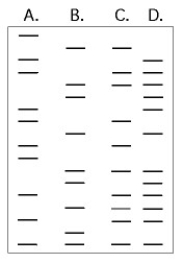 Figure 20.3
-Which of the following statements is most likely true?
Figure 20.3
-Which of the following statements is most likely true? (Multiple Choice)
4.7/5 (96)
(96) Use the following information to answer the next few questions.
A group of six students has taken samples of their own cheek cells, purified the DNA, and used a restriction enzyme known to cut at zero, one, or two sites in a particular gene of interest.
-Analysis of the data obtained shows that two students each have two fragments, two students each have three fragments, and two students each have one only. What does this demonstrate?
(Multiple Choice)
4.9/5 (80)
(80) 
Filters
- Essay(0)
- Multiple Choice(0)
- Short Answer(0)
- True False(0)
- Matching(0)