



 Chat with AI
Exam 13: Mechanisms of International Adjustment

Exam 1: The International Economy and Globalization71 Questions
Exam 2: Foundations of Modern Trade Theory: Comparative Advantage215 Questions
Exam 3: Sources of Comparative Advantage143 Questions
Exam 4: Tariffs162 Questions
Exam 5: Nontariff Trade Barriers164 Questions
Exam 6: Trade Regulations and Industrial Policies187 Questions
Exam 7: Trade Policies for the Developing Nations305 Questions
Exam 8: Regional Trading Arrangements164 Questions
Exam 9: International Factor Movements and Multinational Enterprises123 Questions
Exam 10: The Balance-of-payments156 Questions
Exam 11: Foreign Exchange206 Questions
Exam 12: Exchange Rate Determination199 Questions
Exam 13: Mechanisms of International Adjustment107 Questions
Exam 14: Exchange Rate Adjustments and the Balance-of-payments122 Questions
Exam 15: Exchange Rate Systems and Currency Crises168 Questions
Exam 16: Macroeconomic Policy in an Open-economy72 Questions
Exam 17: International Banking: Reserves, Debt, and Risk96 Questions
Select questions type


Table 13.1.Canada's Saving,Investment,Import,and Export Functions (in billions of dollars) Under a System of Fixed Exchange Rates
Export Function X = 3000
Investment Function I = 1000
Saving Function S = -1000 + 0.2Y
Import Function M = 500 + 0.25Y
-Refer to Table 13.1.If weak economic conditions abroad result in Canada's exports falling from $3000 billion to $2500 billion,Canada's equilibrium income falls by approximately:
(Multiple Choice)
4.8/5  (63)
(63) The value of the foreign trade multiplier equals the reciprocal of the sum of the marginal propensities to:
(Multiple Choice)
4.9/5 (76)
(76) Under the gold standard,a surplus nation facing a gold inflow and an increase in its money supply would also experience a:
(Multiple Choice)
4.9/5 (72)
(72) Under the classical gold standard,a trade surplus nation would realize gold inflows,an increase in its money supply,rising interest rates,and net investment inflows.
(True/False)
4.7/5 (80)
(80) That the balance of payments could be adjusted by prices and interest rates,under a fixed exchange rate system,originated with Keynesian theory during the 1930s.
(True/False)
4.9/5 (87)
(87) Figure 13.4.Canadian Economy Under a Fixed Exchange Rate System
 -Referring to Figure 13.4,Canada's marginal propensity to save equals 0.25 and marginal propensity to import equal 0.5.
 (True/False)
4.8/5 (87)
(87) Figure 13.2.Australian Economy Under a Fixed Exchange Rate System
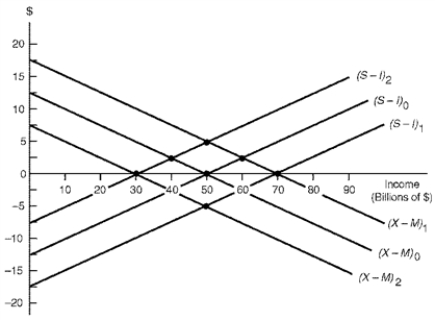 -Refer to Figure 13.2.Starting at equilibrium income $50 billion,where (S-I)0 intersects (X-M)0,suppose that improving profit expectations lead to an autonomous increase in Australian investment of $5 billion.Australian income thus ____ which leads to Australia's trade account moving to a ____.
 (Multiple Choice)
4.9/5 (71)
(71) 
Filters
- Essay(0)
- Multiple Choice(0)
- Short Answer(0)
- True False(0)
- Matching(0)