



 Chat with AI
Exam 13: Mechanisms of International Adjustment

Exam 1: The International Economy and Globalization71 Questions
Exam 2: Foundations of Modern Trade Theory: Comparative Advantage215 Questions
Exam 3: Sources of Comparative Advantage143 Questions
Exam 4: Tariffs162 Questions
Exam 5: Nontariff Trade Barriers164 Questions
Exam 6: Trade Regulations and Industrial Policies187 Questions
Exam 7: Trade Policies for the Developing Nations305 Questions
Exam 8: Regional Trading Arrangements164 Questions
Exam 9: International Factor Movements and Multinational Enterprises123 Questions
Exam 10: The Balance-of-payments156 Questions
Exam 11: Foreign Exchange206 Questions
Exam 12: Exchange Rate Determination199 Questions
Exam 13: Mechanisms of International Adjustment107 Questions
Exam 14: Exchange Rate Adjustments and the Balance-of-payments122 Questions
Exam 15: Exchange Rate Systems and Currency Crises168 Questions
Exam 16: Macroeconomic Policy in an Open-economy72 Questions
Exam 17: International Banking: Reserves, Debt, and Risk96 Questions
Select questions type


Regarding the equation of exchange,the classical economists assumed that final output was below its maximum level while the velocity of money was volatile.
(True/False)
4.8/5  (75)
(75) Figure 13.1.U.S.Capital and Financial Account
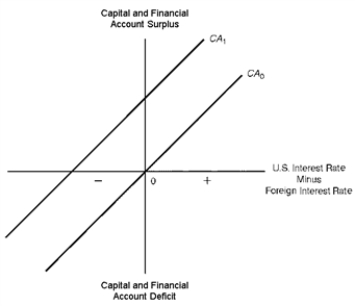 -Refer to Figure 13.1.The U.S.capital and financial account schedule would shift upward from CA0 to CA1 if:
 (Multiple Choice)
4.9/5 (71)
(71) The gold standard's "rules of the game" required central bankers in a trade deficit nation to expand the money supply,leading to falling interest rates and net investment outflows.
(True/False)
4.7/5 (90)
(90) According to the equation of exchange,the total expenditures on final goods equals the monetary value of the final goods sold.
(True/False)
4.9/5 (80)
(80) Under the gold standard,a nation with a current-account surplus would realize gold outflows,a decrease in its money supply,and a fall in its domestic price level.
(True/False)
4.9/5 (84)
(84) Figure 13.4.Canadian Economy Under a Fixed Exchange Rate System
 -Refer to Figure 13.4.Starting at equilibrium income $100 billion,where (S - I)0 intersects (X - M)0,an autonomous decrease in saving of $10 billion leads to a $20 billion increase in income and a trade deficit of $5 billion.
 (True/False)
4.9/5 (67)
(67) Figure 13.4.Canadian Economy Under a Fixed Exchange Rate System
-Referring to Figure 13.4,Canada's foreign-trade multiplier equals 2.0.
-Referring to Figure 13.4,Canada's foreign-trade multiplier equals 2.0. (True/False)
4.9/5 (84)
(84) Figure 13.1.U.S.Capital and Financial Account
-Refer to Figure 13.1.Upward movements along U.S.capital and financial account schedule CA0 would be caused by:
-Refer to Figure 13.1.Upward movements along U.S.capital and financial account schedule CA0 would be caused by: (Multiple Choice)
4.9/5 (80)
(80) Starting from a position where the nation's money demand equals the money supply,and its balance of payments is in equilibrium,economic theory suggests that the nation's balance of payments would move into a deficit position if there occurred in the nation a:
(Multiple Choice)
4.7/5 (81)
(81) Figure 13.3.U.S.Capital and Financial Account Under a Fixed Exchange Rate System
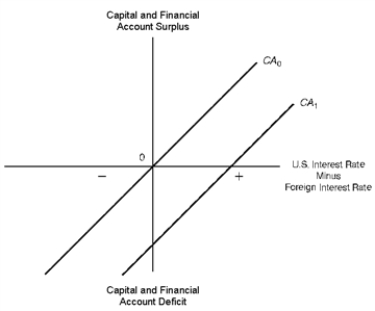 -Refer to Figure 13.3.As the U.S.government decreases taxes on income earned by U.S.residents from foreign investments,the U.S.capital and financial account schedule shifts downward from CA0 to CA1 and the United States realizes net financial outflows.
 (True/False)
4.9/5 (85)
(85) Starting from a position where the nation's money demand equals the money supply and its balance of payments is in equilibrium,economic theory suggests that the nation's balance of payments would move into a surplus position if there occurred in the nation:
(Multiple Choice)
4.8/5 (73)
(73) Under the price-adjustment mechanism,a trade-surplus nation would realize gold inflows,an increase in its money supply,and a loss of international competitiveness.
(True/False)
4.8/5 (81)
(81) Under a fixed exchange rate system,adjustment mechanisms work for the automatic return to current-account balance after the initial balance has been disrupted.
(True/False)
4.8/5 (86)
(86) An "automatic" adjustment mechanism would require a trade-surplus nation to accept price deflation and/or falling income as the cost of increasing imports.
(True/False)
4.9/5 (77)
(77) Figure 13.4.Canadian Economy Under a Fixed Exchange Rate System
-Refer to Figure 13.4.Starting at equilibrium income $100 billion,where (S - I)0 intersects (X - M)0,an autonomous decrease in Canadian exports of $10 billion leads to a $20 decrease in income and a trade deficit of $5 billion.
-Refer to Figure 13.4.Starting at equilibrium income $100 billion,where (S - I)0 intersects (X - M)0,an autonomous decrease in Canadian exports of $10 billion leads to a $20 decrease in income and a trade deficit of $5 billion. (True/False)
4.8/5 (78)
(78) Which chain of events would promote payments equilibrium for a deficit nation,according to the price-adjustment mechanism?
(Multiple Choice)
4.9/5 (84)
(84) Figure 13.1.U.S.Capital and Financial Account
-Refer to Figure 13.1.The U.S.capital and financial account schedule would shift upward from CA0 to CA1 if:
-Refer to Figure 13.1.The U.S.capital and financial account schedule would shift upward from CA0 to CA1 if: (Multiple Choice)
4.8/5 (83)
(83) In explaining balance-of-payments adjustments,the classical economists
(Multiple Choice)
4.9/5 (81)
(81) According to the monetary approach,balance-of-payments disequilibriums are the result of imbalances in a country's money supply and money demand.
(True/False)
4.8/5 (73)
(73) The foreign-trade multiplier equals the sum of the marginal propensity to import and the marginal propensity to save.
(True/False)
4.8/5 (82)
(82) 
Filters
- Essay(0)
- Multiple Choice(0)
- Short Answer(0)
- True False(0)
- Matching(0)