



 Chat with AI
Exam 13: Mechanisms of International Adjustment

Exam 1: The International Economy and Globalization71 Questions
Exam 2: Foundations of Modern Trade Theory: Comparative Advantage215 Questions
Exam 3: Sources of Comparative Advantage143 Questions
Exam 4: Tariffs162 Questions
Exam 5: Nontariff Trade Barriers164 Questions
Exam 6: Trade Regulations and Industrial Policies187 Questions
Exam 7: Trade Policies for the Developing Nations305 Questions
Exam 8: Regional Trading Arrangements164 Questions
Exam 9: International Factor Movements and Multinational Enterprises123 Questions
Exam 10: The Balance-of-payments156 Questions
Exam 11: Foreign Exchange206 Questions
Exam 12: Exchange Rate Determination199 Questions
Exam 13: Mechanisms of International Adjustment107 Questions
Exam 14: Exchange Rate Adjustments and the Balance-of-payments122 Questions
Exam 15: Exchange Rate Systems and Currency Crises168 Questions
Exam 16: Macroeconomic Policy in an Open-economy72 Questions
Exam 17: International Banking: Reserves, Debt, and Risk96 Questions
Select questions type


Table 13.1.Canada's Saving,Investment,Import,and Export Functions (in billions of dollars) Under a System of Fixed Exchange Rates
Export Function X = 3000
Investment Function I = 1000
Saving Function S = -1000 + 0.2Y
Import Function M = 500 + 0.25Y
-Referring to Table 13.1,if Canada's income rises by $200 billion,saving would rise by:
(Multiple Choice)
5.0/5  (74)
(74) Figure 13.2.Australian Economy Under a Fixed Exchange Rate System
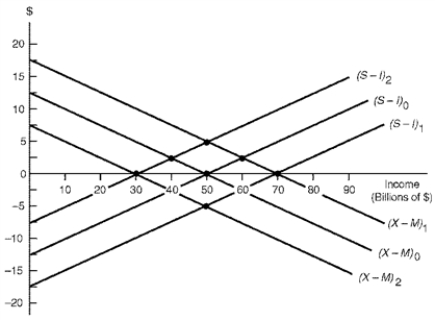 -Refer to Figure 13.2.Starting at equilibrium income $50 billion,where (S-I)0 intersects (X-M)0,suppose that changing preferences lead to an autonomous decrease in Australian imports of $5 billion.Australian income thus ____ which leads to Australia's trade account moving to a ____.
 (Multiple Choice)
4.9/5 (77)
(77) Prices,interest rates,and income are the automatic adjustment variables that help restore current-account equilibrium under a system of fixed exchange rates.
(True/False)
5.0/5 (71)
(71) Starting from a position where the nation's money demand equals the money supply and its balance of payments is in equilibrium,economic theory suggests that the nation's balance of payments would move into a deficit position if there occurred in the nation:
(Multiple Choice)
4.8/5 (80)
(80) Assume that interest rates on comparable securities are identical in the United States and foreign countries.Now suppose that investors anticipate that in the future the U.S.dollar will appreciate against foreign currencies.Investment funds would thus be expected to:
(Multiple Choice)
4.8/5 (82)
(82) Figure 13.3.U.S.Capital and Financial Account Under a Fixed Exchange Rate System
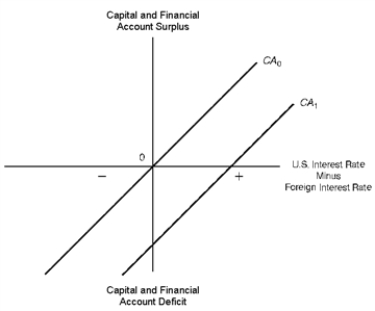 -Refer to Figure 13.3.As U.S.interest rates rise relative to foreign interest rates,the U.S.slides upward along schedule CA0,thus moving towards capital and financial account surplus.
 (True/False)
4.9/5 (78)
(78) The monetary approach contends that,under a fixed exchange rate system,an excess supply of money leads to a trade surplus.
(True/False)
4.9/5 (79)
(79) The essence of the classical price-adjustment mechanism is embodied in the quantity theory of money.
(True/False)
5.0/5 (76)
(76) Which of the following balance-of-payments adjustment mechanisms is most closely related to the quantity theory of money?
(Multiple Choice)
4.8/5 (84)
(84) The monetary approach contends that,under a fixed exchange rate system,policies that increase the supply of money relative to the demand for money lead to a trade surplus.
(True/False)
4.9/5 (80)
(80) Figure 13.4.Canadian Economy Under a Fixed Exchange Rate System
 -Refer to Figure 13.4.Starting at equilibrium income $100 billion,where (S - I)0 intersects (X - M)0,an autonomous decrease in Canadian imports of $10 billion leads to a $20 billion decrease in income and a trade deficit of $5 billion.
 (True/False)
4.9/5 (94)
(94) Exhibit 13.1
Assume the marginal propensity to consume for U.S.households equals 0.9,and the marginal propensity to import for the United States equals 0.1.Suppose there occurs an increase in investment of $10 billion at each level of income.
-Refer to Exhibit 13.1.The value of the multiplier for the United States equals:
(Multiple Choice)
4.7/5 (76)
(76) The balance-of-payments adjustment mechanism developed during the 1700s by the English economist David Hume is the:
(Multiple Choice)
4.9/5 (82)
(82) According to the quantity theory of money,a change in the money supply will induce an inverse and less-than-proportionate change in the price level.
(True/False)
4.7/5 (80)
(80) Figure 13.1.U.S.Capital and Financial Account
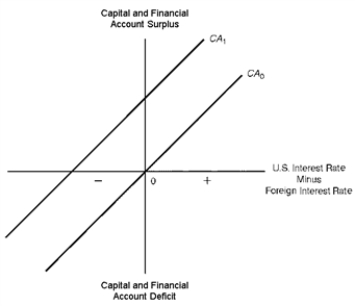 -Refer to Figure 13.1.The U.S.capital and financial account schedule would shift upward from CA0 to CA1 if:
 (Multiple Choice)
4.8/5 (72)
(72) Under the gold standard of the 1800s,exchange rates were allowed to float freely in the currency markets.
(True/False)
4.7/5 (76)
(76) When a country's current account moves into disequilibrium,automatic adjustments in tariffs and quotas occur which move the current account back into equilibrium.
(True/False)
4.8/5 (75)
(75) Table 13.1.Canada's Saving,Investment,Import,and Export Functions (in billions of dollars) Under a System of Fixed Exchange Rates
Export Function X = 3000
Investment Function I = 1000
Saving Function S = -1000 + 0.2Y
Import Function M = 500 + 0.25Y
-Referring to Table 13.1,if Canada's income rises by $200 billion,imports would rise by:
(Multiple Choice)
4.9/5 (82)
(82) Suppose that rising U.S.income leads to higher sales and profits in the United States.This would likely result in:
(Multiple Choice)
4.7/5 (73)
(73) Which chain of events would promote payments equilibrium for a surplus nation,according to the price-adjustment mechanism?
(Multiple Choice)
4.9/5 (68)
(68) 
Filters
- Essay(0)
- Multiple Choice(0)
- Short Answer(0)
- True False(0)
- Matching(0)