



 Chat with AI
Exam 6: Risks and Rates of Return

Exam 1: An Overview of Financial Management and the Financial Environment38 Questions
Exam 2: Financial Statements, Cash Flow, and Taxes3 Questions
Exam 3: Analysis of Financial Statements104 Questions
Exam 4: Time Value of Money139 Questions
Exam 5: Bonds, Bond Valuation, and Interest Rates100 Questions
Exam 6: Risks and Rates of Return132 Questions
Exam 7: Stocks and Their Valuation48 Questions
Exam 8: Financial Options and Applications in Corporate Finance22 Questions
Exam 9: The Cost of Capital87 Questions
Exam 10: The Basics of Capital Budgeting98 Questions
Exam 11: Cash Flow Estimation and Risk Analysis66 Questions
Exam 12: Financial Planning and Forecasting Financial Statements46 Questions
Exam 13: Corporate Valuation, Value-Based Management, and Corporate Governance24 Questions
Exam 14: Distributions to Shareholders: Dividends and Repurchases26 Questions
Exam 15: Capital Structure Decisions70 Questions
Exam 16: Working Capital Management129 Questions
Exam 17: Multinational Financial Management39 Questions
Exam 18: Lease Financing20 Questions
Exam 19: Hybrid Financing: Preferred Stock, Warrants, and Convertibles27 Questions
Exam 20: Initial Public Offerings, Investment Banking, and Financial Restructuring22 Questions
Exam 21: Mergers, Lbos, Divestitures, and Holding Companies41 Questions
Exam 22: Bankruptcy, Reorganization, and Liquidation8 Questions
Exam 23: Derivatives and Risk Management14 Questions
Exam 24: Portfolio Theory, Asset Pricing Models, and Behavioral Finance25 Questions
Exam 25: Real Options15 Questions
Exam 26: Analysis of Capital Structure Theory27 Questions
Exam 27: Providing and Obtaining Credit31 Questions
Exam 28: Advanced Issues in Cash Management and Inventory Control20 Questions
Exam 29: Pension Plan Management9 Questions
Exam 30: Financial Management in Not-For-Profit Businesses10 Questions
Select questions type


Bob has a $50,000 stock portfolio with a beta of 1.2, an expected Return of 10.8%, and a standard deviation of 25%. Becky also has a
$50,000 portfolio, but it has a beta of 0.8, an expected return of 9.2%, and a standard deviation that is also 25%. The correlation coefficient, r, between Bob's and Becky's portfolios is zero. If Bob and Becky marry and combine their portfolios, which of the following best describes their combined $100,000 portfolio?
(Multiple Choice)
4.9/5  (74)
(74) The distributions of rates of return for Companies AA and BB are given below:  We can conclude from the above information that any rational, risk- averse investor would be better off adding Security AA to a well- diversified portfolio over Security BB.
 (True/False)
4.9/5 (82)
(82) Stock A has a beta of 1.2 and a standard deviation of 25%. Stock B has a beta of 1.4 and a standard deviation of 20%. Portfolio AB was created by investing in a combination of Stocks A and B. Portfolio AB has a beta of 1.25 and a standard deviation of 18%. Which of the following statements is CORRECT?
(Multiple Choice)
4.8/5 (77)
(77) Under the CAPM, the required rate of return on a firm's common stock is determined only by the firm's market risk. If its market risk is known, and if that risk is expected to remain constant, then analysts have all the information they need to calculate the firm's required rate of return.
(True/False)
4.9/5 (81)
(81) Assume that you hold a well-diversified portfolio that has an expected return of 11.0% and a beta of 1.20. You are in the process of buying 1,000 shares of Omega Corp at $10 a share and adding it to your portfolio. Omega has an expected return of 13.0% and a beta of 1.50. The total value of your current portfolio is $90,000. What will the expected return and beta on the portfolio be after the purchase of the Omega stock?
(Multiple Choice)
4.8/5 (74)
(74) Mike Flannery holds the following portfolio: 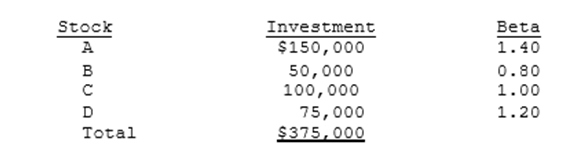 What is the portfolio's beta?
 (Multiple Choice)
4.8/5 (81)
(81) Stock A's stock has a beta of 1.30, and its required return is 12.00%. Stock B's beta is 0.80. If the risk-free rate is 4.75%, what is the required rate of return on B's stock? (Hint: First find the market risk premium.)
(Multiple Choice)
4.9/5 (76)
(76) Other things held constant, if the expected inflation rate decreases and investors also become more risk averse, the Security Market Line would be affected as follows:
(Multiple Choice)
4.8/5 (86)
(86) Assume that you manage a $10.00 million mutual fund that has a beta of
1)05 and a 9.50% required return. The risk-free rate is 4.20%. You now receive another $5.00 million, which you invest in stocks with an average beta of 0.65. What is the required rate of return on the new portfolio? (Hint: You must first find the market risk premium, then find the new portfolio beta.)
(Multiple Choice)
4.9/5 (83)
(83) Levine Inc. is considering an investment that has an expected return of 15% and a standard deviation of 10%. What is the investment's coefficient of variation?
(Multiple Choice)
4.9/5 (71)
(71) The coefficient of variation, calculated as the standard deviation of expected returns divided by the expected return, is a standardized measure of the risk per unit of expected return.
(True/False)
4.9/5 (82)
(82) 
Filters
- Essay(0)
- Multiple Choice(0)
- Short Answer(0)
- True False(0)
- Matching(0)