



 Chat with AI
Exam 6: Risks and Rates of Return

Exam 1: An Overview of Financial Management and the Financial Environment38 Questions
Exam 2: Financial Statements, Cash Flow, and Taxes3 Questions
Exam 3: Analysis of Financial Statements104 Questions
Exam 4: Time Value of Money139 Questions
Exam 5: Bonds, Bond Valuation, and Interest Rates100 Questions
Exam 6: Risks and Rates of Return132 Questions
Exam 7: Stocks and Their Valuation48 Questions
Exam 8: Financial Options and Applications in Corporate Finance22 Questions
Exam 9: The Cost of Capital87 Questions
Exam 10: The Basics of Capital Budgeting98 Questions
Exam 11: Cash Flow Estimation and Risk Analysis66 Questions
Exam 12: Financial Planning and Forecasting Financial Statements46 Questions
Exam 13: Corporate Valuation, Value-Based Management, and Corporate Governance24 Questions
Exam 14: Distributions to Shareholders: Dividends and Repurchases26 Questions
Exam 15: Capital Structure Decisions70 Questions
Exam 16: Working Capital Management129 Questions
Exam 17: Multinational Financial Management39 Questions
Exam 18: Lease Financing20 Questions
Exam 19: Hybrid Financing: Preferred Stock, Warrants, and Convertibles27 Questions
Exam 20: Initial Public Offerings, Investment Banking, and Financial Restructuring22 Questions
Exam 21: Mergers, Lbos, Divestitures, and Holding Companies41 Questions
Exam 22: Bankruptcy, Reorganization, and Liquidation8 Questions
Exam 23: Derivatives and Risk Management14 Questions
Exam 24: Portfolio Theory, Asset Pricing Models, and Behavioral Finance25 Questions
Exam 25: Real Options15 Questions
Exam 26: Analysis of Capital Structure Theory27 Questions
Exam 27: Providing and Obtaining Credit31 Questions
Exam 28: Advanced Issues in Cash Management and Inventory Control20 Questions
Exam 29: Pension Plan Management9 Questions
Exam 30: Financial Management in Not-For-Profit Businesses10 Questions
Select questions type


Inflation, recession, and high interest rates are economic events that are best characterized as being
(Multiple Choice)
4.8/5  (88)
(88) One key conclusion of the Capital Asset Pricing Model is that the value of an asset should be measured by considering both the risk and the expected return of the asset, assuming that the asset is held in a
well-diversified portfolio. The risk of the asset held in isolation is not relevant under the CAPM.
(True/False)
4.8/5 (85)
(85) Nile Food's stock has a beta of 1.4, while Elba Eateries' stock has a beta of 0.7. Assume that the risk-free rate, rRF, is 5.5% and the market risk premium, (rM − rRF), equals 4%. Which of the following statements is CORRECT?
(Multiple Choice)
4.9/5 (69)
(69) Someone who is risk averse has a general dislike for risk and a preference for certainty. If risk aversion exists in the market, then investors in general are willing to accept somewhat lower returns on less risky securities. Different investors have different degrees of risk aversion, and the end result is that investors with greater risk aversion tend to hold securities with lower risk (and therefore a lower expected return) than investors who have more tolerance for risk.
(True/False)
4.9/5 (76)
(76) Diversification will normally reduce the riskiness of a portfolio of stocks.
(True/False)
4.8/5 (81)
(81) In portfolio analysis, we often use ex post (historical) returns and standard deviations, despite the fact that we are really interested in ex ante (future) data.
(True/False)
4.8/5 (89)
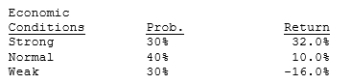
(89) Magee Inc.'s manager believes that economic conditions during the next year will be strong, normal, or weak, and she thinks that the firm's returns will have the probability distribution shown below. What's the standard deviation of the estimated returns? (Hint: Use the formula for the standard deviation of a population, not a sample.)
(Multiple Choice)
4.8/5 (72)
(72) Even if the correlation between the returns on two securities is +1.0, if the securities are combined in the correct proportions, the resulting 2-asset portfolio will have less risk than either security held alone.
(True/False)
4.9/5 (81)
(81) Because of differences in the expected returns on different investments, the standard deviation is not always an adequate measure of risk. However, the coefficient of variation adjusts for differences in expected returns and thus allows investors to make better comparisons of investments' stand-alone risk.
(True/False)
4.9/5 (82)
(82) Stock A has a beta = 0.8, while Stock B has a beta = 1.6. Which of the following statements is CORRECT?
(Multiple Choice)
4.9/5 (84)
(84) If investors become less averse to risk, the slope of the Security Market Line (SML) will increase.
(True/False)
4.7/5 (90)
(90) Kristina Raattama holds a $200,000 portfolio consisting of the following Stocks. The portfolio's beta is 0.875.
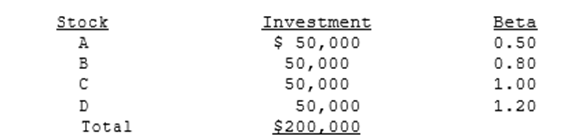 If Kristina replaces Stock A with another stock, , which has a beta of 1.50, what will the portfolio's new beta be?
 (Multiple Choice)
4.9/5 (75)
(75) Stocks A and B each have an expected return of 15%, a standard deviation of 20%, and a beta of 1.2. The returns on the two stocks have a correlation coefficient of +0.6. You have a portfolio that consists of 50% A and 50% B. Which of the following statements is CORRECT?
(Multiple Choice)
4.7/5 (89)
(89) Assume that the risk-free rate is 5%. Which of the following statements is CORRECT?
(Multiple Choice)
4.8/5 (92)
(92) Stock A has a beta of 0.7, whereas Stock B has a beta of 1.3. Portfolio P has 50% invested in both A and B. Which of the following would occur if the market risk premium increased by 1% but the risk- free rate remained constant?
(Multiple Choice)
4.8/5 (77)
(77) Since the market return represents the expected return on an average stock, the market return reflects a certain amount of risk. As a result, there exists a market risk premium, which is the amount over and above the risk-free rate, that is required to compensate stock investors for assuming an average amount of risk.
(True/False)
4.8/5 (71)
(71) If investors are risk averse and hold only one stock, we can conclude that the required rate of return on a stock whose standard deviation is
0.21 will be greater than the required return on a stock whose standard deviation is 0.10. However, if stocks are held in portfolios, it is possible that the required return could be higher on the stock with the low standard deviation.
(True/False)
4.9/5 (81)
(81) Wei Inc. is considering a capital budgeting project that has an expected return of 25% and a standard deviation of 30%. What is the project's coefficient of variation?
(Multiple Choice)
4.9/5 (81)
(81) 
Filters
- Essay(0)
- Multiple Choice(0)
- Short Answer(0)
- True False(0)
- Matching(0)