



 Chat with AI
Exam 6: Risks and Rates of Return

Exam 1: An Overview of Financial Management and the Financial Environment38 Questions
Exam 2: Financial Statements, Cash Flow, and Taxes3 Questions
Exam 3: Analysis of Financial Statements104 Questions
Exam 4: Time Value of Money139 Questions
Exam 5: Bonds, Bond Valuation, and Interest Rates100 Questions
Exam 6: Risks and Rates of Return132 Questions
Exam 7: Stocks and Their Valuation48 Questions
Exam 8: Financial Options and Applications in Corporate Finance22 Questions
Exam 9: The Cost of Capital87 Questions
Exam 10: The Basics of Capital Budgeting98 Questions
Exam 11: Cash Flow Estimation and Risk Analysis66 Questions
Exam 12: Financial Planning and Forecasting Financial Statements46 Questions
Exam 13: Corporate Valuation, Value-Based Management, and Corporate Governance24 Questions
Exam 14: Distributions to Shareholders: Dividends and Repurchases26 Questions
Exam 15: Capital Structure Decisions70 Questions
Exam 16: Working Capital Management129 Questions
Exam 17: Multinational Financial Management39 Questions
Exam 18: Lease Financing20 Questions
Exam 19: Hybrid Financing: Preferred Stock, Warrants, and Convertibles27 Questions
Exam 20: Initial Public Offerings, Investment Banking, and Financial Restructuring22 Questions
Exam 21: Mergers, Lbos, Divestitures, and Holding Companies41 Questions
Exam 22: Bankruptcy, Reorganization, and Liquidation8 Questions
Exam 23: Derivatives and Risk Management14 Questions
Exam 24: Portfolio Theory, Asset Pricing Models, and Behavioral Finance25 Questions
Exam 25: Real Options15 Questions
Exam 26: Analysis of Capital Structure Theory27 Questions
Exam 27: Providing and Obtaining Credit31 Questions
Exam 28: Advanced Issues in Cash Management and Inventory Control20 Questions
Exam 29: Pension Plan Management9 Questions
Exam 30: Financial Management in Not-For-Profit Businesses10 Questions
Select questions type


Assume that the risk-free rate, rRF, increases but the market risk premium, (rM − rRF), declines with the net effect being that the overall required return on the market, rM, remains constant. Which of the following statements is CORRECT?
(Multiple Choice)
4.9/5  (78)
(78) Suppose you hold a portfolio consisting of a $10,000 investment in each of 8 different common stocks. The portfolio's beta is 1.25. Now suppose you decided to sell one of your stocks that has a beta of 1.00 and to use the proceeds to buy a replacement stock with a beta of 1.35. What would the portfolio's new beta be?
(Multiple Choice)
4.8/5 (87)
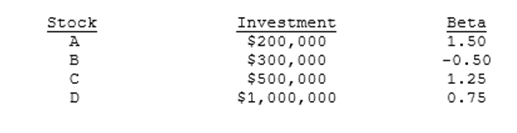
(87) Consider the following information and then calculate the required rate of return for the Global Investment Fund, which holds 4 stocks. The market's required rate of return is 13.25%, the risk-free rate is 7.00%, and the Fund's assets are as follows:
(Multiple Choice)
4.9/5 (83)
(83) Assume that the risk-free rate is 6% and the market risk premium is 5%. Given this information, which of the following statements is CORRECT?
(Multiple Choice)
4.8/5 (71)
(71) The standard deviation is a better measure of risk than the coefficient of variation if the expected returns of the securities being compared differ significantly.
(True/False)
4.8/5 (92)
(92) Engler Equipment has a beta of 0.88 and an expected dividend growth rate of 4.00% per year. The T-bill rate is 4.00%, and the T-bond rate is 5.25%. The annual return on the stock market during the past 4 years was 10.25%. Investors expect the average annual future return on the market to be 12.50%. Using the SML, what is the firm's required rate of return?
(Multiple Choice)
4.9/5 (69)
(69) Data for Dana Industries is shown below. Now Dana acquires some risky assets that cause its beta to increase by 30%. In addition, expected inflation increases by 2.00%. What is the stock's new required rate of return? 
(Multiple Choice)
4.8/5 (77)
(77) Stock HB has a beta of 1.5 and Stock LB has a beta of 0.5. The market is in equilibrium, with required returns equaling expected returns. Which of the following statements is CORRECT?
(Multiple Choice)
4.9/5 (74)
(74) Stock A's beta is 1.5 and Stock B's beta is 0.5. Which of the following statements must be true, assuming the CAPM is correct.
(Multiple Choice)
4.8/5 (79)
(79) Returns for the Dayton Company over the last 3 years are shown below. What's the standard deviation of the firm's returns? (Hint: This is a sample, not a complete population, so the sample standard deviation formula should be used.) 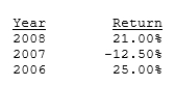
(Multiple Choice)
4.9/5 (78)
(78) The Y-axis intercept of the SML represents the required return of a portfolio with a beta of zero, which is the risk-free rate.
(True/False)
4.7/5 (70)
(70) Stock A's beta is 1.5 and Stock B's beta is 0.5. Which of the following statements must be true about these securities? (Assume market equilibrium.)
(Multiple Choice)
4.9/5 (82)
(82) The CAPM is built on historic conditions, although in most cases we use expected future data in applying it. Because betas used in the CAPM are calculated using expected future data, they are not subject to changes in future volatility. This is one of the strengths of the CAPM.
(True/False)
4.8/5 (93)
(93) During the coming year, the market risk premium (rM − rRF), is expected to fall, while the risk-free rate, rRF, is expected to remain the same. Given this forecast, which of the following statements is CORRECT?
(Multiple Choice)
4.9/5 (74)
(74) Stock A has an expected return of 10% and a standard deviation of 20%. Stock B has an expected return of 13% and a standard deviation of 30%. The risk-free rate is 5% and the market risk premium, rM − rRF, is 6%. Assume that the market is in equilibrium. Portfolio AB has 50% invested in Stock A and 50% invested in Stock B. The returns of Stock A and Stock B are independent of one another, i.e., the correlation coefficient between them is zero. Which of the following statements is CORRECT?
(Multiple Choice)
4.7/5 (73)
(73) 
Filters
- Essay(0)
- Multiple Choice(0)
- Short Answer(0)
- True False(0)
- Matching(0)