



 Chat with AI
Exam 14: Glaciers, Shorelines, and Changing Sea Levels

Exam 1: The Nature of Geology110 Questions
Exam 2: Investigating Geologic Questions106 Questions
Exam 3: Plate Tectonics152 Questions
Exam 4: Earth Materials131 Questions
Exam 5: Igneous Environments147 Questions
Exam 6: Volcanoes and Volcanic Hazards186 Questions
Exam 7: Sedimentary Environments155 Questions
Exam 8: Deformation and Metamorphism144 Questions
Exam 9: Geologic Time126 Questions
Exam 10: Seafloor and Continental Margins105 Questions
Exam 11: Mountains, Basins, and Continents124 Questions
Exam 12: Earthquakes and Earths Interior119 Questions
Exam 13: Climate and Weathering109 Questions
Exam 14: Glaciers, Shorelines, and Changing Sea Levels109 Questions
Exam 15: Weathering, Soil, and Unstable Slopes92 Questions
Exam 16: Streams and Flooding137 Questions
Exam 17: Water Resources142 Questions
Exam 18: Energy and Mineral Resources95 Questions
Exam 19: Geology of the Solar System77 Questions
Select questions type


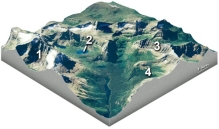

Which of the following is NOT an approach communities have tried to address shoreline problems?
(Multiple Choice)
4.9/5  (82)
(82) If the amount of ice on the planet increased to the amount that was present during the last glacial maximum, how much would it cause global sea level to fall? If you do not remember the approximate size of this rise, the volume of additional ice is 52,000,000 km3 and the surface area of the world's ocean is 361,000,000 km2.
(Multiple Choice)
4.9/5 (83)
(83) How can climate influence the processes along coastal landscapes
(Multiple Choice)
4.7/5 (91)
(91) Which numbered features) on this photograph are consistent with the presence of glaciers sometime in the past? 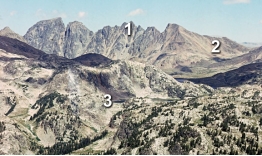
(Multiple Choice)
4.9/5 (89)
(89) What is one reason why the East Coast has so many bays and islands?
(Multiple Choice)
4.8/5 (74)
(74) What is probably the least expensive approach for avoiding shoreline hazards?
(Multiple Choice)
4.8/5 (70)
(70) 
Filters
- Essay(0)
- Multiple Choice(0)
- Short Answer(0)
- True False(0)
- Matching(0)