



 Chat with AI
Exam 6: Volcanoes and Volcanic Hazards

Exam 1: The Nature of Geology110 Questions
Exam 2: Investigating Geologic Questions106 Questions
Exam 3: Plate Tectonics152 Questions
Exam 4: Earth Materials131 Questions
Exam 5: Igneous Environments147 Questions
Exam 6: Volcanoes and Volcanic Hazards186 Questions
Exam 7: Sedimentary Environments155 Questions
Exam 8: Deformation and Metamorphism144 Questions
Exam 9: Geologic Time126 Questions
Exam 10: Seafloor and Continental Margins105 Questions
Exam 11: Mountains, Basins, and Continents124 Questions
Exam 12: Earthquakes and Earths Interior119 Questions
Exam 13: Climate and Weathering109 Questions
Exam 14: Glaciers, Shorelines, and Changing Sea Levels109 Questions
Exam 15: Weathering, Soil, and Unstable Slopes92 Questions
Exam 16: Streams and Flooding137 Questions
Exam 17: Water Resources142 Questions
Exam 18: Energy and Mineral Resources95 Questions
Exam 19: Geology of the Solar System77 Questions
Select questions type


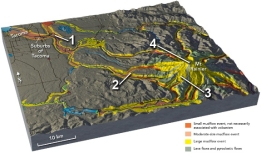
Which of the following is NOT true about shield volcanoes in the landscape?
(Multiple Choice)
4.9/5  (95)
(95) 
Which of the following was common to the eruptions of Vesuvius, Mount Pelée and Mount St. Helens?
(Multiple Choice)
4.9/5 (88)
(88) The typical shape of most volcanoes, including the one shown here, is: 
(Multiple Choice)
4.9/5 (65)
(65) This volcano is relatively small and composed of volcanic cinders. What kind of volcano is it? 
(Multiple Choice)
4.7/5 (84)
(84) 
This relatively large, symmetrical volcano contains interlayered lava flow, pyroclastic deposits, and volcanic mudflows. What kind of volcano is it? 
(Multiple Choice)
5.0/5 (83)
(83) Compared to a younger scoria cone, an older scoria cone would have:
(Multiple Choice)
4.7/5 (81)
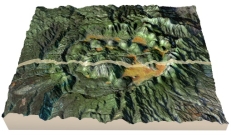
(81) What type of eruption formed this unit composed of volcanic blocks and volcanic ash? 
(Multiple Choice)
4.8/5 (80)
(80) 

A lava solidifies into nonvesicular basalt instead of vesicular basalt because:
(Multiple Choice)
4.8/5 (73)
(73) Which of the following sites would most likely have less dangerous volcanoes? A is on an island arc, B is in the Andes, C is near Hawaii, D is along a mid-ocean ridge. 
(Multiple Choice)
4.9/5 (69)
(69) Volcanic domes commonly form from all of the following rocks except:
(Multiple Choice)
4.8/5 (69)
(69) Volcanic domes grow from lava being injected into the interior of mounds of cooled lava and from the breaking out and moving down the flanks of:
(Multiple Choice)
4.8/5 (81)
(81) 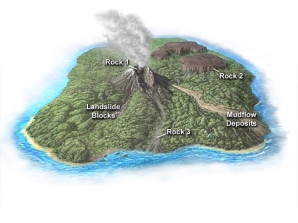
What is the interpreted origin for magma that forms flood basalts?
(Multiple Choice)
5.0/5 (75)
(75) 

Filters
- Essay(0)
- Multiple Choice(0)
- Short Answer(0)
- True False(0)
- Matching(0)