



 Chat with AI
Exam 3: Plate Tectonics

Exam 1: The Nature of Geology110 Questions
Exam 2: Investigating Geologic Questions106 Questions
Exam 3: Plate Tectonics152 Questions
Exam 4: Earth Materials131 Questions
Exam 5: Igneous Environments147 Questions
Exam 6: Volcanoes and Volcanic Hazards186 Questions
Exam 7: Sedimentary Environments155 Questions
Exam 8: Deformation and Metamorphism144 Questions
Exam 9: Geologic Time126 Questions
Exam 10: Seafloor and Continental Margins105 Questions
Exam 11: Mountains, Basins, and Continents124 Questions
Exam 12: Earthquakes and Earths Interior119 Questions
Exam 13: Climate and Weathering109 Questions
Exam 14: Glaciers, Shorelines, and Changing Sea Levels109 Questions
Exam 15: Weathering, Soil, and Unstable Slopes92 Questions
Exam 16: Streams and Flooding137 Questions
Exam 17: Water Resources142 Questions
Exam 18: Energy and Mineral Resources95 Questions
Exam 19: Geology of the Solar System77 Questions
Select questions type


Select the statement that best describes how the process of plate tectonics circulates materials between the asthenosphere and the lithosphere.
(Multiple Choice)
4.9/5  (97)
(97) On the accompanying figure, which letter is over the oldest oceanic crust? 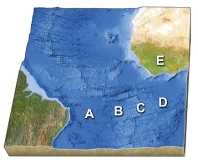
(Multiple Choice)
5.0/5 (95)
(95) The main reason why the hypothesis of continental drift was not widely accepted was:
(Multiple Choice)
4.9/5 (89)
(89) On this map of the South Atlantic, which letter is on an oceanic fracture zone? 
(Multiple Choice)
4.8/5 (92)
(92) On the accompanying map, earthquakes are least likely at locations: 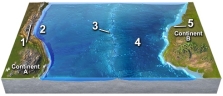
(Multiple Choice)
4.7/5 (69)
(69) The safest place for humans to live, away from volcanic activity and earthquakes, is: 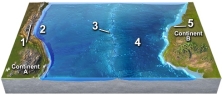
(Multiple Choice)
4.8/5 (82)
(82) This diagram shows magnetic stripes on either side of the mid-ocean ridge. How many different ages of stripes are represented in this diagram? 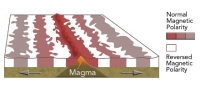
(Multiple Choice)
4.8/5 (80)
(80) 
Filters
- Essay(0)
- Multiple Choice(0)
- Short Answer(0)
- True False(0)
- Matching(0)