Exam 5: Analytic Trigonometry

arrow
  • Select Tags
search iconSearch Question
  • Select Tags

Determine which of the following are trigonometric identities. cos⁡(4x)−cos⁡(2x)2tan⁡(3x)=−tan⁡(x)\frac { \cos ( 4 x ) - \cos ( 2 x ) } { 2 \tan ( 3 x ) } = - \tan ( x ) cos⁡(3x)−cos⁡(x)sin⁡(3x)−sin⁡(x)=−tan⁡(2x)\frac { \cos ( 3 x ) - \cos ( x ) } { \sin ( 3 x ) - \sin ( x ) } = - \tan ( 2 x ) cos⁡(6x)−cos⁡(2x)sin⁡(4x)+sin⁡(2x)=−tan⁡(3x\frac { \cos ( 6 x ) - \cos ( 2 x ) } { \sin ( 4 x ) + \sin ( 2 x ) } = - \tan ( 3 x

(Multiple Choice)
4.9/5
(76)

Verify the given identity. sin⁡5x+sin⁡3xcos⁡5x+cos⁡3x=tan⁡4x\frac { \sin 5 x + \sin 3 x } { \cos 5 x + \cos 3 x } = \tan 4 x

(Essay)
4.8/5
(73)

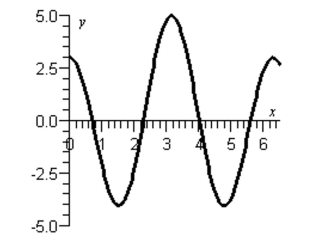
Approximate the solutions of the equation 2sin⁡2(x)=2cos⁡(x)+12 \sin ^ { 2 } ( x ) = 2 \cos ( x ) + 1 by considering its graph below. Round your answer to one decimal.  Approximate the solutions of the equation  2 \sin ^ { 2 } ( x ) = 2 \cos ( x ) + 1  by considering its graph below. Round your answer to one decimal.
(Multiple Choice)
4.8/5
(81)

Use the product-to-sum formula to write the given product as a sum or difference. 6sin⁡π8cos⁡π86 \sin \frac { \pi } { 8 } \cos \frac { \pi } { 8 }

(Multiple Choice)
4.8/5
(85)

Determine the exact value of the following expression. cos⁡(120∘−0∘)\cos \left( 120 ^ { \circ } - 0 ^ { \circ } \right)

(Multiple Choice)
4.9/5
(66)

Write the given expression as the sine of an angle. sin⁡75∘cos⁡35∘−sin⁡35∘cos⁡75∘\sin 75 ^ { \circ } \cos 35 ^ { \circ } - \sin 35 ^ { \circ } \cos 75 ^ { \circ }

(Multiple Choice)
4.7/5
(81)

Solve the following equation. 3csc⁡2(x)−4=03 \csc ^ { 2 } ( x ) - 4 = 0

(Multiple Choice)
4.8/5
(84)

Find the exact value of tan⁡(u+v)\tan ( u + v ) given that sin⁡u=−1161\sin u = - \frac { 11 } { 61 } and cos⁡v=4041\cos v = \frac { 40 } { 41 } . (Both uu and vv are in Quadrant IV.)

(Multiple Choice)
4.7/5
(89)

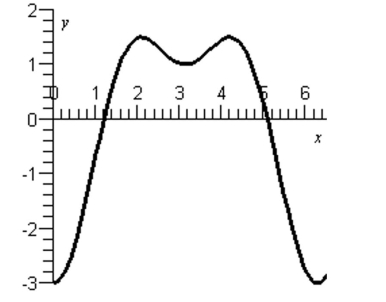
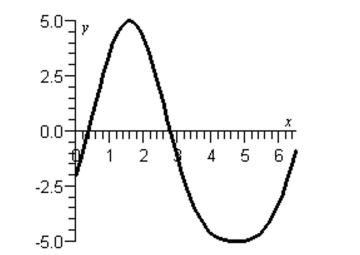
Approximate the solutions of the equation 2sin⁡2(x)+5sin⁡(x)−2=02 \sin ^ { 2 } ( x ) + 5 \sin ( x ) - 2 = 0 by considering its graph below. Round your answer to one decimal.  Approximate the solutions of the equation  2 \sin ^ { 2 } ( x ) + 5 \sin ( x ) - 2 = 0  by considering its graph below. Round your answer to one decimal.

(Multiple Choice)
4.8/5
(86)

Verify the identity shown below. tan⁡θ+1sec⁡θ+csc⁡θ=sin⁡θ\frac { \tan \theta + 1 } { \sec \theta + \csc \theta } = \sin \theta

(Essay)
4.8/5
(96)

Verify the given identity. sin⁡u+sin⁡vcos⁡u+cos⁡v=tan⁡12(u+v)\frac { \sin u + \sin v } { \cos u + \cos v } = \tan \frac { 1 } { 2 } ( u + v )

(Essay)
4.8/5
(70)

Find the exact value of tan⁡(u+v)\tan ( u + v ) given that sin⁡u=−725\sin u = - \frac { 7 } { 25 } and cos⁡v=1213\cos v = \frac { 12 } { 13 } . (Both uu and vv are in Quadrant IV.)

(Multiple Choice)
4.8/5
(92)

Multiply; then use fundamental identities to simplify the expression below and determine which of the following is not equivalent. (sin⁡x+cos⁡x)(sin⁡x−cos⁡x)( \sin x + \cos x ) ( \sin x - \cos x )

(Multiple Choice)
4.9/5
(93)

Find the exact value of cos⁡(u+v)\cos ( u + v ) given that sin⁡u=941\sin u = \frac { 9 } { 41 } and cos⁡v=−1517\cos v = - \frac { 15 } { 17 } . (Both uu and vv are in Quadrant II.)

(Multiple Choice)
4.8/5
(102)

Use the sum-to-product formulas to write the given expression as a product. cos⁡8θ−cos⁡6θ\cos 8 \theta - \cos 6 \theta

(Multiple Choice)
4.7/5
(80)

Use the graph below of the function to approximate the solutions to 4cos⁡(2x)−cos⁡(x)=04 \cos ( 2 x ) - \cos ( x ) = 0 in the interval [0,2π)[ 0,2 \pi ) . Round your answers to one decimal.  Use the graph below of the function to approximate the solutions to  4 \cos ( 2 x ) - \cos ( x ) = 0  in the interval  [ 0,2 \pi ) . Round your answers to one decimal.

(Multiple Choice)
4.9/5
(86)

Solve the multi-angle equation below. sin⁡(2x)=32\sin ( 2 x ) = \frac { \sqrt { 3 } } { 2 }

(Multiple Choice)
4.7/5
(71)

Determine which of the following are trigonometric identities. I. cos⁡(4x)+cos⁡(2x)2cot⁡(3x)=cot⁡(x)\frac { \cos ( 4 x ) + \cos ( 2 x ) } { 2 \cot ( 3 x ) } = \cot ( x ) II. cos⁡(4x)+cos⁡(x)sin⁡(3x)−sin⁡(x)=cot⁡(2x)\frac { \cos ( 4 x ) + \cos ( x ) } { \sin ( 3 x ) - \sin ( x ) } = \cot ( 2 x ) III. cos⁡(6x)+cos⁡(2x)sin⁡(4x)+sin⁡(2x)=cot⁡(3x)\frac { \cos ( 6 x ) + \cos ( 2 x ) } { \sin ( 4 x ) + \sin ( 2 x ) } = \cot ( 3 x )

(Multiple Choice)
4.8/5
(64)

Verify the identity shown below. sec⁡2μ−cot⁡2(π2−μ)=1\sec ^ { 2 } \mu - \cot ^ { 2 } \left( \frac { \pi } { 2 } - \mu \right) = 1

(Essay)
5.0/5
(84)

Factor; then use fundamental identities to simplify the expression below and determine which of the following is not equivalent. sin⁡3x−sin⁡2x−sin⁡x+1\sin ^ { 3 } x - \sin ^ { 2 } x - \sin x + 1

(Multiple Choice)
4.9/5
(90)
Showing 101 - 120 of 120
close modal

Filters

  • Essay(0)
  • Multiple Choice(0)
  • Short Answer(0)
  • True False(0)
  • Matching(0)