Exam 5: Analytic Trigonometry

arrow
  • Select Tags
search iconSearch Question
  • Select Tags

Solve the multi-angle equation below. cos⁡(x2)=22\cos \left( \frac { x } { 2 } \right) = \frac { \sqrt { 2 } } { 2 }

(Multiple Choice)
4.9/5
(83)

Find the exact value of cos⁡(u+v)\cos ( u + v ) given that sin⁡u=1161\sin u = \frac { 11 } { 61 } and cos⁡v=−4041\cos v = - \frac { 40 } { 41 } . (Both uu and vv are in Quadrant II.)

(Multiple Choice)
4.9/5
(78)

Multiply; then use fundamental identities to simplify the expression below and determine which of the following is not equivalent. (sin⁡x+cos⁡x)(sin⁡x−cos⁡x)( \sin x + \cos x ) ( \sin x - \cos x )

(Multiple Choice)
4.8/5
(70)

Verify the identity shown below. 1+tan⁡θ1+cot⁡θ=tan⁡θ\frac { 1 + \tan \theta } { 1 + \cot \theta } = \tan \theta

(Essay)
4.8/5
(91)

Determine which of the following are trigonometric identities. I. cos⁡(t)−cos⁡(s)sin⁡(t)+sin⁡(s)+sin⁡(t)−sin⁡(s)cos⁡(t)+cos⁡(s)=0\frac { \cos ( \mathrm { t } ) - \cos ( \mathrm { s } ) } { \sin ( \mathrm { t } ) + \sin ( \mathrm { s } ) } + \frac { \sin ( \mathrm { t } ) - \sin ( \mathrm { s } ) } { \cos ( \mathrm { t } ) + \cos ( \mathrm { s } ) } = 0 II. cos⁡(t)+cos⁡(s)sin⁡(t)+sin⁡(s)+sin⁡(t)+sin⁡(s)cos⁡(t)+cos⁡(s)=1\frac { \cos ( \mathrm { t } ) + \cos ( \mathrm { s } ) } { \sin ( \mathrm { t } ) + \sin ( \mathrm { s } ) } + \frac { \sin ( \mathrm { t } ) + \sin ( \mathrm { s } ) } { \cos ( \mathrm { t } ) + \cos ( \mathrm { s } ) } = 1 III. cos⁡(t)+sin⁡(s)cos⁡(t)sin⁡(s)=cos⁡(s)+sin⁡(t)\frac { \cos ( \mathrm { t } ) + \sin ( \mathrm { s } ) } { \cos ( \mathrm { t } ) \sin ( \mathrm { s } ) } = \cos ( \mathrm { s } ) + \sin ( \mathrm { t } )

(Multiple Choice)
4.8/5
(82)

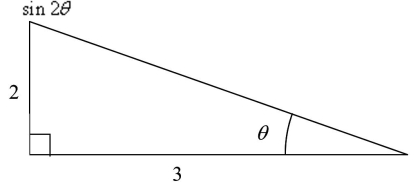
Use the figure below to determine the exact value of the given function. Use the figure below to determine the exact value of the given function.
(Multiple Choice)
4.9/5
(92)

Find the exact value of tan⁡(u+v)\tan ( u + v ) given that sin⁡u=−35\sin u = - \frac { 3 } { 5 } and cos⁡v=2425\cos v = \frac { 24 } { 25 } . (Both uu and vv are in Quadrant IV.)

(Multiple Choice)
4.7/5
(70)

Use the product-to-sum formula to write the given product as a sum or difference. 10sin⁡π8cos⁡π810 \sin \frac { \pi } { 8 } \cos \frac { \pi } { 8 }

(Multiple Choice)
4.7/5
(74)

Use the trigonometric substitution x=8sec⁡(θ)x = 8 \sec ( \theta ) to write the expression x2−64\sqrt { x ^ { 2 } - 64 } as a trigonometric function of θ\theta , where 0<θ<π20 < \theta < \frac { \pi } { 2 } .

(Multiple Choice)
4.9/5
(100)

Determine which of the following are trigonometric identities. I. sin⁡(x)−sin⁡(y)cos⁡(x)+cos⁡(y)+cos⁡(x)−cos⁡(y)sin⁡(x)+sin⁡(y)=0\frac { \sin ( x ) - \sin ( y ) } { \cos ( x ) + \cos ( y ) } + \frac { \cos ( x ) - \cos ( y ) } { \sin ( x ) + \sin ( y ) } = 0 II. sin⁡(x)+sin⁡(y)cos⁡(x)+cos⁡(y)+cos⁡(x)+cos⁡(y)sin⁡(x)+sin⁡(y)=1\frac { \sin ( \mathrm { x } ) + \sin ( \mathrm { y } ) } { \cos ( \mathrm { x } ) + \cos ( \mathrm { y } ) } + \frac { \cos ( \mathrm { x } ) + \cos ( \mathrm { y } ) } { \sin ( \mathrm { x } ) + \sin ( \mathrm { y } ) } = 1 III. sin⁡(x)+cos⁡(y)sin⁡(x)cos⁡(y)=sin⁡(y)+cos⁡(x)\frac { \sin ( \mathrm { x } ) + \cos ( \mathrm { y } ) } { \sin ( \mathrm { x } ) \cos ( \mathrm { y } ) } = \sin ( \mathrm { y } ) + \cos ( \mathrm { x } )

(Multiple Choice)
5.0/5
(65)

Find all solutions of the following equation in the interval [0,2π)[ 0,2 \pi ) . csc⁡2x=cot⁡x+1\csc ^ { 2 } x = \cot x + 1

(Multiple Choice)
4.9/5
(86)

Find all solutions of the following equation in the interval [0,2π)[ 0,2 \pi ) . 2cos⁡2x=2+sin⁡x2 \cos ^ { 2 } x = 2 + \sin x

(Multiple Choice)
5.0/5
(77)

Write the given expression as the cosine of an angle. cos⁡30∘cos⁡50∘+sin⁡30∘sin⁡50∘\cos 30 ^ { \circ } \cos 50 ^ { \circ } + \sin 30 ^ { \circ } \sin 50 ^ { \circ }

(Multiple Choice)
4.8/5
(88)

Expand the expression below and use fundamental trigonometric identities to simplify. (sin⁡(ω)+cos⁡(ω))2( \sin ( \omega ) + \cos ( \omega ) ) ^ { 2 }

(Multiple Choice)
4.8/5
(98)

Rewrite the expression sin⁡(y)1−cos⁡(y)\frac { \sin ( y ) } { 1 - \cos ( y ) } so that it is not in fractional form.

(Multiple Choice)
4.9/5
(69)

Factor; then use fundamental identities to simplify the expression below and determine which of the following is not equivalent. cot⁡2α−cot⁡2αcos⁡2α\cot ^ { 2 } \alpha - \cot ^ { 2 } \alpha \cos ^ { 2 } \alpha

(Multiple Choice)
4.9/5
(86)

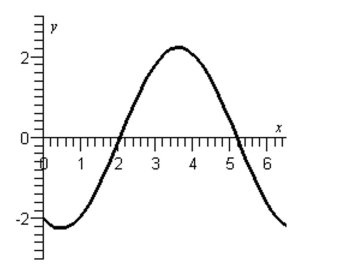
Use the graph below to approximate the solutions of the equation −2cos⁡(x)−sin⁡(x)=0- 2 \cos ( x ) - \sin ( x ) = 0 on the interval [0,2π)[ 0,2 \pi ) . Round your answer to one decimal.  Use the graph below to approximate the solutions of the equation  - 2 \cos ( x ) - \sin ( x ) = 0  on the interval  [ 0,2 \pi ) . Round your answer to one decimal.

(Multiple Choice)
4.7/5
(83)

Determine which of the following are trigonometric identities. I. cos⁡4(t)+sin⁡4(t)=1−2sin⁡2(t)+2sin⁡4(t)\cos ^ { 4 } ( \mathrm { t } ) + \sin ^ { 4 } ( \mathrm { t } ) = 1 - 2 \sin ^ { 2 } ( \mathrm { t } ) + 2 \sin ^ { 4 } ( \mathrm { t } ) II. sin⁡5(t)=sin⁡3(t)cos⁡2(t)−sin⁡3(t)\sin ^ { 5 } ( \mathrm { t } ) = \sin ^ { 3 } ( \mathrm { t } ) \cos ^ { 2 } ( \mathrm { t } ) - \sin ^ { 3 } ( \mathrm { t } ) III. sin⁡3(t)cos⁡2(t)=(cos⁡2(t)−cos⁡4(t))sin⁡(t)\sin ^ { 3 } ( \mathrm { t } ) \cos ^ { 2 } ( \mathrm { t } ) = \left( \cos ^ { 2 } ( \mathrm { t } ) - \cos ^ { 4 } ( \mathrm { t } ) \right) \sin ( \mathrm { t } )

(Multiple Choice)
4.8/5
(88)

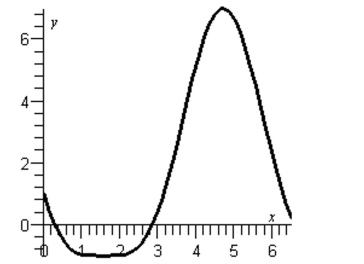
Approximate the solutions of the equation 2sin⁡2(x)−4sin⁡(x)+1=02 \sin ^ { 2 } ( x ) - 4 \sin ( x ) + 1 = 0 by considering its graph below. Round your answer to one decimal.  Approximate the solutions of the equation  2 \sin ^ { 2 } ( x ) - 4 \sin ( x ) + 1 = 0  by considering its graph below. Round your answer to one decimal.
(Multiple Choice)
4.8/5
(90)

If sin⁡x=12\sin x = \frac { 1 } { 2 } and cos⁡x=32\cos x = \frac { \sqrt { 3 } } { 2 } , evaluate the following function. csc⁡x\csc x

(Multiple Choice)
4.8/5
(84)
Showing 81 - 100 of 120
close modal

Filters

  • Essay(0)
  • Multiple Choice(0)
  • Short Answer(0)
  • True False(0)
  • Matching(0)