Exam 5: Analytic Trigonometry

arrow
  • Select Tags
search iconSearch Question
  • Select Tags

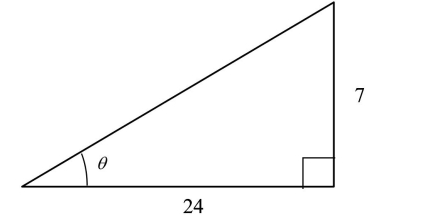
Use the figure below to find the exact value of the given trigonometric expression. cot⁡x2\cot \frac { x } { 2 }  Use the figure below to find the exact value of the given trigonometric expression.  \cot \frac { x } { 2 }
(Multiple Choice)
4.9/5
(88)

Which of the following is a solution to the given equation? sec⁡x−2=0\sec x - 2 = 0

(Multiple Choice)
4.7/5
(79)

Solve the multiple-angle equation in the interval [0,2π)[ 0,2 \pi ) . sec⁡2x=2\sec 2 x = 2

(Multiple Choice)
4.8/5
(81)

Use the half-angle formula to simplify the given expression. 1+cos⁡16x2\sqrt { \frac { 1 + \cos 16 x } { 2 } }

(Multiple Choice)
4.7/5
(71)

Use fundamental identities to simplify the expression below and then determine which of the following is not equivalent. sin⁡α(csc⁡α−sin⁡α)\sin \alpha ( \csc \alpha - \sin \alpha )

(Multiple Choice)
4.9/5
(69)

Determine which of the following are trigonometric identities. I. sin⁡(θ)+cot⁡(θ)cos⁡(θ)=csc⁡(θ)\sin ( \theta ) + \cot ( \theta ) \cos ( \theta ) = \csc ( \theta ) II. cot⁡(θ)−sin⁡(θ)cos⁡(θ)=0\cot ( \theta ) - \sin ( \theta ) \cos ( \theta ) = 0 III. sin⁡(θ)+sin⁡(θ)cos⁡(θ)=csc⁡(θ)\sin ( \theta ) + \sin ( \theta ) \cos ( \theta ) = \csc ( \theta )

(Multiple Choice)
4.8/5
(81)

Which of the following is a solution to the given equation? 2sin⁡x−1=02 \sin x - 1 = 0

(Multiple Choice)
4.8/5
(84)

If x=8cos⁡θx = 8 \cos \theta , use trigonometric substitution to write 64−x2\sqrt { 64 - x ^ { 2 } } as a trigonometric function of θ\theta , where 0<θ<π0 < \theta < \pi .

(Multiple Choice)
4.9/5
(78)

Solve the following equation. tan⁡2x+tan⁡x=0\tan ^ { 2 } x + \tan x = 0

(Multiple Choice)
4.7/5
(75)

Verify the identity shown below. sec⁡2(π2−y)−1=cot⁡2y\sec ^ { 2 } \left( \frac { \pi } { 2 } - y \right) - 1 = \cot ^ { 2 } y

(Essay)
4.9/5
(83)

Determine which of the following are trigonometric identities. I. sin⁡(t)+sin⁡(s)cos⁡(t)−cos⁡(s)+cos⁡(t)+cos⁡(s)sin⁡(t)−sin⁡(s)=0\frac { \sin ( t ) + \sin ( s ) } { \cos ( t ) - \cos ( s ) } + \frac { \cos ( t ) + \cos ( s ) } { \sin ( t ) - \sin ( s ) } = 0 II. sin⁡(t)+sin⁡(s)cos⁡(t)+cos⁡(s)+cos⁡(t)+cos⁡(s)sin⁡(t)+sin⁡(s)=1\frac { \sin ( \mathrm { t } ) + \sin ( \mathrm { s } ) } { \cos ( \mathrm { t } ) + \cos ( \mathrm { s } ) } + \frac { \cos ( \mathrm { t } ) + \cos ( \mathrm { s } ) } { \sin ( \mathrm { t } ) + \sin ( \mathrm { s } ) } = 1 III. sin⁡(t)+cos⁡(s)sin⁡(t)cos⁡(s)=sin⁡(s)+cos⁡(t)\frac { \sin ( \mathrm { t } ) + \cos ( \mathrm { s } ) } { \sin ( \mathrm { t } ) \cos ( \mathrm { s } ) } = \sin ( \mathrm { s } ) + \cos ( \mathrm { t } )

(Multiple Choice)
4.8/5
(77)

Factor; then use fundamental identities to simplify the expression below and determine which of the following is not equivalent. tan⁡3x−tan⁡2x+tan⁡x−1\tan ^ { 3 } x - \tan ^ { 2 } x + \tan x - 1

(Multiple Choice)
4.9/5
(86)

If csc⁡x=433\csc x = \frac { 4 \sqrt { 3 } } { 3 } and cos⁡x<0\cos x < 0 , evaluate the function below. sec⁡x\sec x

(Multiple Choice)
5.0/5
(72)

Find the exact solutions of the given equation in the interval [0,2π)[ 0,2 \pi ) . sin⁡2x=sin⁡x\sin 2 x = \sin x

(Multiple Choice)
4.7/5
(78)

Determine which of the following are trigonometric identities. I. sin⁡(y)−sin⁡(x)cos⁡(y)+cos⁡(x)+cos⁡(y)−cos⁡(x)sin⁡(y)+sin⁡(x)=0\frac { \sin ( y ) - \sin ( x ) } { \cos ( y ) + \cos ( x ) } + \frac { \cos ( y ) - \cos ( x ) } { \sin ( y ) + \sin ( x ) } = 0 II. sin⁡(y)+sin⁡(x)cos⁡(y)+cos⁡(x)+cos⁡(y)+cos⁡(x)sin⁡(y)+sin⁡(x)=1\frac { \sin ( y ) + \sin ( x ) } { \cos ( y ) + \cos ( x ) } + \frac { \cos ( y ) + \cos ( x ) } { \sin ( y ) + \sin ( x ) } = 1 III. sin⁡(y)+cos⁡(x)sin⁡(y)cos⁡(x)=sin⁡(x)+cos⁡(y)\frac { \sin ( y ) + \cos ( x ) } { \sin ( y ) \cos ( x ) } = \sin ( x ) + \cos ( y )

(Multiple Choice)
4.9/5
(77)

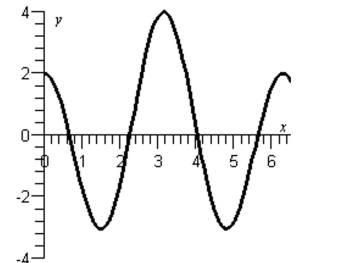
Use the graph below of the function to approximate the solutions to 3cos⁡(2x)−cos⁡(x)=03 \cos ( 2 x ) - \cos ( x ) = 0 in the interval [0,2π)[ 0,2 \pi ) . Round your answers to one decimal.  Use the graph below of the function to approximate the solutions to  3 \cos ( 2 x ) - \cos ( x ) = 0  in the interval  [ 0,2 \pi ) . Round your answers to one decimal.

(Multiple Choice)
5.0/5
(85)

Solve the multiple-angle equation in the interval [0,2π)[ 0,2 \pi ) . tan⁡2x=−1\tan 2 x = - 1

(Multiple Choice)
4.8/5
(68)

Verify the identity shown below. 1sec⁡θ−tan⁡θ=sec⁡θ+tan⁡θ\frac { 1 } { \sec \theta - \tan \theta } = \sec \theta + \tan \theta

(Essay)
4.9/5
(80)

Verify the identity shown below. (1+cot⁡2θ)tan⁡2θ=sec⁡2θ\left( 1 + \cot ^ { 2 } \theta \right) \tan ^ { 2 } \theta = \sec ^ { 2 } \theta

(Essay)
5.0/5
(75)

Which of the following is a solution to the given equation? 2cos⁡x+3=02 \cos x + \sqrt { 3 } = 0

(Multiple Choice)
4.8/5
(80)
Showing 41 - 60 of 120
close modal

Filters

  • Essay(0)
  • Multiple Choice(0)
  • Short Answer(0)
  • True False(0)
  • Matching(0)