



 Chat with AI
Exam 13: Investment Centers and Transfer Pricing

Exam 1: The Changing Role of Managerial Accounting in a Dynamic Business Environment85 Questions
Exam 2: Basic Cost Management Concepts115 Questions
Exam 3: Product Costing and Cost Accumulation in a Batch Production Environment95 Questions
Exam 4: Process Costing and Hybrid Product-Costing Systems88 Questions
Exam 5: Activity-Based Costing and Management103 Questions
Exam 6: Activity Analysis, Cost Behavior, and Cost Estimation90 Questions
Exam 7: Cost-Volume-Profit Analysis109 Questions
Exam 8: Variable Costing and the Costs of Quality and Sustainability74 Questions
Exam 9: Financial Planning and Analysis: the Master Budget112 Questions
Exam 10: Standard Costing and Analysis of Direct Costs97 Questions
Exam 11: Flexible Budgeting and Analysis of Overhead Costs89 Questions
Exam 12: Responsibility Accounting, Operational Performance Measures, and the Balanced Scorecard89 Questions
Exam 13: Investment Centers and Transfer Pricing101 Questions
Exam 14: Decision Making: Relevant Costs and Benefits96 Questions
Exam 15: Target Costing and Cost Analysis for Pricing Decisions107 Questions
Exam 16: Capital Expenditure Decisions120 Questions
Exam 17: Allocation of Support Activity Costs and Joint Costs81 Questions
Exam 18: The Sarbanes-Oxley Act, Internal Controls, and Management Accounting20 Questions
Exam 19: Compound Interest and the Concept of Present Value27 Questions
Exam 20: Inventory Management20 Questions
Select questions type


Which of the following performance measures is (are) used to evaluate the general financial success or failure of investment centers?
(Multiple Choice)
4.8/5  (78)
(78) Overton Company uses cost-based transfer pricing. Its Food Processing Division has a standard variable cost of $8.50 per case and allocated fixed overhead of $2.25. The Processing Division, which has excess capacity, sells its output to external customers for $12.00 per case.
- If Overton uses variable costs as its base, the transfer price charged to its Retail Division should be:
(Multiple Choice)
4.7/5 (82)
(82) Carson, Inc., which produces electronic parts in the United States, has a very strong local market for part no. 54. The variable production cost is $40, and the company can sell its entire supply domestically for $110. The U.S. tax rate is 30%.
Alternatively, Carson can ship the part to a division that is located in Switzerland, to be used in a product that the Swiss division will distribute throughout Europe. Information about the Swiss product and the division's operating environment follows:
Selling price of final product: $400
Shipping fees to import part no. 54: $20
Labor, overhead, and additional material costs of final product: $230
Import duties levied on part no. 54 (to be paid by the Swiss division): 10% of transfer price
Swiss tax rate: 40%
Based on U.S. and Swiss tax laws, the company has established a transfer price for part no. 54 equal to the U.S. market price. Assume that the Swiss division can obtain part no. 54 in Switzerland for $125.
Required:
A. If you were the head of the Swiss division, would you be better off financially to conduct business with your U.S. division or buy part no. 54 locally? Why? Show computations.
B. Carson's accounting department has figured that the company will make $66.40 for each unit transferred and used in the Swiss division's product. Rather than proceed with a transfer, would Carson be better off to sell its goods domestically and allow the Swiss division to acquire part no. 54 in Switzerland? Show computations for both U.S. and Swiss operations to support your answer.
C. Generally speaking, when tax rates differ between countries, what income strategy should a company use in setting its transfer prices? If the seller is in a low tax-rate country, what type of price should it set? Why?
(Essay)
4.9/5 (86)
(86) A division's return on investment may be improved by increasing sales margin and cost of capital.
(True/False)
4.9/5 (83)
(83) To partially eliminate the problems that are associated with the short-term focus of return on investment, residual income, and EVA, the performance of a division's major investments is commonly evaluated through:
(Multiple Choice)
4.8/5 (56)
(56) Return on investment (ROI) is a very popular tool to evaluate performance. The measurement of ROI is dependent, in part, on whether fixed assets are valued at acquisition cost or net book value.
List several advantages of acquisition cost and net book value as ways to value long-lived assets.
(Essay)
4.9/5 (75)
(75) The Nashville Division of Country Classics currently reports a profit of $3.6 million. Divisional invested capital totals $9.5 million; the imputed interest rate is 12%. On the basis of this information, Nashville's residual income is:
(Multiple Choice)
4.8/5 (79)
(79) Gamma Division of Fava Corporation produces electric motors, 20% of which are sold to Fava's Omega Division and 80% to outside customers. Fava treats its divisions as profit centers and allows division managers to choose whether to sell to or buy from internal divisions. Corporate policy requires that all interdivisional sales and purchases be transferred at variable cost. Gamma Division's estimated sales and standard cost data for the year ended December 31, based on a capacity of 60,000 units, are as follows:
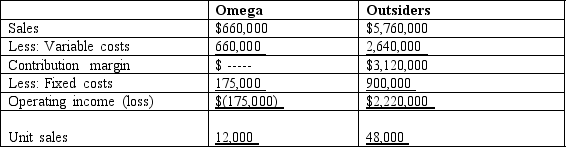 Gamma has an opportunity to sell the 12,000 units shown above to an outside customer at $80 per unit. Omega can purchase the units it needs from an outside supplier for $92 each.
Required:
A. Assuming that Gamma desires to maximize operating income, should it take on the new customer and discontinue sales to Omega? Why? (Note: Answer this question from Gamma's perspective.)
B. Assume that Fava allows division managers to negotiate transfer prices. The managers agreed on a tentative price of $80 per unit, to be reduced by an equal sharing of the additional Gamma income that results from the sale to Omega of 12,000 motors at $80 per unit. On the basis of this information, compute the company's new transfer price.
Gamma has an opportunity to sell the 12,000 units shown above to an outside customer at $80 per unit. Omega can purchase the units it needs from an outside supplier for $92 each.
Required:
A. Assuming that Gamma desires to maximize operating income, should it take on the new customer and discontinue sales to Omega? Why? (Note: Answer this question from Gamma's perspective.)
B. Assume that Fava allows division managers to negotiate transfer prices. The managers agreed on a tentative price of $80 per unit, to be reduced by an equal sharing of the additional Gamma income that results from the sale to Omega of 12,000 motors at $80 per unit. On the basis of this information, compute the company's new transfer price. (Essay)
4.9/5 (89)
(89) The information that follows relates to Khan Corporation:
Sales margin: 7.5%
Capital turnover: 2
Invested capital: $20,000,000
On the basis of this information, the company's sales revenue is:
(Multiple Choice)
4.8/5 (79)
(79) Although the general rule for transfer prices is the outlay cost plus opportunity cost, many companies instead use negotiated prices to price their goods and services. When are negotiated transfer prices used? Are such prices consistent or inconsistent with responsibility accounting? Explain.
(Essay)
4.9/5 (86)
(86) Racine Corporation has excess capacity. If the firm desires to implement the general transfer-pricing rule, opportunity cost would be equal to:
(Multiple Choice)
4.8/5 (75)
(75) A general calculation method for transfer prices that achieves goal congruence begins with the additional outlay cost per unit incurred because goods are transformed and then
(Multiple Choice)
4.8/5 (85)
(85) Standard costs rather than actual costs should be used in transfer-pricing methods because:
(Multiple Choice)
4.9/5 (69)
(69) Buzz's Florida Division is currently purchasing a part from an outside supplier. The company's Georgia Division, which has excess capacity, makes and sells this part for external customers at a variable cost of $22 and a selling price of $34. If Georgia begins sales to Florida, it (1) will use the general transfer-pricing rule and (2) will be able to reduce variable cost on internal transfers by $4. If sales to outsiders will not be affected, Georgia would establish a transfer price of:
(Multiple Choice)
5.0/5 (90)
(90) The amounts charged for goods and services exchanged between two divisions are known as:
(Multiple Choice)
4.7/5 (79)
(79) ROI is most appropriately used to evaluate the performance of:
(Multiple Choice)
4.8/5 (84)
(84) One benefit of residual income is that it can be used to compare the performance of different-sized investment centers.
(True/False)
4.8/5 (66)
(66) Vello, Inc. reported a return on investment of 12%, a capital turnover of 5, and income of $180,000. On the basis of this information, the company's invested capital was:
(Multiple Choice)
4.9/5 (75)
(75) The following information relates to the Falcon Division of Xenon Enterprises:
 On the basis of this information, Falcon's weighted-average cost of capital is closest to:
 (Multiple Choice)
4.9/5 (74)
(74) Arlene Clanston, general manager of the Northwest Division of Blanton Enterprises, has significant authority over pricing decisions as well as programs that involve cost reduction/control. The data that follow relate to upcoming divisional operations:
Average invested capital: $15,000,000
Annual fixed costs: $3,900,000
Variable cost per unit: $80
Number of units expected to be sold: 120,000
Required:
A. Top management will promote Clanston if she can earn a 14% return on investment for the year. What unit selling price should she establish to get her promotion?
B. Independent of part "A," assume the unit selling price is $132 and that Blanton has a 16% imputed interest charge. Top management will promote Clanston to corporate headquarters if her division can generate $200,000 of residual income. If Clanston desires to move to corporate, what must the division do to the amount of annual fixed costs incurred? Show your calculations.
(Essay)
4.9/5 (87)
(87) 
Filters
- Essay(0)
- Multiple Choice(0)
- Short Answer(0)
- True False(0)
- Matching(0)