Exam 6: Analytic Trigonometry

arrow
  • Select Tags
search iconSearch Question
  • Select Tags

Use the information given about the angle θ, 0 ≤θ ≤ 2π, to find the exact value of the indicated trigonometric function. - cos⁡θ=−35,sin⁡θ>0\cos \theta = - \frac { 3 } { 5 } , \quad \sin \theta > 0 \quad Find cos⁡θ2\cos \frac { \theta } { 2 } .

(Multiple Choice)
4.7/5
(83)

Find the exact value of the expression. Do not use a calculator. - tan⁡−1[tan⁡(6π7)]\tan ^ { - 1 } \left[ \tan \left( \frac { 6 \pi } { 7 } \right) \right]

(Multiple Choice)
4.9/5
(78)

Solve the problem. -The formula D=24[1−cos⁡−1(tan⁡itan⁡θ)π]\mathrm { D } = 24 \left[ 1 - \frac { \cos ^ { - 1 } ( \tan \mathrm { i } \tan \theta ) } { \pi } \right] can be used to approximate the number of hours of daylight when the declination of the sun is i∘i ^ { \circ } at a location θ∘\theta ^ { \circ } latitude for any date between the vernal equinox and autumnal equinox. To use this formula, cos⁡−1\cos ^ { - 1 } (tan i tan θ\theta ) must be expressed in radians. Approximate the number of hours of daylight in Fargo, North Dakota, (4652'north latitude) for vernal equinox (i=0∘)\left( \mathrm { i } = 0 ^ { \circ } \right) . orth

(Short Answer)
4.8/5
(82)

Find the exact value of the expression. - sin⁡−1(0.5)\sin ^ { - 1 } ( 0.5 )

(Multiple Choice)
4.9/5
(79)

Find the exact value under the given conditions. - sin⁡α=35,π2<α<π;cos⁡β=25,0<β<π2\sin \alpha = \frac { 3 } { 5 } , \frac { \pi } { 2 } < \alpha < \pi ; \quad \cos \beta = \frac { 2 } { 5 } , 0 < \beta < \frac { \pi } { 2 } Find cos⁡(α−β)\cos ( \alpha - \beta )

(Multiple Choice)
4.7/5
(84)

Find the exact value of the expression. Do not use a calculator. - cos⁡−1[cos⁡(π10)]\cos ^ { - 1 } \left[ \cos \left( \frac { \pi } { 10 } \right) \right]

(Multiple Choice)
4.7/5
(81)

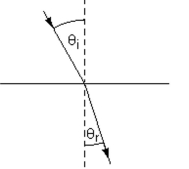
Solve the problem. -When light travels from one medium to another-from air to water, for instance-it changes direction. (This is why a pencil, partially submerged in water, looks as though it is bent.) The angle of incidence θi\theta _ { \mathrm { i } } is the angle in the first medium; the angle of refraction θr\theta _ { \mathrm { r } } is the second medium. (See illustration.) Each medium has an index of refraction −ni- n _ { i } and nrn _ { r } , respectively-which can be found in tables. Snell's law relates these quantities in the forr nisin⁡θi=nrsin⁡θr\mathrm { n } _ { \mathrm { i } } \sin \theta _ { \mathrm { i } } = \mathrm { n } _ { \mathrm { r } } \sin \theta _ { \mathrm { r } } Solving for θr\theta _ { r } , we obtain θr=sin⁡−1(ninrsin⁡θi)\theta _ { \mathrm { r } } = \sin ^ { - 1 } \left( \frac { \mathrm { n } _ { \mathrm { i } } } { \mathrm { n } _ { \mathrm { r } } } \sin \theta _ { \mathrm { i } } \right) Find θr\theta _ { \mathrm { r } } for crown glass (ni=1.52)\left( \mathrm { n } _ { \mathrm { i } } = 1.52 \right) , water( nr=1.33)\left. \mathrm { n } _ { \mathrm { r } } = 1.33 \right) , and θi=38∘\theta _ { \mathrm { i } } = 38 ^ { \circ } .  Solve the problem. -When light travels from one medium to another-from air to water, for instance-it changes direction. (This is why a pencil, partially submerged in water, looks as though it is bent.) The angle of incidence  \theta _ { \mathrm { i } }  is the angle in the first medium; the angle of refraction  \theta _ { \mathrm { r } }  is the second medium. (See illustration.) Each medium has an index of refraction  - n _ { i }  and  n _ { r } , respectively-which can be found in tables. Snell's law relates these quantities in the forr  \mathrm { n } _ { \mathrm { i } } \sin \theta _ { \mathrm { i } } = \mathrm { n } _ { \mathrm { r } } \sin \theta _ { \mathrm { r } }  Solving for  \theta _ { r } , we obtain  \theta _ { \mathrm { r } } = \sin ^ { - 1 } \left( \frac { \mathrm { n } _ { \mathrm { i } } } { \mathrm { n } _ { \mathrm { r } } } \sin \theta _ { \mathrm { i } } \right)  Find  \theta _ { \mathrm { r } }  for crown glass  \left( \mathrm { n } _ { \mathrm { i } } = 1.52 \right) , water(  \left. \mathrm { n } _ { \mathrm { r } } = 1.33 \right) , and  \theta _ { \mathrm { i } } = 38 ^ { \circ } .

(Essay)
4.8/5
(71)

Find the exact value of the expression. - sec⁡−1(2)\sec ^ { - 1 } ( \sqrt { 2 } )

(Multiple Choice)
4.8/5
(71)

Solve the problem. -Rewrite over a common denominator: 11−sin⁡θ+11+sin⁡θ\frac { 1 } { 1 - \sin \theta } + \frac { 1 } { 1 + \sin \theta }

(Essay)
4.9/5
(80)

Solve the equation on the interval 0≤θ<2π0 \leq \theta < 2 \pi - 6csc⁡θ−2=46 \csc \theta - 2 = 4

(Multiple Choice)
4.9/5
(88)

Solve the problem. -A weight is suspended on a system of spring and oscillates up and down according to P=0.1[3cos⁡(8t)−sin⁡(8t)]P = 0.1 [ 3 \cos ( 8 t ) - \sin ( 8 t ) ] where P is the position in meters above or below the point of equilibrium (P = 0) and t is time in seconds. Find the time when the weight is at equilibrium. Find all values of 0≤t≤10 \leq t \leq 1 1, rounded to the nearest 0.01 second.

(Short Answer)
4.8/5
(95)

Find the exact value of the expression. - sec⁡[sin⁡−1(−32)]\sec \left[ \sin ^ { - 1 } \left( - \frac { \sqrt { 3 } } { 2 } \right) \right]

(Multiple Choice)
4.8/5
(73)

Find the exact value of the expression.884:890 - cos⁡[sin⁡−123+2sin⁡−1(−13)]\cos \left[ \sin ^ { - 1 } \frac { 2 } { 3 } + 2 \sin ^ { - 1 } \left( - \frac { 1 } { 3 } \right) \right]

(Multiple Choice)
4.8/5
(72)

Find the exact value of the expression. - tan⁡−1(1)\tan ^ { - 1 } ( 1 )

(Multiple Choice)
4.9/5
(65)

Express the product as a sum containing only sines or cosines. - sin⁡(5θ)sin⁡(2θ)\sin ( 5 \theta ) \sin ( 2 \theta )

(Multiple Choice)
4.9/5
(86)

Complete the identity. - 2tan⁡θ−(1+tan⁡θ)2=?2 \tan \theta - ( 1 + \tan \theta ) ^ { 2 } = ?

(Multiple Choice)
4.8/5
(81)

Solve the equation on the interval 0≤θ<2π. 0 \leq \theta < 2 \pi \text {. } - 3sin⁡θ−cos⁡θ=−1\sqrt { 3 } \sin \theta - \cos \theta = - 1

(Multiple Choice)
4.7/5
(85)

Use a calculator to solve the equation on the interval 0 0≤θ<2π0 \leq \theta < 2 \pi . Round the answer to two decimal places. - sin⁡θ=0,29\sin \theta = 0,29

(Multiple Choice)
4.9/5
(75)

Find the exact value under the given conditions. - sin⁡α=725,0<α<π2;cos⁡β=2029,0<β<π2\sin \alpha = \frac { 7 } { 25 } , 0 < \alpha < \frac { \pi } { 2 } ; \quad \cos \beta = \frac { 20 } { 29 } , 0 < \beta < \frac { \pi } { 2 } \quad Find cos⁡(α+β)\cos ( \alpha + \beta ) .

(Multiple Choice)
4.9/5
(90)

Write the trigonometric expression as an algebraic expression in u. - sin⁡(csc⁡−1u)\sin \left( \csc ^ { - 1 } \mathrm { u } \right)

(Multiple Choice)
4.9/5
(79)
Showing 261 - 280 of 402
close modal

Filters

  • Essay(0)
  • Multiple Choice(0)
  • Short Answer(0)
  • True False(0)
  • Matching(0)