Exam 6: Analytic Trigonometry

arrow
  • Select Tags
search iconSearch Question
  • Select Tags

Express the product as a sum containing only sines or cosines. - sin⁡(3θ)cos⁡(4θ)\sin ( 3 \theta ) \cos ( 4 \theta )

(Multiple Choice)
4.8/5
(78)

Solve the problem. - tan⁡2u(1+cos⁡2u)=1−cos⁡2u\tan ^ { 2 } u ( 1 + \cos 2 u ) = 1 - \cos 2 u

(Essay)
4.8/5
(80)

Complete the identity. - tan⁡(π−θ)= ? \tan ( \pi - \theta ) = \text { ? }

(Multiple Choice)
4.8/5
(76)

Solve the problem using Snell's Law: sin⁡θ1sin⁡θ2=v1v2\frac { \sin \theta _ { 1 } } { \sin \theta _ { 2 } } = \frac { v _ { 1 } } { v _ { 2 } } -A ray of light near the horizon with an angle of incidence of 77° enters a pool of water and strikes a fish's eye. If the index of refraction is 1.33, what is the angle of refraction (to two decimal places)?

(Multiple Choice)
4.9/5
(68)

Find the exact value under the given conditions. - sin⁡α=−2425,π<α<3π2;tan⁡β=−22121,π2<β<π\sin \alpha = - \frac { 24 } { 25 } , \pi < \alpha < \frac { 3 \pi } { 2 } ; \quad \tan \beta = - \frac { 2 \sqrt { 21 } } { 21 } , \frac { \pi } { 2 } < \beta < \pi \quad Find cos⁡(α+β)\cos ( \alpha + \beta )

(Multiple Choice)
4.8/5
(93)

Solve the problem. -The average daily temperature T of a city in the United States is approximated by T=55−23cos⁡2π365(t−30)T = 55 - 23 \cos \frac { 2 \pi } { 365 } ( t - 30 ) where t is in days, 1≤t≤3651 \leq t \leq 365 nd t = 1 corresponds to January 1. For what range of values of t is the average daily temperature above 70°F? Use a calculator and round answers to the nearest whole number.

(Essay)
4.9/5
(86)

Use a calculator to solve the equation on the interval 0 0≤x<2π0 \leq x < 2 \pi . Round the answer to one decimal place if necessary. - 2x−3cos⁡x=02 x - 3 \cos x = 0

(Short Answer)
4.7/5
(82)

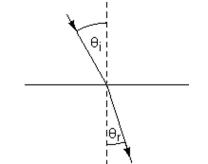
Solve the problem. -When light travels from one medium to another-from air to water, for instance-it changes direction. (This is why a pencil, partially submerged in water, looks as though it is bent.) The angle of incidence θr\theta _ { \mathrm { r } } is the angle in the first medium; the angle of refraction θr\theta _ { \mathrm { r } } is the second medium. (See illustration.) Each medium has an index of refraction −ni- \mathrm { n } _ { \mathrm { i } } and nr\mathrm { n } _ { \mathrm { r } } , respectively -which can be found in tables. Snell's law relates these quantities in the forr nisin⁡θi=nrsin⁡θr\mathrm { n } _ { \mathrm { i } } \sin \theta _ { \mathrm { i } } = \mathrm { n } _ { \mathrm { r } } \sin \theta _ { \mathrm { r } } Solving for θr\theta _ { \mathbf { r } } , we obtain θr=sin⁡−1(ninrsin⁡θi)\theta _ { \mathrm { r } } = \sin ^ { - 1 } \left( \frac { \mathrm { n } _ { \mathrm { i } } } { \mathrm { n } _ { \mathrm { r } } } \sin \theta _ { \mathrm { i } } \right) Find θr\theta _ { \mathrm { r } } for air (ni=1.0003)\left( \mathrm { n } _ { \mathrm { i } } = 1.0003 \right) , methylene iodide (nr=1.74)\left( \mathrm { n } _ { \mathrm { r } } = 1.74 \right) , and θi=14.7∘\theta _ { \mathrm { i } } = 14.7 ^ { \circ } .  Solve the problem. -When light travels from one medium to another-from air to water, for instance-it changes direction. (This is why a pencil, partially submerged in water, looks as though it is bent.) The angle of incidence  \theta _ { \mathrm { r } }  is the angle in the first medium; the angle of refraction  \theta _ { \mathrm { r } }  is the second medium. (See illustration.) Each medium has an index of refraction  - \mathrm { n } _ { \mathrm { i } }  and  \mathrm { n } _ { \mathrm { r } } , respectively -which can be found in tables. Snell's law relates these quantities in the forr  \mathrm { n } _ { \mathrm { i } } \sin \theta _ { \mathrm { i } } = \mathrm { n } _ { \mathrm { r } } \sin \theta _ { \mathrm { r } }  Solving for  \theta _ { \mathbf { r } } , we obtain  \theta _ { \mathrm { r } } = \sin ^ { - 1 } \left( \frac { \mathrm { n } _ { \mathrm { i } } } { \mathrm { n } _ { \mathrm { r } } } \sin \theta _ { \mathrm { i } } \right)  Find  \theta _ { \mathrm { r } }  for air  \left( \mathrm { n } _ { \mathrm { i } } = 1.0003 \right) , methylene iodide  \left( \mathrm { n } _ { \mathrm { r } } = 1.74 \right) , and  \theta _ { \mathrm { i } } = 14.7 ^ { \circ } .

(Essay)
4.7/5
(84)

Establish the identity. - cos⁡xsec⁡x−1−cos⁡xsec⁡x+1=2cos⁡xtan⁡2x\frac { \cos x } { \sec x - 1 } - \frac { \cos x } { \sec x + 1 } = \frac { 2 \cos x } { \tan ^ { 2 } x }

(Essay)
4.9/5
(67)

Solve the equation on the interval 0≤θ<2π0 \leq \theta < 2 \pi - sin⁡(2θ)+sin⁡θ=0\sin ( 2 \theta ) + \sin \theta = 0

(Multiple Choice)
4.8/5
(79)

Find the inverse function f−1\mathrm { f } ^ { - 1 } of the function f. - f(x)=7cos⁡x+4f ( x ) = 7 \cos x + 4

(Multiple Choice)
4.9/5
(66)

Use the Half-angle Formulas to find the exact value of the trigonometric function. - sin⁡165∘\sin 165 ^ { \circ }

(Multiple Choice)
4.7/5
(78)

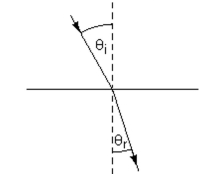
Solve the problem. -When light travels from one medium to another-from air to water, for instance-it changes direction. (This is why a pencil, partially submerged in water, looks as though it is bent.) The angle of incidence θi\theta _ { \mathrm { i } } is the angle in the first medium; the angle of refraction θr\theta _ { r } is the second medium. (See illustration.) Each medium has an index of refraction −ni- n _ { i } and nrn _ { r } , respectively −- which can be found in tables. Snell's law relates these quantities in the forr nisin⁡θi=nrsin⁡θr\mathrm { n } _ { \mathrm { i } } \sin \theta _ { \mathrm { i } } = \mathrm { n } _ { \mathrm { r } } \sin \theta _ { \mathrm { r } } Solving for θr\theta _ { \mathbf { r } } , we obtain θr=sin⁡−1(ninrsin⁡θi)\theta _ { \mathrm { r } } = \sin ^ { - 1 } \left( \frac { \mathrm { n } _ { \mathrm { i } } } { \mathrm { n } _ { \mathrm { r } } } \sin \theta _ { \mathrm { i } } \right) Find θr\theta _ { \mathrm { r } } for fused quartz (ni=1.46)\left( \mathrm { n } _ { \mathrm { i } } = 1.46 \right) , ethyl alcohol (nr=1.36)\left( \mathrm { n } _ { \mathrm { r } } = 1.36 \right) , and θi=8.5∘\theta _ { \mathrm { i } } = 8.5 ^ { \circ } .  Solve the problem. -When light travels from one medium to another-from air to water, for instance-it changes direction. (This is why a pencil, partially submerged in water, looks as though it is bent.) The angle of incidence  \theta _ { \mathrm { i } }  is the angle in the first medium; the angle of refraction  \theta _ { r }  is the second medium. (See illustration.) Each medium has an index of refraction  - n _ { i }  and  n _ { r } , respectively  -  which can be found in tables. Snell's law relates these quantities in the forr  \mathrm { n } _ { \mathrm { i } } \sin \theta _ { \mathrm { i } } = \mathrm { n } _ { \mathrm { r } } \sin \theta _ { \mathrm { r } }  Solving for  \theta _ { \mathbf { r } } , we obtain  \theta _ { \mathrm { r } } = \sin ^ { - 1 } \left( \frac { \mathrm { n } _ { \mathrm { i } } } { \mathrm { n } _ { \mathrm { r } } } \sin \theta _ { \mathrm { i } } \right)  Find  \theta _ { \mathrm { r } }  for fused quartz  \left( \mathrm { n } _ { \mathrm { i } } = 1.46 \right) , ethyl alcohol  \left( \mathrm { n } _ { \mathrm { r } } = 1.36 \right) , and  \theta _ { \mathrm { i } } = 8.5 ^ { \circ } .    a a

(Essay)
4.8/5
(76)

Use a graphing utility to solve the equation on the interval 0 0∘≤x<360∘0 ^ { \circ } \leq x < 360 ^ { \circ } . Express the solution(s) rounded to one decimal place. - sin⁡2x−8sin⁡x+16=0\sin ^ { 2 } x - 8 \sin x + 16 = 0

(Multiple Choice)
4.8/5
(66)

Find the domain of the function f and of its inverse function f−1\mathrm { f } ^ { - 1 } . - f(x)=tan⁡(x−4)+7f ( x ) = \tan ( x - 4 ) + 7

(Multiple Choice)
5.0/5
(80)

Find the exact value of the expression. - cos⁡285∘\cos 285 ^ { \circ }

(Multiple Choice)
4.9/5
(71)

Use a calculator to find the value of the expression rounded to two decimal places. - cos⁡−1(0.3)\cos ^ { - 1 } ( 0.3 )

(Multiple Choice)
4.9/5
(66)

Find the exact value of the expression. - cos⁡20∘cos⁡40∘−sin⁡20∘sin⁡40∘\cos 20 ^ { \circ } \cos 40 ^ { \circ } - \sin 20 ^ { \circ } \sin 40 ^ { \circ }

(Multiple Choice)
4.9/5
(78)

Solve the equation. Give a general formula for all the solutions. - sin⁡θ=0\sin \theta = 0

(Multiple Choice)
4.9/5
(83)

Use the Half-angle Formulas to find the exact value of the trigonometric function. - sin⁡75∘\sin 75 ^ { \circ }

(Multiple Choice)
5.0/5
(67)
Showing 241 - 260 of 402
close modal

Filters

  • Essay(0)
  • Multiple Choice(0)
  • Short Answer(0)
  • True False(0)
  • Matching(0)