



 Chat with AI
Exam 5: Accounting for Retail Businesses

Exam 1: Introduction to Accounting and Business243 Questions
Exam 2: Analyzing Transactions234 Questions
Exam 3: The Adjusting Process225 Questions
Exam 4: The Accounting Cycle211 Questions
Exam 5: Accounting for Retail Businesses273 Questions
Exam 6: Inventories236 Questions
Exam 7: Internal Control and Cash197 Questions
Exam 8: Receivables210 Questions
Exam 9: Long-Term Assets: Fixed and Intangible243 Questions
Exam 10: Liabilities: Current, Installment Notes, and Contingencies199 Questions
Exam 11: Liabilities: Bonds Payable172 Questions
Exam 12: Corporations: Organization, Stock Transactions, and Dividends221 Questions
Exam 13: Statement of Cash Flows193 Questions
Exam 14: Financial Statement Analysis206 Questions
Exam 15: Introduction to Managerial Accounting244 Questions
Exam 16: Job Order Costing212 Questions
Exam 17: Process Cost Systems196 Questions
Exam 18: Activity-Based Costing109 Questions
Exam 19: Support Department and Joint Cost Allocation172 Questions
Exam 20: Cost-Volume-Profit Analysis247 Questions
Exam 21: Variable Costing for Management Analysis136 Questions
Exam 22: Budgeting197 Questions
Exam 23: Evaluating Variances From Standard Costs172 Questions
Exam 24: Evaluating Decentralized Operations210 Questions
Exam 25: Differential Analysis and Product Pricing157 Questions
Exam 26: Capital Investment Analysis191 Questions
Exam 27: Lean Manufacturing and Activity Analysis134 Questions
Exam 28: The Balanced Scorecard and Corporate Social Responsibility170 Questions
Exam 29: Investments137 Questions
Select questions type


A physical inventory taken at year end indicated that there was $125,000 on hand. The Estimated Returns Inventory is $8,200. Depreciation for the year is $24,500. On December 31, the close of the fiscal year, the balances of selected accounts appearing in the ledger of Broxton Gallery, an art retailer, are as follows: 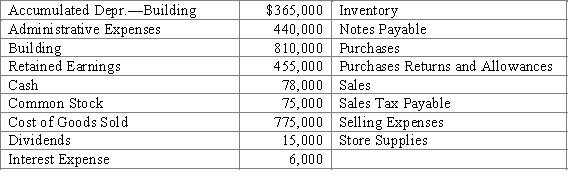 Prepare the December 31 closing entries for Broxton Gallery.
Prepare the December 31 closing entries for Broxton Gallery. (Essay)
4.8/5  (72)
(72) Which of the following is not a difference between a retail business and a service business?
(Multiple Choice)
4.8/5 (73)
(73) During the current year, merchandise is sold for $86,000 cash and for $93,950 on account. The cost of the goods sold is $76,240. What is the amount of the gross profit?
(Essay)
5.0/5 (75)
(75) Using the following data taken from Payton Inc., which uses a periodic inventory system, determine the gross profit to be reported on the income statement for the year ended May 31. 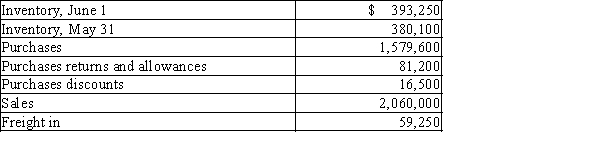
(Essay)
4.9/5 (74)
(74) Abbey Co. sold merchandise to Gomez Co. on account, $35,000, terms 2/15, net 45. The cost of the goods sold is $24,500. Abbey Co. issued a credit memo for $3,600 for merchandise returned that originally cost $1,700. Gomez Co. paid the invoice within the discount period. What is the amount of gross profit earned by Abbey Co. on the above transactions?
(Essay)
5.0/5 (84)
(84) Merchandise subject to terms 2/10, n/30, FOB shipping point, is sold on account to a customer for $25,000. What is the amount of sales discount allowable?
(Multiple Choice)
4.8/5 (78)
(78) In a perpetual inventory system, merchandise returned to vendors reduces the inventory account.
(True/False)
4.9/5 (70)
(70) Under a periodic inventory system, closing entries will include
(Multiple Choice)
4.8/5 (84)
(84) Merchandise is sold for $3,600, terms FOB destination, 2/10, n/30, with prepaid freight costs of $150. The sales amount recorded is $3,528.
(True/False)
4.8/5 (84)
(84) A company using the periodic inventory system has the following account balances: Inventory at the beginning of the year, $3,600; Freight In, $650; Purchases, $10,700; Purchases Returns and Allowances, $1,950; Purchases Discounts, $330. The cost of merchandise purchased is equal to
(Multiple Choice)
4.8/5 (91)
(91) Bradford Company had sales of $700,000 for a year. The total assets at the beginning of the year were $240,000, and the total assets at the end of the year were $280,000. The asset turnover ratio is (round answer to 2 decimal places)
(Multiple Choice)
4.9/5 (74)
(74) Match each of the following terms (a-h) with the correct definition below.
-Inventory system that updates the inventory account only at the end of the accounting period based on a physical count of inventory on hand.
A)Credit terms
B)FOB destination
C)FOB shipping point
D)Periodic inventory system
E)Perpetual inventory system
F)Inventory shrinkage
G)Single-step income statement
H)Multiple-step income statement
(Short Answer)
4.8/5 (77)
(77) Assume that the total inventory on hand at the end of the year as determined by taking a physical inventory is $62,000. Of the $62,000, $8,000 has been sold FOB destination and is awaiting pickup by the carrier. What is the cost of inventory reported on the balance sheet?
(Multiple Choice)
4.9/5 (85)
(85) Using the following data taken from Hsu's Imports Inc. which uses a periodic inventory system, determine the gross profit to be reported on the income statement for the year ended March 31. 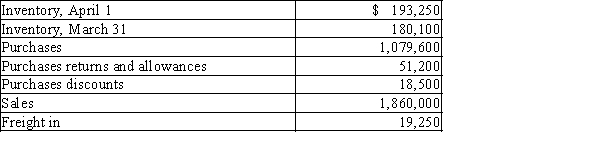
(Essay)
4.8/5 (84)
(84) Match each of the following items (a-h) with the appropriate definition below.
-Early payment discount offered to customers by the seller.
A)Freight
B)Delivery Expense
C)Inventory
D)Sales discount
E)Purchases Returns and Allowances
F)Debit memo
G)Purchases discount
H)Trade discount
(Short Answer)
5.0/5 (87)
(87) Expenses that are incurred directly or entirely in connection with the selling of merchandise are classified as
(Multiple Choice)
4.8/5 (70)
(70) Complete the following data taken from the condensed income statements for merchandising Companies A, B, and C. 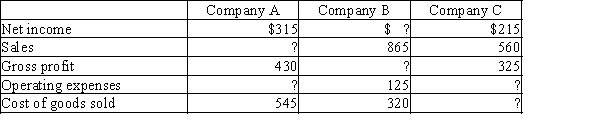
(Essay)
4.9/5 (86)
(86) During the current year, merchandise is sold for $137,500 cash and $425,600 on account. The cost of the goods sold is $322,325. What is the amount of the gross profit?
(Short Answer)
4.8/5 (76)
(76) Who is responsible for the freight costs when the terms are FOB shipping point?
(Multiple Choice)
4.8/5 (96)
(96) 
Filters
- Essay(0)
- Multiple Choice(0)
- Short Answer(0)
- True False(0)
- Matching(0)