



 Chat with AI
Exam 8: Receivables

Exam 1: Introduction to Accounting and Business243 Questions
Exam 2: Analyzing Transactions234 Questions
Exam 3: The Adjusting Process225 Questions
Exam 4: The Accounting Cycle211 Questions
Exam 5: Accounting for Retail Businesses273 Questions
Exam 6: Inventories236 Questions
Exam 7: Internal Control and Cash197 Questions
Exam 8: Receivables210 Questions
Exam 9: Long-Term Assets: Fixed and Intangible243 Questions
Exam 10: Liabilities: Current, Installment Notes, and Contingencies199 Questions
Exam 11: Liabilities: Bonds Payable172 Questions
Exam 12: Corporations: Organization, Stock Transactions, and Dividends221 Questions
Exam 13: Statement of Cash Flows193 Questions
Exam 14: Financial Statement Analysis206 Questions
Exam 15: Introduction to Managerial Accounting244 Questions
Exam 16: Job Order Costing212 Questions
Exam 17: Process Cost Systems196 Questions
Exam 18: Activity-Based Costing109 Questions
Exam 19: Support Department and Joint Cost Allocation172 Questions
Exam 20: Cost-Volume-Profit Analysis247 Questions
Exam 21: Variable Costing for Management Analysis136 Questions
Exam 22: Budgeting197 Questions
Exam 23: Evaluating Variances From Standard Costs172 Questions
Exam 24: Evaluating Decentralized Operations210 Questions
Exam 25: Differential Analysis and Product Pricing157 Questions
Exam 26: Capital Investment Analysis191 Questions
Exam 27: Lean Manufacturing and Activity Analysis134 Questions
Exam 28: The Balanced Scorecard and Corporate Social Responsibility170 Questions
Exam 29: Investments137 Questions
Select questions type


If the allowance method of accounting for uncollectible receivables is used, what general ledger account is credited to write off a customer's account as uncollectible?
(Multiple Choice)
4.9/5  (69)
(69) The maturity value of a $40,000, 9%, 40-day note receivable dated July 3 is
(Multiple Choice)
4.8/5 (80)
(80) Match each description to the appropriate term (a-i).
-All money claims against other entities
A)Accounts receivable turnover
B)Net realizable value
C)Accounts receivable
D)Aging report
E)Receivables
F)Direct write-off method
G)Allowance for doubtful accounts
H)Bad debt expense
I)Factoring
(Short Answer)
4.8/5 (60)
(60) Jefferson uses the percent of sales method of estimating uncollectible expenses. Based on past history, 2% of credit sales are expected to be uncollectible. Sales for the current year are $5,550,000. Which of the following is correct?
(Multiple Choice)
4.8/5 (90)
(90) If a promissory note is dishonored, the payee should still record interest revenue.
(True/False)
4.8/5 (86)
(86) Under the direct write-off method of uncollectible accounts, if a written off account is later collected, the effect on the accounting equation is
(Multiple Choice)
5.0/5 (75)
(75) Match each description to the appropriate term (a-h).
-The amount due that must be paid at the due date of a note receivable
A)Face amount
B)Term
C)Interest
D)Maturity value
E)Dishonored note
F)Maker
G)Notes receivable
H)Interest rate
(Short Answer)
4.8/5 (93)
(93) Match each description to the appropriate term (a-d). Each term may be used more than once.
-This method focuses on the balance sheet.
A)Direct write-off method
B)Aging of receivables method
C)Percent of sales method
D)Allowance method
(Short Answer)
4.9/5 (62)
(62) Allowance for Doubtful Accounts has a debit balance of $600 at the end of the year (before adjustment), and an analysis of accounts in the customers ledger indicates uncollectible receivables of $13,000. Which of the following entries records the proper adjusting entry for bad debt expense?
(Multiple Choice)
4.8/5 (79)
(79) Based on the following data and using a 365-day year, compute (a) the accounts receivable turnover and (b) the number of days' sales in receivables for year 2 to 2 decimal places. The industry average turnover is 20 times during the year, and the number of days' sales in receivables averages 25. (c) Comment on this situation.12/31/Year 1 accounts receivable
$ 100,000
12/31/Year 2 accounts receivable
70,000
For the year ended 12/31/Year 1, sales
1,050,000
For the year ended 12/31/Year 2, sales
1,200,000
(Essay)
4.9/5 (76)
(76) Journalize the following transactions for the Scott Company:
November 4 Received a $6,500, 90-day, 6% note from Tim's Co.in payment of the account.December 31 Accrued interest on the Tim's Co. note.February 2 Received the amount due from Tim's Co. on the note. 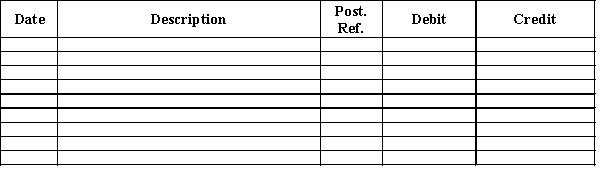
(Essay)
4.8/5 (90)
(90) Under the allowance method of uncollectible accounts, how does the adjusting entry to estimate the amount that will become uncollectible affect the accounting equation?
(Essay)
4.8/5 (78)
(78) On October 1, Black Company receives a 9% interest-bearing note from Reese Company to settle a $20,000 account receivable. The note is due in six months. At December 31, Black should record interest revenue of
(Multiple Choice)
4.9/5 (67)
(67) Journalize the following transactions in the accounts of Simmons Company:
Mar. 1 Received a $60,000, 60-day, 6% note dated March 1 from Bynum Company on account.Mar. 18 Received a $25,000, 60-day, 9% note dated March 18 from Solo Company on account.Apr. 30 The note dated March 1 from Bynum Company is dishonored, and the customer's account is charged for the note, including interest.May 17 The note dated March 18 from Solo Company is dishonored, and the customer's account is charged for the note, including interest.July 29 Cash is received for the amount due on the dishonored note dated March 1 plus interest for 90 days at 8% on the total amount debited to Bynum Company on April 30.Aug. 23 Wrote off against the allowance account the amount charged to Solo Company on May 17 for the dishonored note dated March 18.
(Essay)
4.8/5 (83)
(83) Blackwell Industries received a 120-day, 9% note for $180,000, dated August 10 from a customer on account.Required:
(a)Determine the due date of the note.(b)Determine the maturity value of the note.(c)Journalize the entry to record the receipt of the payment of the note at maturity.
(Essay)
4.7/5 (81)
(81) Journalize the following transactions (assume a 360-day year when calculating interest):
Mar. 1
Received a 90-day, 10% note for $24,000, dated March 1, from Batson Co. on account.May 30
The note of March 1 was dishonored.
(Essay)
4.9/5 (80)
(80) Match each description to the appropriate term (a-i).
-The difference between accounts receivable and allowance for doubtful accounts
A)Accounts receivable turnover
B)Net realizable value
C)Accounts receivable
D)Aging report
E)Receivables
F)Direct write-off method
G)Allowance for doubtful accounts
H)Bad debt expense
I)Factoring
(Short Answer)
4.9/5 (77)
(77) 
Filters
- Essay(0)
- Multiple Choice(0)
- Short Answer(0)
- True False(0)
- Matching(0)