



 Chat with AI
Exam 8: Receivables

Exam 1: Introduction to Accounting and Business243 Questions
Exam 2: Analyzing Transactions234 Questions
Exam 3: The Adjusting Process225 Questions
Exam 4: The Accounting Cycle211 Questions
Exam 5: Accounting for Retail Businesses273 Questions
Exam 6: Inventories236 Questions
Exam 7: Internal Control and Cash197 Questions
Exam 8: Receivables210 Questions
Exam 9: Long-Term Assets: Fixed and Intangible243 Questions
Exam 10: Liabilities: Current, Installment Notes, and Contingencies199 Questions
Exam 11: Liabilities: Bonds Payable172 Questions
Exam 12: Corporations: Organization, Stock Transactions, and Dividends221 Questions
Exam 13: Statement of Cash Flows193 Questions
Exam 14: Financial Statement Analysis206 Questions
Exam 15: Introduction to Managerial Accounting244 Questions
Exam 16: Job Order Costing212 Questions
Exam 17: Process Cost Systems196 Questions
Exam 18: Activity-Based Costing109 Questions
Exam 19: Support Department and Joint Cost Allocation172 Questions
Exam 20: Cost-Volume-Profit Analysis247 Questions
Exam 21: Variable Costing for Management Analysis136 Questions
Exam 22: Budgeting197 Questions
Exam 23: Evaluating Variances From Standard Costs172 Questions
Exam 24: Evaluating Decentralized Operations210 Questions
Exam 25: Differential Analysis and Product Pricing157 Questions
Exam 26: Capital Investment Analysis191 Questions
Exam 27: Lean Manufacturing and Activity Analysis134 Questions
Exam 28: The Balanced Scorecard and Corporate Social Responsibility170 Questions
Exam 29: Investments137 Questions
Select questions type


At the end of the current year, Accounts Receivable has a balance of $550,000; Allowance for Doubtful Accounts has a credit balance of $5,500; and sales for the year total $2,500,000. An analysis of receivables estimates uncollectible receivables as $25,000.
Determine (a) the amount of the adjusting entry for bad debt expense; (b) the adjusted balances of Accounts Receivable, Allowance for Doubtful Accounts, and Bad Debt Expense; and (c) the net realizable value of accounts receivable.
(Essay)
4.9/5  (72)
(72) Determine the due date and the amount of interest due at maturity on the following notes: 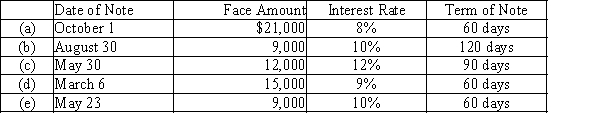
(Essay)
5.0/5 (74)
(74) If the maker of a note fails to pay the debt on the due date, the note is said to be dishonored.
(True/False)
4.7/5 (86)
(86) When using the analysis of receivables method for estimating uncollectible receivables, the amount computed in the analysis is usually the amount that would be recorded in the end-of-period adjusting entry.
(True/False)
4.9/5 (77)
(77) Two methods of accounting for uncollectible accounts are the
(Multiple Choice)
4.8/5 (75)
(75) When a company uses the allowance method of accounting for uncollectible receivables, which entry would not be found in the general journal? 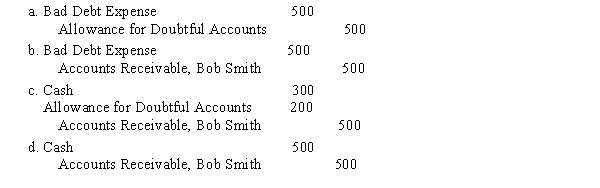
(Short Answer)
5.0/5 (81)
(81) Match each description to the appropriate term (a-h).
-A formal, written instrument of credit that represents amounts due from customers
A)Face amount
B)Term
C)Interest
D)Maturity value
E)Dishonored note
F)Maker
G)Notes receivable
H)Interest rate
(Short Answer)
4.9/5 (87)
(87) Harper Company lends Hewell Company $40,000 on March 1, accepting a four-month, 6% interest note. Harper Company prepares financial statements on March 31. What adjusting entry should be made before the financial statements can be prepared? 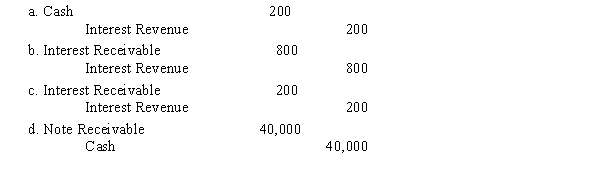
(Short Answer)
4.9/5 (92)
(92) Match each description to the appropriate term (a-h).
-A note that is not paid when it is due
A)Face amount
B)Term
C)Interest
D)Maturity value
E)Dishonored note
F)Maker
G)Notes receivable
H)Interest rate
(Short Answer)
4.8/5 (72)
(72) The number of days' sales in receivables is an estimate of the length of time the accounts receivable have been outstanding.
(True/False)
4.9/5 (78)
(78) Allowance for Doubtful Accounts has a credit balance of $2,100 at the end of the year (before adjustment), and an analysis of customers' accounts indicates uncollectible receivables of $19,700. Which of the following entries records the proper adjustment for bad debt expense?
(Multiple Choice)
4.7/5 (91)
(91) Match each description to the appropriate term (a-i).
-A receivable created from selling merchandise or services on account
A)Accounts receivable turnover
B)Net realizable value
C)Accounts receivable
D)Aging report
E)Receivables
F)Direct write-off method
G)Allowance for doubtful accounts
H)Bad debt expense
I)Factoring
(Short Answer)
4.7/5 (79)
(79) A 60-day, 9% note for $10,000, dated May 1, is received from a customer on account. The maturity value of the note is
(Multiple Choice)
4.8/5 (97)
(97) At the end of a period (before adjustment), Allowance for Doubtful Accounts has a credit balance of $5,000. The Accounts Receivable balance is analyzed by aging the accounts and the amount estimated to be uncollectible is $50,000. The amount to be recorded in the adjusting entry for the Bad Debt Expense is $45,000.
(True/False)
4.7/5 (79)
(79) The balance in Allowance for Doubtful Accounts at the end of the year includes the total of all accounts written off since the beginning of the year.
(True/False)
4.9/5 (70)
(70) Under the direct write-off method of accounting for uncollectible accounts, Bad Debts Expense is debited
(Multiple Choice)
4.9/5 (72)
(72) On the basis of the following data related to assets due within one year for Webb Co., prepare a partial balance sheet in good form at December 31. Show total current assets. 
(Essay)
4.7/5 (75)
(75) When a note is received from a customer on account, it is recorded by debiting Notes Receivable and crediting Accounts Receivable.
(True/False)
4.7/5 (89)
(89) Receivables that are expected to be collected in cash in eighteen months or less are reported in the current asset section of the balance sheet.
(True/False)
5.0/5 (76)
(76) 
Filters
- Essay(0)
- Multiple Choice(0)
- Short Answer(0)
- True False(0)
- Matching(0)