



 Chat with AI
Exam 6: Mechanisms of Enzymes

Exam 1: Introduction to Biochemistry60 Questions
Exam 2: Water80 Questions
Exam 3: Amino Acids and the Primary Structures of Proteins85 Questions
Exam 4: Proteins: Three-Dimensional Structure and Function101 Questions
Exam 5: Properties of Enzymes80 Questions
Exam 6: Mechanisms of Enzymes75 Questions
Exam 7: Coenzymes and Vitamins80 Questions
Exam 8: Carbohydrates77 Questions
Exam 9: Lipids and Membranes85 Questions
Exam 10: Introduction to Metabolism75 Questions
Exam 11: Glycolysis74 Questions
Exam 12: Gluconeogenesis, the Pentose Phosphate Pathway, and Glycogen Metabolism75 Questions
Exam 13: The Citric Acid Cycle75 Questions
Exam 14: Electron Transport and Oxidative Phosphorylation82 Questions
Exam 15: Photosynthesis70 Questions
Exam 16: Lipid Metabolism75 Questions
Exam 17: Amino Acid Metabolism73 Questions
Exam 18: Nucleotide Metabolism65 Questions
Exam 19: Nucleic Acids83 Questions
Exam 20: Dna Replication, Repair, and Recombination76 Questions
Exam 21: Transcription and Rna Processing75 Questions
Exam 22: Protein Synthesis85 Questions
Exam 23: Recombinant Dna Technology73 Questions
Select questions type


Enzymes which have induced fit to the substrate are generally more effective than those in an active form initially.
(True/False)
4.9/5  (80)
(80) A reaction that occurs with every collision between reactant molecules is called a/an .
(Multiple Choice)
4.9/5 (90)
(90) Trypsin as well as chymotrypsin can activate chymotrypsinogen to chymotrypsin.
(True/False)
4.8/5 (79)
(79) In the following chemical reaction which species is the reducing agent? CH4 + 2 O2 → CO2 + 2 H2O
(Multiple Choice)
4.9/5 (69)
(69) The proximity effect of speeding an enzyme-catalyzed reaction is explained by .
(Multiple Choice)
4.9/5 (90)
(90) The roles of amino acid residues at the active site of enzymes can be determined by removing certain residues using the technique of
(Multiple Choice)
4.8/5 (86)
(86) Most Km values of enzymes for their substrates are on the order of M.
(Multiple Choice)
4.8/5 (86)
(86) Aspartate and lysine are in the active site of an enzyme. They are both known to participate directly in catalysis. The pKaʹs of the residues are found to be 3.2 and 9.6, respectively for aspartate and lysine. The optimum pH for the enzyme is 6.4. Which forms of these two residues will predominate when the enzyme is most active?
(Multiple Choice)
4.9/5 (74)
(74) Which graph might you expect for the pH profile of an enzymeʹs activity if the only ionizable residue in the active site is aspartate? 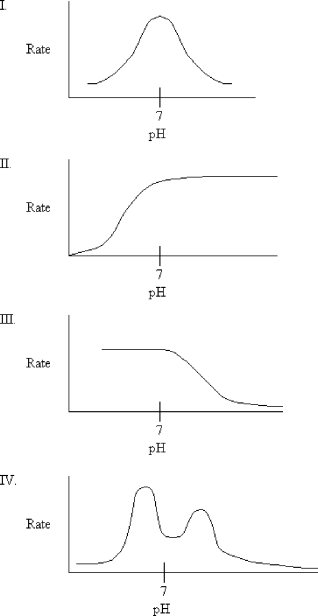
(Multiple Choice)
4.8/5 (71)
(71) X-ray crystallographic examination of the active site of arginine kinase was possible because
(Multiple Choice)
4.8/5 (79)
(79) Weak substrate binding is an important feature to help describe enzyme catalysis.
(True/False)
4.9/5 (77)
(77) An update of Fischerʹs lock-and-key theory of enzyme specificity view the as the lock and as the key.
(Multiple Choice)
4.9/5 (78)
(78) 
Filters
- Essay(0)
- Multiple Choice(0)
- Short Answer(0)
- True False(0)
- Matching(0)