



 Chat with AI
Exam 5: Properties of Enzymes

Exam 1: Introduction to Biochemistry60 Questions
Exam 2: Water80 Questions
Exam 3: Amino Acids and the Primary Structures of Proteins85 Questions
Exam 4: Proteins: Three-Dimensional Structure and Function101 Questions
Exam 5: Properties of Enzymes80 Questions
Exam 6: Mechanisms of Enzymes75 Questions
Exam 7: Coenzymes and Vitamins80 Questions
Exam 8: Carbohydrates77 Questions
Exam 9: Lipids and Membranes85 Questions
Exam 10: Introduction to Metabolism75 Questions
Exam 11: Glycolysis74 Questions
Exam 12: Gluconeogenesis, the Pentose Phosphate Pathway, and Glycogen Metabolism75 Questions
Exam 13: The Citric Acid Cycle75 Questions
Exam 14: Electron Transport and Oxidative Phosphorylation82 Questions
Exam 15: Photosynthesis70 Questions
Exam 16: Lipid Metabolism75 Questions
Exam 17: Amino Acid Metabolism73 Questions
Exam 18: Nucleotide Metabolism65 Questions
Exam 19: Nucleic Acids83 Questions
Exam 20: Dna Replication, Repair, and Recombination76 Questions
Exam 21: Transcription and Rna Processing75 Questions
Exam 22: Protein Synthesis85 Questions
Exam 23: Recombinant Dna Technology73 Questions
Select questions type


Nonclassical competitive inhibition involves .

Free
(Multiple Choice)
4.9/5  (84)
(84) Correct Answer: Verified
B
In E. coli is an activator and is a negative allosteric modulator of the enzyme phosphofructokinase-1.
Free
(Multiple Choice)
4.9/5 (73)
(73) Correct Answer:Verified
VerifiedC
Allosteric modulators seldom resemble the substrate or product of the enzyme. What does this observation show?
Free
(Multiple Choice)
4.9/5 (78)
(78) Correct Answer:Verified
VerifiedA
In an enzyme reaction involving one enzyme and one substrate, the rate of the reaction depends on
(Multiple Choice)
4.9/5 (80)
(80) Two curves showing the rate versus substrate concentration are shown below for an enzyme-catalyzed reaction. One curve is for the reaction in the presence of substance X. The other curve is for data in the absence of substance X. Examine the curves and tell which statement below is false. 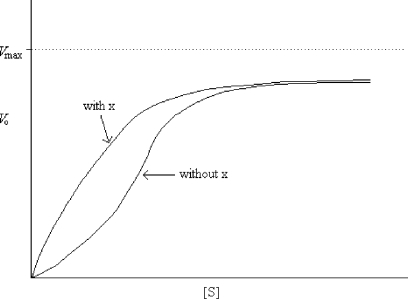
(Multiple Choice)
4.7/5 (86)
(86) What distinguishes reversible inhibitors from irreversible inhibitors?
(Multiple Choice)
4.9/5 (86)
(86) The following data were obtained in the presence and absence of inhibitor. What type of inhibition is shown? Substrateconcentration millimolar) Rate withoutinhibitor /) Rate with inhibitor /) 0.100 2.5 1.6 0.200 4.2 2.9 0.500 6.6 5.1 0.750 7.4 6.2 1.000 9.9 9.8 2.000 10.0 10.1
(Multiple Choice)
4.9/5 (65)
(65) Select the correct class of enzyme for each of these reactions. A) isomerase
B) ligase
C) lyase
D) transferase
E) oxidoreductase
F) hydrolase
-L-Glutamate + ATP + NH4+
→ L-glutamine + ADP + Pi
(Short Answer)
4.9/5 (80)
(80) Ethanol CH3CH2OH) is the alcohol found in beverages. It is oxidized in the body to acetaldehyde by the enzyme alcohol dehydrogenase. Methanol CH3OH), also known as wood alcohol, is converted to formaldehyde by the same enzyme. Acetaldehyde is toxic, but formaldehyde is far more toxic to humans, which is why the ingestion of relatively small amounts of methanol can cause blindness or death. One treatment for mild methanol poisoning is the administration of ethanol. Why might a doctor choose this treatment?
(Multiple Choice)
4.8/5 (83)
(83) Protein A has four identical subunits, each of which binds one molecule of ligand Y. The binding of one molecule of Y to one of the subunits induces a conformational change in neighboring subunits that enhances the binding of additional units of Y. This is an example of .
(Multiple Choice)
4.8/5 (81)
(81) In a certain enzyme-catalyzed reaction the following steps occur: 1. A phosphate group on substrate A is transferred to a side chain of an active site residue of the enzyme.
2. The dephosphorylated form of substrate A dissociates from the enzyme.
3. Substrate B enters the active site and is phosphorylated with simultaneous regeneration of the enzyme in its original form.
What kind of kinetic mechanism is described?
(Multiple Choice)
4.7/5 (99)
(99) When there are two substrates in a reaction, the reaction is said to be second order if .
(Multiple Choice)
4.9/5 (87)
(87) Both reversible and irreversible inhibitors can be separated from solutions of enzymes by dialysis.
(True/False)
4.8/5 (82)
(82) Increasing the concentration of a classic competitive inhibitor has no effect on the maximum velocity of an enzyme-substrate reaction.
(True/False)
4.8/5 (67)
(67) The enymatic rate constant kcat/Km) of orotidine 5ʹ-phosphate decarboxylase is 6 x 10⁷ M-1s-1 and the nonenzymatic rate constant kn) is 3 x 10-16 s-1. What is the value of the enzymeʹs catalytic proficiency?
(Multiple Choice)
4.9/5 (75)
(75) An enzyme is irreversibly inhibited by diisopropylfluorophosphate DFP). What does this show?
(Multiple Choice)
4.9/5 (79)
(79) 
Filters
- Essay(0)
- Multiple Choice(0)
- Short Answer(0)
- True False(0)
- Matching(0)