



 Chat with AI
Exam 5: Properties of Enzymes

Exam 1: Introduction to Biochemistry60 Questions
Exam 2: Water80 Questions
Exam 3: Amino Acids and the Primary Structures of Proteins85 Questions
Exam 4: Proteins: Three-Dimensional Structure and Function101 Questions
Exam 5: Properties of Enzymes80 Questions
Exam 6: Mechanisms of Enzymes75 Questions
Exam 7: Coenzymes and Vitamins80 Questions
Exam 8: Carbohydrates77 Questions
Exam 9: Lipids and Membranes85 Questions
Exam 10: Introduction to Metabolism75 Questions
Exam 11: Glycolysis74 Questions
Exam 12: Gluconeogenesis, the Pentose Phosphate Pathway, and Glycogen Metabolism75 Questions
Exam 13: The Citric Acid Cycle75 Questions
Exam 14: Electron Transport and Oxidative Phosphorylation82 Questions
Exam 15: Photosynthesis70 Questions
Exam 16: Lipid Metabolism75 Questions
Exam 17: Amino Acid Metabolism73 Questions
Exam 18: Nucleotide Metabolism65 Questions
Exam 19: Nucleic Acids83 Questions
Exam 20: Dna Replication, Repair, and Recombination76 Questions
Exam 21: Transcription and Rna Processing75 Questions
Exam 22: Protein Synthesis85 Questions
Exam 23: Recombinant Dna Technology73 Questions
Select questions type


Unlike typical catalyzed reactions in organic chemistry enzyme reactions are
(Multiple Choice)
4.9/5  (88)
(88) It is difficult to determine either Km or Vmax from a graph of velocity vs. substrate concentration because
(Multiple Choice)
4.8/5 (85)
(85) Phosphorylation that changes an enzymeʹs activity is an example of .
(Multiple Choice)
4.8/5 (74)
(74) Which equilibrium below applies to noncompetitive inhibition? 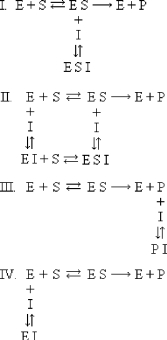
(Multiple Choice)
4.7/5 (71)
(71) Which is not an explanation of why site-directed mutagenesis is a more powerful tool than many other techniques for determining important residues in an enzyme?
(Multiple Choice)
4.9/5 (84)
(84) Affinity labels are radioactive competitive inhibitors used to identify the most important residues in an enzymeʹs active site.
(True/False)
4.9/5 (79)
(79) Select the correct class of enzyme for each of these reactions. A) isomerase
B) ligase
C) lyase
D) transferase
E) oxidoreductase
F) hydrolase
-L-aspartic acid +
a-ketoglutarate → oxaloacetic acid + L-Glutamate
(Short Answer)
5.0/5 (80)
(80) The concentrations of enzymes are determined by using pseudo first-order conditions in which
(Multiple Choice)
4.7/5 (82)
(82) What type of inhibition is indicated by the data graphed below? 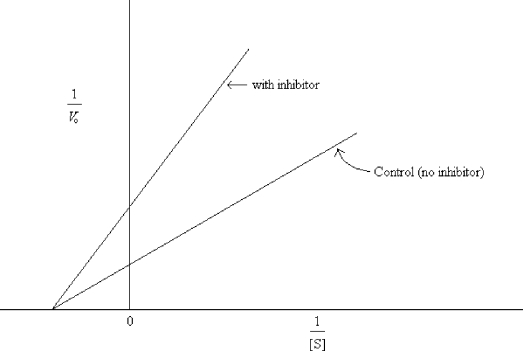
(Multiple Choice)
5.0/5 (74)
(74) An inhibitor binds to a site other than the active site of the enzyme. Which statement below correlates with this observation?
(Multiple Choice)
4.9/5 (73)
(73) At sufficiently high substrate concentration all types of reversible inhibition can be overwhelmed. At high substrate concentration the enzyme will be saturated and the reaction will proceed at the same maximum velocity as in the absence of inhibitor.
(True/False)
4.7/5 (88)
(88) When two different substrates react to form two different products, the rate constants for each separate substrate can be determined by
(Multiple Choice)
4.9/5 (75)
(75) The hydrophobic cleft in globular proteins which bind substrate molecules is called the .
(Multiple Choice)
4.9/5 (79)
(79) When varying the substrate concentration at a fixed concentration of enzyme it is observed that at low concentrations of substrate the reaction is ,while at high concentrations of substrate the reaction is .
(Multiple Choice)
5.0/5 (75)
(75) 
Filters
- Essay(0)
- Multiple Choice(0)
- Short Answer(0)
- True False(0)
- Matching(0)