



 Chat with AI
Exam 12: The Design of the Tax System

Exam 1: Ten Principles of Economics220 Questions
Exam 2: Thinking Like an Economist284 Questions
Exam 3: Interdependence and the Gains From Trade192 Questions
Exam 4: The Market Forces of Supply and Demand277 Questions
Exam 5: Elasticity and Its Application222 Questions
Exam 6: Supply, Demand, and Government Policies321 Questions
Exam 7: Consumers, Producers, and the Efficiency of Markets218 Questions
Exam 8: Applications: The Costs of Taxation203 Questions
Exam 9: Application: International Trade214 Questions
Exam 10: Externalities204 Questions
Exam 11: Public Goods and Common Resources182 Questions
Exam 12: The Design of the Tax System225 Questions
Exam 13: The Costs of Production261 Questions
Exam 14: Firms in Competitive Markets243 Questions
Exam 15: Monopoly231 Questions
Exam 16: Monopolistic Competition246 Questions
Exam 17: Oligopoly204 Questions
Exam 18: The Markets for the Factors of Production232 Questions
Exam 19: Earnings and Discrimination230 Questions
Exam 20: Income Inequality and Poverty194 Questions
Exam 21: The Theory of Consumer Choice209 Questions
Exam 22: Frontiers in Microeconomics185 Questions
Exam 23: Measuring a Nations Income231 Questions
Exam 24: Measuring the Cost of Living214 Questions
Exam 25: Production and Growth187 Questions
Exam 26: Saving, Investment, and the Financial System225 Questions
Exam 27: Tools of Finance198 Questions
Exam 28: Unemployment and Its Natural Rate361 Questions
Exam 29: The Monetary System210 Questions
Exam 30: Money Growth and Inflation201 Questions
Exam 31: Open-Economy Macroeconomics: Basic Concepts194 Questions
Exam 32: A Macroeconomic Theory of the Open Economy188 Questions
Exam 33: Aggregate Demand and Aggregate Supply189 Questions
Exam 34: The Influence of Monetary and Fiscal Policy on Aggregate Demand207 Questions
Exam 35: The Short-Run Tradeoff Between Inflation and Unemployment223 Questions
Exam 36: Six Debates Over Macroeconomic Policy154 Questions
Select questions type


The largest category of expenditures for state and local governments is __________.
(Short Answer)
4.8/5  (82)
(82) One reason for the projected increase, over the next several decades, in government spending as a percentage of GDP is the projected increase in the size of the elderly population.
(True/False)
4.9/5 (80)
(80) The government raises revenue through taxation to pay for the services it provides.
(True/False)
4.8/5 (88)
(88) A tax system exhibits vertical equity when taxpayers with similar abilities to pay contribute the same amount.
(True/False)
4.8/5 (66)
(66) Why do some policymakers support a consumption tax rather than an income tax?
(Multiple Choice)
4.8/5 (85)
(85) Rob's income rises from $50,000 to $60,000 and his income tax increases from $6,000 to $7,500.His marginal tax rate is 12.5%.
(True/False)
4.9/5 (83)
(83) If all taxpayers pay the same percentage of income in taxes, the tax system is proportional.
(True/False)
4.8/5 (76)
(76) Individual income taxes and social insurance taxes generate the highest tax revenue for the federal government.
(True/False)
4.8/5 (79)
(79) An efficient tax system is one that imposes small deadweight losses and small administrative burdens.
(True/False)
4.8/5 (83)
(83) One reason that deadweight losses are so difficult to avoid is that
(Multiple Choice)
4.8/5 (89)
(89) If your income is $50,000, your income tax liability is $10,000, and you paid $0.25 in taxes on the last dollar you earned, your
(Multiple Choice)
4.8/5 (72)
(72) Table 12-6
The table below provides information on the four households that make up a small economy and how much they would pay in taxes under three types of taxes.
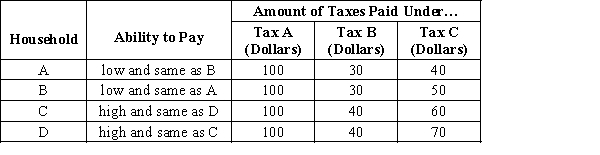 -Refer to Table 12-6. In this economy Tax A exhibits
 (Multiple Choice)
4.9/5 (88)
(88) A tax system with little deadweight loss and a small administrative burden would be described as
(Multiple Choice)
5.0/5 (90)
(90) Athos, Porthos, and Aramis each like to take fencing lessons. The price of a fencing lesson is $10. Athos values a lesson at $17, Porthos at $15, and Aramis at $12. Suppose that if the government taxes fencing lessons at $3 each, the price will rise to $13. A consequence of the tax is that consumer surplus shrinks by
(Multiple Choice)
4.8/5 (89)
(89) Table 12-1
Person Value of a White Water Rafting Trip (Dollars) Ken 150 Alex 120 Brenda 90 Rob 60
-Refer to Table 12-1. Assume that the price of a weekend ski pass is $55 and that the price reflects the actual unit cost of the trip. Suppose the government imposes a tax of $12 on white water rafting, which raises the price to $67. How much tax revenue is collected from these four participants?
(Multiple Choice)
4.7/5 (78)
(78) The revenue that the federal government collects from payroll taxes is mostly earmarked to pay for
(Multiple Choice)
4.9/5 (71)
(71) Scenario 12-2
Suppose Regina and Ben receive great satisfaction from their consumption of cheesecake. Regina would be willing to purchase only one slice and would pay up to $13 for it. Ben would be willing to pay $17 for his first slice, $14 for his second slice, and $10 for his third slice. The current market price is $10 per slice.
-Refer to Scenario 12-2. How much consumer surplus does Regina receive from consuming her slice of cheesecake?
(Multiple Choice)
4.8/5 (75)
(75) Government spending is projected to rise over the next few decades. Three of the most important reasons are spending on Social Security, Medicare, and healthcare.
(True/False)
4.8/5 (80)
(80) If James earns $80,000 in taxable income and pays $20,000 in taxes, his average tax rate is 25 percent.
(True/False)
4.7/5 (82)
(82) 
Filters
- Essay(0)
- Multiple Choice(0)
- Short Answer(0)
- True False(0)
- Matching(0)