



 Chat with AI
Exam 12: The Design of the Tax System

Exam 1: Ten Principles of Economics220 Questions
Exam 2: Thinking Like an Economist284 Questions
Exam 3: Interdependence and the Gains From Trade192 Questions
Exam 4: The Market Forces of Supply and Demand277 Questions
Exam 5: Elasticity and Its Application222 Questions
Exam 6: Supply, Demand, and Government Policies321 Questions
Exam 7: Consumers, Producers, and the Efficiency of Markets218 Questions
Exam 8: Applications: The Costs of Taxation203 Questions
Exam 9: Application: International Trade214 Questions
Exam 10: Externalities204 Questions
Exam 11: Public Goods and Common Resources182 Questions
Exam 12: The Design of the Tax System225 Questions
Exam 13: The Costs of Production261 Questions
Exam 14: Firms in Competitive Markets243 Questions
Exam 15: Monopoly231 Questions
Exam 16: Monopolistic Competition246 Questions
Exam 17: Oligopoly204 Questions
Exam 18: The Markets for the Factors of Production232 Questions
Exam 19: Earnings and Discrimination230 Questions
Exam 20: Income Inequality and Poverty194 Questions
Exam 21: The Theory of Consumer Choice209 Questions
Exam 22: Frontiers in Microeconomics185 Questions
Exam 23: Measuring a Nations Income231 Questions
Exam 24: Measuring the Cost of Living214 Questions
Exam 25: Production and Growth187 Questions
Exam 26: Saving, Investment, and the Financial System225 Questions
Exam 27: Tools of Finance198 Questions
Exam 28: Unemployment and Its Natural Rate361 Questions
Exam 29: The Monetary System210 Questions
Exam 30: Money Growth and Inflation201 Questions
Exam 31: Open-Economy Macroeconomics: Basic Concepts194 Questions
Exam 32: A Macroeconomic Theory of the Open Economy188 Questions
Exam 33: Aggregate Demand and Aggregate Supply189 Questions
Exam 34: The Influence of Monetary and Fiscal Policy on Aggregate Demand207 Questions
Exam 35: The Short-Run Tradeoff Between Inflation and Unemployment223 Questions
Exam 36: Six Debates Over Macroeconomic Policy154 Questions
Select questions type


Use Table A to complete Table B.
TABLE A On Taxable Income The Tax Rate Is Up to \ 27,050 15.0\% From \ 27,051 to \ 65,550 27.5\% From \ 65,551 to \ 136,750 30.5\% From \ 136,751 to \ 297,350 35.5\% Over \ 297,350 39.1\% TABLE B Taxpayer Income Tax Amount Average Tax Rate John \ 52,700 Todd \ 132,500 Glen \ 237,000 Jake \ 315,250
(Essay)
4.8/5  (88)
(88) A lump-sum tax would take different amounts from the poor and the rich.
(True/False)
4.8/5 (76)
(76) Under a regressive tax system, the marginal tax rate for high income taxpayers is
(Multiple Choice)
4.8/5 (80)
(80) Sue earns income of $80,000 per year. Her average tax rate is 50 percent. Sue paid $5,000 in taxes on the first $30,000 she earned. What was the marginal tax rate on the first $30,000 she earned, and what was the marginal tax rate on the remaining $50,000?
(Multiple Choice)
4.9/5 (82)
(82) A budget deficit occurs when government receipts fall short of government spending.
(True/False)
4.8/5 (79)
(79) Table 12-6
The table below provides information on the four households that make up a small economy and how much they would pay in taxes under three types of taxes.
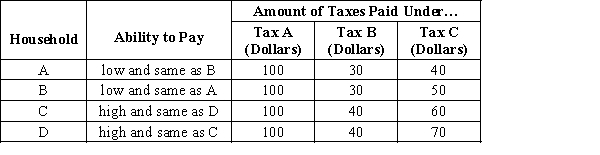 -Refer to Table 12-6. In this economy Tax C exhibits
 (Multiple Choice)
4.7/5 (72)
(72) Over the past 100 years, as the U.S. economy's income has grown,
(Multiple Choice)
4.8/5 (90)
(90) Which of the following best describes the case when taxes can be justified?
(Multiple Choice)
4.8/5 (86)
(86) Table 12-1
Person Value of a White Water Rafting Trip (Dollars) Ken 150 Alex 120 Brenda 90 Rob 60
-Refer to Table 12-1. Assume that the price of a white water rafting trip pass is $55 and that the price reflects the actual unit cost of the trip. Suppose the government imposes a tax of $12 on white water rafting, which raises the price to $67. What is the value of the surplus that accrues to all four participants?
(Multiple Choice)
4.9/5 (73)
(73) If your income is $40,000 and your income tax liability is $5,000, your
(Multiple Choice)
4.8/5 (83)
(83) Horizontal and vertical equity are the two primary measures of efficiency of a tax system.
(True/False)
4.8/5 (88)
(88) Suppose a recent increase in federal gasoline taxes is estimated to cause a $150 million reduction in the total surplus (consumer plus producer surplus) in the gasoline market. If tax revenues increased by $100 million, what is the deadweight loss associated with the tax? As a result of the tax, 10,000 people sold their cars and started riding their bicycles to work. How much of the burden of the deadweight loss is incurred by the bicycle riders?
(Essay)
4.8/5 (60)
(60) The United States federal government has a large budget deficit. Long-term projections suggest that under current law, taxes, as a percentage of GDP, will __________ and government spending, as a percentage of GDP, will __________.
(Short Answer)
4.9/5 (88)
(88) One of the most difficult issues associated with trying to structure a tax policy to satisfy horizontal equity is determining
(Multiple Choice)
4.8/5 (86)
(86) The U.S. federal government collects about one-half of the taxes in our economy.
(True/False)
4.9/5 (87)
(87) The U.S. tax burden is high compared to many European countries..
(True/False)
5.0/5 (92)
(92) 
Filters
- Essay(0)
- Multiple Choice(0)
- Short Answer(0)
- True False(0)
- Matching(0)