



 Chat with AI
Exam 28: Unemployment and Its Natural Rate

Exam 1: Ten Principles of Economics220 Questions
Exam 2: Thinking Like an Economist284 Questions
Exam 3: Interdependence and the Gains From Trade192 Questions
Exam 4: The Market Forces of Supply and Demand277 Questions
Exam 5: Elasticity and Its Application222 Questions
Exam 6: Supply, Demand, and Government Policies321 Questions
Exam 7: Consumers, Producers, and the Efficiency of Markets218 Questions
Exam 8: Applications: The Costs of Taxation203 Questions
Exam 9: Application: International Trade214 Questions
Exam 10: Externalities204 Questions
Exam 11: Public Goods and Common Resources182 Questions
Exam 12: The Design of the Tax System225 Questions
Exam 13: The Costs of Production261 Questions
Exam 14: Firms in Competitive Markets243 Questions
Exam 15: Monopoly231 Questions
Exam 16: Monopolistic Competition246 Questions
Exam 17: Oligopoly204 Questions
Exam 18: The Markets for the Factors of Production232 Questions
Exam 19: Earnings and Discrimination230 Questions
Exam 20: Income Inequality and Poverty194 Questions
Exam 21: The Theory of Consumer Choice209 Questions
Exam 22: Frontiers in Microeconomics185 Questions
Exam 23: Measuring a Nations Income231 Questions
Exam 24: Measuring the Cost of Living214 Questions
Exam 25: Production and Growth187 Questions
Exam 26: Saving, Investment, and the Financial System225 Questions
Exam 27: Tools of Finance198 Questions
Exam 28: Unemployment and Its Natural Rate361 Questions
Exam 29: The Monetary System210 Questions
Exam 30: Money Growth and Inflation201 Questions
Exam 31: Open-Economy Macroeconomics: Basic Concepts194 Questions
Exam 32: A Macroeconomic Theory of the Open Economy188 Questions
Exam 33: Aggregate Demand and Aggregate Supply189 Questions
Exam 34: The Influence of Monetary and Fiscal Policy on Aggregate Demand207 Questions
Exam 35: The Short-Run Tradeoff Between Inflation and Unemployment223 Questions
Exam 36: Six Debates Over Macroeconomic Policy154 Questions
Select questions type


Every adult who was not employed during the previous four weeks is included in the Bureau of Labor Statistics' "unemployed" category.
(True/False)
5.0/5  (80)
(80) An economist claims that changes in information technology and unemployment insurance have reduced unemployment. Which of these changes affect frictional unemployment?
(Multiple Choice)
4.8/5 (73)
(73) Most spells of unemployment are short, and most unemployment observed at any given time is long-term.
(True/False)
4.8/5 (82)
(82) Economists at the Congressional Budget Office estimated that for 2015, the U.S. natural rate of unemployment was about 4.9 percent.
(True/False)
4.8/5 (67)
(67) The Bureau of Labor Statistics' household survey and establishment survey both yield information about unemployment.
(True/False)
4.9/5 (77)
(77) Minimum wage laws help explain the natural rate of unemployment if they create a surplus in any labor market.
(True/False)
4.7/5 (93)
(93) Figure 28-3
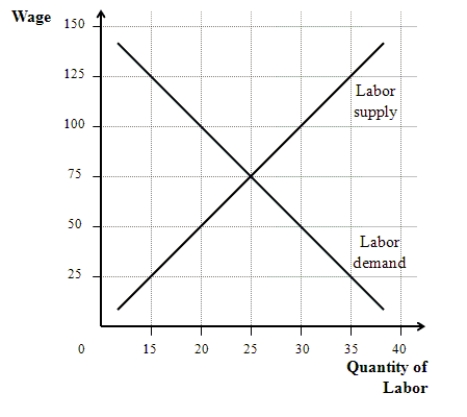 -Refer to Figure 28-3. If the minimum wage increases from $100 to $125, how many additional workers will be unemployed?
 (Short Answer)
4.8/5 (63)
(63) Table 28-2
Suppose people in the adult population in a small country are classified based on their age.

-Refer to Table 28-2. In the proper order, which age group has the highest unemployment rate and which has the highest labor-force participation rate?
-Refer to Table 28-2. In the proper order, which age group has the highest unemployment rate and which has the highest labor-force participation rate? (Multiple Choice)
4.8/5 (68)
(68) Advocates of unions contend that unions are a necessary antidote to the market power of the firms that hire workers and that unions are important for helping firms respond efficiently to workers' concerns.
(True/False)
4.8/5 (86)
(86) There are always some workers without jobs, even when the overall economy is doing well.
(True/False)
4.8/5 (77)
(77) A firm might offer efficiency wages in order to attract a better pool of applicants.
(True/False)
4.9/5 (76)
(76) Table 28-7
The table below lists the number of people by labor force classification for the country of Springfield.
Employed 78 million Part-time employed 22 million Unemployed 12 million Marginally attached 3 million Not in the Labor Force 30 million Discouraged 4 million
-Refer to Table 28-7. Calculate the U-4 unemployment rate.
(Short Answer)
4.9/5 (86)
(86) In terms of duration, how does cyclical unemployment differ from structural unemployment?
(Essay)
4.9/5 (72)
(72) Unemployment insurance reduces the incentive for the unemployed to find and take new jobs.
(True/False)
4.9/5 (79)
(79) In the U.S., it is illegal for employers to interfere when workers try to organize unions.
(True/False)
4.8/5 (90)
(90) Give an historical example of an efficiency wage that was considered by the firm to be "one of the finest cost-cutting moves we ever made."
(Essay)
4.8/5 (62)
(62) 
Filters
- Essay(0)
- Multiple Choice(0)
- Short Answer(0)
- True False(0)
- Matching(0)