



 Chat with AI
Exam 28: Unemployment and Its Natural Rate

Exam 1: Ten Principles of Economics220 Questions
Exam 2: Thinking Like an Economist284 Questions
Exam 3: Interdependence and the Gains From Trade192 Questions
Exam 4: The Market Forces of Supply and Demand277 Questions
Exam 5: Elasticity and Its Application222 Questions
Exam 6: Supply, Demand, and Government Policies321 Questions
Exam 7: Consumers, Producers, and the Efficiency of Markets218 Questions
Exam 8: Applications: The Costs of Taxation203 Questions
Exam 9: Application: International Trade214 Questions
Exam 10: Externalities204 Questions
Exam 11: Public Goods and Common Resources182 Questions
Exam 12: The Design of the Tax System225 Questions
Exam 13: The Costs of Production261 Questions
Exam 14: Firms in Competitive Markets243 Questions
Exam 15: Monopoly231 Questions
Exam 16: Monopolistic Competition246 Questions
Exam 17: Oligopoly204 Questions
Exam 18: The Markets for the Factors of Production232 Questions
Exam 19: Earnings and Discrimination230 Questions
Exam 20: Income Inequality and Poverty194 Questions
Exam 21: The Theory of Consumer Choice209 Questions
Exam 22: Frontiers in Microeconomics185 Questions
Exam 23: Measuring a Nations Income231 Questions
Exam 24: Measuring the Cost of Living214 Questions
Exam 25: Production and Growth187 Questions
Exam 26: Saving, Investment, and the Financial System225 Questions
Exam 27: Tools of Finance198 Questions
Exam 28: Unemployment and Its Natural Rate361 Questions
Exam 29: The Monetary System210 Questions
Exam 30: Money Growth and Inflation201 Questions
Exam 31: Open-Economy Macroeconomics: Basic Concepts194 Questions
Exam 32: A Macroeconomic Theory of the Open Economy188 Questions
Exam 33: Aggregate Demand and Aggregate Supply189 Questions
Exam 34: The Influence of Monetary and Fiscal Policy on Aggregate Demand207 Questions
Exam 35: The Short-Run Tradeoff Between Inflation and Unemployment223 Questions
Exam 36: Six Debates Over Macroeconomic Policy154 Questions
Select questions type


Structural unemployment is often thought to explain relatively long spells of unemployment.
(True/False)
4.8/5  (74)
(74) The unemployment that results from the process of matching workers and jobs is called frictional unemployment.
(True/False)
4.9/5 (84)
(84) Explain the effect of right-to-work laws on the collective bargaining power of labor unions.
(Essay)
4.9/5 (86)
(86) The adult population must equal the sum of the employed and the unemployed.
(True/False)
4.8/5 (93)
(93) The Bureau of Labor Statistics' U-1 measure of joblessness is smaller than its U-6 measure of joblessness.
(True/False)
4.9/5 (70)
(70) When a union raises the wage above the equilibrium level, it reduces the quantity of labor supplied and raises the quantity of labor demanded, resulting in unemployment.
(True/False)
4.9/5 (63)
(63) Who of the following is not included in the Bureau of Labor Statistics' "employed" category?
(Multiple Choice)
4.9/5 (83)
(83) Table 28-5
2015 Labor Data for Tajnia
Number of adults employed 10,000 Number of adults unemployed 2,250 Number of adults not in the labor force 17,750
-Refer to Table 28-5. The labor-force participation rate of Tajnia in 2015 is about 33.3 percent.
(True/False)
4.8/5 (90)
(90) Figure 28-3
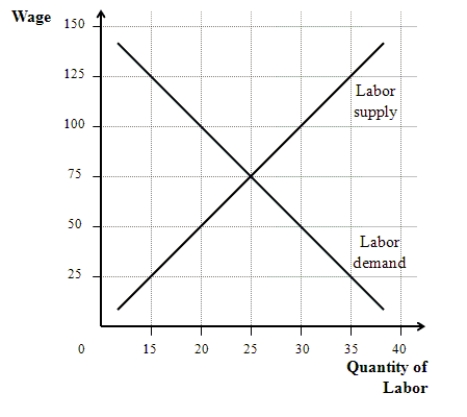 -Refer to Figure 28-3. At a minimum wage of $125, how much is the surplus of labor?
 (Short Answer)
4.9/5 (70)
(70) Table 28-5
2015 Labor Data for Tajnia
Number of adults employed 10,000 Number of adults unemployed 2,250 Number of adults not in the labor force 17,750
-Refer to Table 28-5. The unemployment rate of Tajnia in 2015 is about 18.4 percent.
(True/False)
4.9/5 (75)
(75) Unions are often thought to cause conflict between different groups of workers -- between the insiders who benefit from high union wages and the outsiders who do not get the union jobs.
(True/False)
4.8/5 (92)
(92) Within the U.S. population, teenagers (ages 16-19) have similar rates of unemployment to adults of prime working age (ages 25-54), regardless of race or gender.
(True/False)
5.0/5 (74)
(74) Most people rely primarily on income other than their labor earnings to maintain their standard of living.
(True/False)
4.8/5 (89)
(89) Most spells of unemployment are long, and most unemployment observed at any given time is long-term.
(True/False)
4.9/5 (67)
(67) Studies have shown that the design of the unemployment insurance system reduces the job search effort of the unemployed.
(True/False)
4.7/5 (60)
(60) Table 28-7
The table below lists the number of people by labor force classification for the country of Springfield.
Employed 78 million Part-time employed 22 million Unemployed 12 million Marginally attached 3 million Not in the Labor Force 30 million Discouraged 4 million
-Refer to Table 28-7. Calculate the U-5 unemployment rate.
(Short Answer)
5.0/5 (79)
(79) Every week, the Bureau of Labor Statistics produces data on unemployment.
(True/False)
4.9/5 (67)
(67) Some economists have argued that unemployment insurance improves the ability of the economy to match each worker with the most appropriate job.
(True/False)
4.8/5 (71)
(71) 
Filters
- Essay(0)
- Multiple Choice(0)
- Short Answer(0)
- True False(0)
- Matching(0)