



 Chat with AI
Exam 15: Modern Macroeconomics: From the Short Run to the Long Run

Exam 1: Introduction: What Is Economics?118 Questions
Exam 2: The Key Principles of Economics144 Questions
Exam 3: Exchange and Markets111 Questions
Exam 4: Demand, Supply, and Market Equilibrium172 Questions
Exam 5: Measuring a Nation's Production and Income152 Questions
Exam 6:Unemployment and Inflation155 Questions
Exam 7:The Economy at Full Employment148 Questions
Exam 8: Why Do Economies Grow?167 Questions
Exam 9: Aggregate Demand and Aggregate Supply160 Questions
Exam 10: Fiscal Policy133 Questions
Exam 11: The Income-Expenditure Model193 Questions
Exam 12: Investment and Financial Markets150 Questions
Exam 13: Money and the Banking System170 Questions
Exam 14: The Federal Reserve and Monetary Policy149 Questions
Exam 15: Modern Macroeconomics: From the Short Run to the Long Run152 Questions
Exam 16: The Dynamics of Inflation and Unemployment149 Questions
Exam 17: Macroeconomic Policy Debates147 Questions
Exam 18: International Trade and Public Policy155 Questions
Exam 19: The World of International Finance150 Questions
Select questions type


Suppose Venezuela experiences economic expansion in 2013, yet its unemployment rate is 15 percent, and economists have estimated that the natural rate of unemployment in Venezuela is also approximately 15 percent.. If this is the case, then for the Venezuelan economy in 2013,
(Multiple Choice)
4.9/5  (80)
(80) Figure 15.3
 -Refer to Figure 15.3 If this economy is initially at full employment, a recession would be reflected by movements to point ________ in graph (A), point ________ in graph (B), and point ________ in graph (C).
 (Multiple Choice)
4.8/5 (67)
(67) Wages and prices will decrease when unemployment is below the natural rate.
(True/False)
5.0/5 (90)
(90) 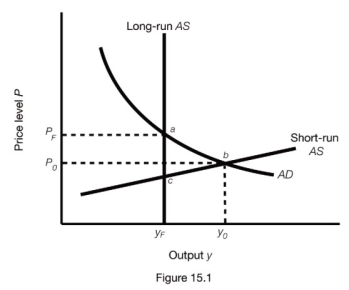 -Refer to Figure 15.1. The long-run equilibrium occurs at point
 (Multiple Choice)
4.8/5 (80)
(80) If increases in defense spending by the government "crowd out" private investment spending, this will lead to
(Multiple Choice)
4.8/5 (74)
(74) Figure 15.4
 -Refer to Figure 15.4. Suppose that the economy is originally in equilibrium at point a. In the long run, as the supply of money decreases, the economy moves to point
 (Multiple Choice)
4.8/5 (78)
(78) Wages and prices throughout an economy will rise above previous inflation rates when
(Multiple Choice)
4.9/5 (67)
(67) Recall the Application about Fed Chairman Ben Bernanke's views on how to fight a liquidity trap to answer the following question(s).
-The classic political business cycle would have a politician following
(Multiple Choice)
4.9/5 (76)
(76) Recall the Application about the links between presidential elections and macroeconomic performance to answer the following question(s). Early theories on the links between presidential elections and macroeconomic performance focused on incumbent presidents trying to manipulate the economy in their favor to gain reelection. Subsequent research began to incorporate other factors. The first innovation was recognizing that political parties can have different goals or preferences on how to manipulate the economy. In the United States, Republicans historically have been more concerned about fighting inflation, whereas Democrats have concentrated on reducing unemployment. The second major innovation was recognizing that the public would anticipate that politicians will try to manipulate the economy before an election.
-Historically, Democrats have been known to be primarily concerned with fighting unemployment. Assuming this is true, then after a Democratic electoral victory, the public could anticipate which of the following economic actions to fight unemployment?
(Multiple Choice)
4.9/5 (76)
(76) 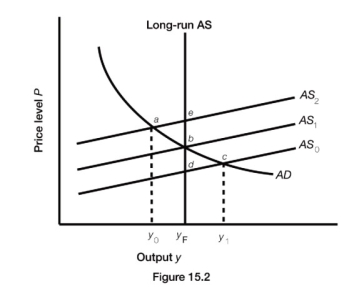 -Refer to Figure 15.2. A movement from point c to point b would be the result of the
 (Multiple Choice)
4.8/5 (77)
(77) Suppose that the unemployment rate is ________ the natural rate. We would expect prices to rise, money demand to rise, interest rates to rise, and total demand to ________.
(Multiple Choice)
4.8/5 (79)
(79) Suppose that the unemployment rate is ________ the natural rate. We would expect prices to fall, money demand to fall, interest rates to fall, and total demand to ________.
(Multiple Choice)
4.9/5 (80)
(80) If output is below full employment, we expect wages and prices to fall, money demand to decrease, and interest rates to fall.
(True/False)
4.7/5 (82)
(82) If the economy is operating below full employment, falling wages and prices will increase money demand and raise interest rates.
(True/False)
4.9/5 (68)
(68) Explain why the flexibility of wages and prices tend to favor the Keynesian economic view in the short run and the classical economic view in the long run.
(Essay)
4.7/5 (74)
(74) Figure 15.3
 -Refer to Figure 15.3 and explain what happens in each graph when an economy is moving from a recession (point a)back to full employment.
 (Essay)
4.9/5 (78)
(78) In an aggregate supply and aggregate demand diagram, the short-run aggregate supply curve is represented by
(Multiple Choice)
4.8/5 (85)
(85) An increase in the price level causes an increase in money demand because
(Multiple Choice)
4.9/5 (82)
(82) A decrease in the money supply will decrease interest rates in the long run.
(True/False)
4.9/5 (69)
(69) 
Filters
- Essay(0)
- Multiple Choice(0)
- Short Answer(0)
- True False(0)
- Matching(0)