



 Chat with AI
Exam 15: Modern Macroeconomics: From the Short Run to the Long Run

Exam 1: Introduction: What Is Economics?118 Questions
Exam 2: The Key Principles of Economics144 Questions
Exam 3: Exchange and Markets111 Questions
Exam 4: Demand, Supply, and Market Equilibrium172 Questions
Exam 5: Measuring a Nation's Production and Income152 Questions
Exam 6:Unemployment and Inflation155 Questions
Exam 7:The Economy at Full Employment148 Questions
Exam 8: Why Do Economies Grow?167 Questions
Exam 9: Aggregate Demand and Aggregate Supply160 Questions
Exam 10: Fiscal Policy133 Questions
Exam 11: The Income-Expenditure Model193 Questions
Exam 12: Investment and Financial Markets150 Questions
Exam 13: Money and the Banking System170 Questions
Exam 14: The Federal Reserve and Monetary Policy149 Questions
Exam 15: Modern Macroeconomics: From the Short Run to the Long Run152 Questions
Exam 16: The Dynamics of Inflation and Unemployment149 Questions
Exam 17: Macroeconomic Policy Debates147 Questions
Exam 18: International Trade and Public Policy155 Questions
Exam 19: The World of International Finance150 Questions
Select questions type


The GDP for the nation of Economia is currently above potential output. If the adjustment to the long-run equilibrium occurs rapidly, the government of Economia is likely to pursue a policy of
(Multiple Choice)
4.9/5  (75)
(75) 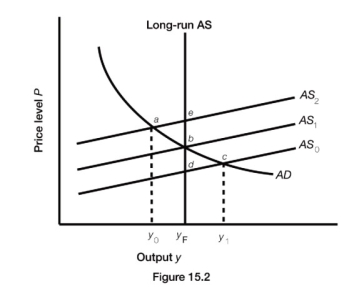 -Refer to Figure 15.2. Output is likely to fall and prices are likely to rise if the economy is at point
 (Multiple Choice)
4.9/5 (75)
(75) Consider an aggregate demand / aggregate supply diagram. The intersection of the vertical aggregate supply curve and the aggregate demand curve determines the
(Multiple Choice)
4.8/5 (77)
(77) In the short run, ________ in the supply of money ________ the level of output.
(Multiple Choice)
5.0/5 (77)
(77) Figure 15.4
 -Refer to Figure 15.4. Suppose that the economy is originally in equilibrium at point a. In the short run, as the supply of money increases, the economy moves to point
 (Multiple Choice)
4.7/5 (81)
(81) The long run in macroeconomics is the period of time in which prices do not change or do not change very much.
(True/False)
4.8/5 (72)
(72) Figure 15.4
-Refer to Figure 15.4. Suppose that the economy is originally in equilibrium at point a. In the short run, as the supply of money decreases, the economy moves to point
-Refer to Figure 15.4. Suppose that the economy is originally in equilibrium at point a. In the short run, as the supply of money decreases, the economy moves to point (Multiple Choice)
4.9/5 (79)
(79) Suppose an economy that has been operating at full employment has been experiencing 4 percent annual inflation. If output later falls to a level that is less than potential output, prices generally will begin to rise at
(Multiple Choice)
4.8/5 (83)
(83) Recall the Application about Fed Chairman Ben Bernanke's views on how to fight a liquidity trap to answer the following question(s).
-According to the Application, future Fed Chairman Ben Bernanke criticized the Bank of Japan for not taking strong enough action when their interest rates fell close to zero. Bernanke argued that the Bank of Japan should have made substantial purchases of ________ and also publicly commit to ________ inflation.
(Multiple Choice)
4.7/5 (78)
(78) In macroeconomics, the period of time in which prices have fully adjusted to any economic changes is called the short run.
(True/False)
4.8/5 (88)
(88) Classical economics refers to a body of work initially developed by John Maynard Keynes.
(True/False)
4.9/5 (77)
(77) The GDP for the nation of Economia is currently below potential output. If the adjustment to the long-run equilibrium occurs rapidly, the government of Economia is likely to pursue a policy of
(Multiple Choice)
4.9/5 (74)
(74) Consider an aggregate demand / aggregate supply diagram. The intersection of the relatively flat, upward-sloping aggregate supply curve and the aggregate demand curve determines the
(Multiple Choice)
4.9/5 (90)
(90) How might economic policy be used to fight a recession? What would happen to prices in this case?
(Essay)
4.9/5 (71)
(71) When an economy is experiencing a "liquidity trap," monetary policy to bring the economy back to full employment
(Multiple Choice)
4.8/5 (78)
(78) A necessary condition for the classical model to work is that
(Multiple Choice)
4.9/5 (83)
(83) Suppose that the economy is above the full employment level of output. Describe the adjustment process of returning this economy to full employment.
(Essay)
4.9/5 (84)
(84) The Keynesian aggregate supply curve moves up if output is below its potential.
(True/False)
4.9/5 (77)
(77) Figure 15.3
 -Refer to Figure 15.3 If this economy is initially in a recession, the price level will start to change to bring the economy back to full employment, which is reflected by the movement from
 (Multiple Choice)
4.9/5 (83)
(83) Recall the Application about the links between presidential elections and macroeconomic performance to answer the following question(s). Early theories on the links between presidential elections and macroeconomic performance focused on incumbent presidents trying to manipulate the economy in their favor to gain reelection. Subsequent research began to incorporate other factors. The first innovation was recognizing that political parties can have different goals or preferences on how to manipulate the economy. In the United States, Republicans historically have been more concerned about fighting inflation, whereas Democrats have concentrated on reducing unemployment. The second major innovation was recognizing that the public would anticipate that politicians will try to manipulate the economy before an election.
-This Application addresses the idea that politicians use monetary or fiscal policy to stimulate the economy before an election to improve their reelection prospects. This concept is known as a(n)
(Multiple Choice)
4.8/5 (70)
(70) 
Filters
- Essay(0)
- Multiple Choice(0)
- Short Answer(0)
- True False(0)
- Matching(0)