



 Chat with AI
Exam 15: Modern Macroeconomics: From the Short Run to the Long Run

Exam 1: Introduction: What Is Economics?118 Questions
Exam 2: The Key Principles of Economics144 Questions
Exam 3: Exchange and Markets111 Questions
Exam 4: Demand, Supply, and Market Equilibrium172 Questions
Exam 5: Measuring a Nation's Production and Income152 Questions
Exam 6:Unemployment and Inflation155 Questions
Exam 7:The Economy at Full Employment148 Questions
Exam 8: Why Do Economies Grow?167 Questions
Exam 9: Aggregate Demand and Aggregate Supply160 Questions
Exam 10: Fiscal Policy133 Questions
Exam 11: The Income-Expenditure Model193 Questions
Exam 12: Investment and Financial Markets150 Questions
Exam 13: Money and the Banking System170 Questions
Exam 14: The Federal Reserve and Monetary Policy149 Questions
Exam 15: Modern Macroeconomics: From the Short Run to the Long Run152 Questions
Exam 16: The Dynamics of Inflation and Unemployment149 Questions
Exam 17: Macroeconomic Policy Debates147 Questions
Exam 18: International Trade and Public Policy155 Questions
Exam 19: The World of International Finance150 Questions
Select questions type


The term "crowding out" refers to increases in government spending which affect private investment spending.
(True/False)
4.8/5  (74)
(74) Suppose Venezuela experiences economic expansion in 2013, yet its unemployment rate is 15 percent. All else equal, if this unemployment rate is above the natural rate of unemployment, what will tend to happen over time?
(Multiple Choice)
4.7/5 (72)
(72) Assuming an upward-sloping short-run aggregate supply curve, ________ in aggregate demand will result in a new equilibrium at a greater level of output and ________ price level.
(Multiple Choice)
4.8/5 (67)
(67) How do economists' beliefs about the speed of the adjustment process affect their recommendations about policy?
(Essay)
4.8/5 (81)
(81) Recall the Application about the possibility of increases in health-care expenditures crowding out consumption or investment spending to answer the following question(s). In 1950, health-care expenditures in the United States were 5.2 percent of GDP; by 2000, this share had risen to 15.4 percent. Driving these increases were several factors: increasing relative prices of health care compared to other goods, a larger population of the elderly, and increased longevity. Since 1950, the average life span has increased by 1.7 years per decade.
-According to the Application, increases in health-care expenditures will have to crowd out some other component of GDP. The preferred outcome stated in the Application is that increased spending on health-care would come at the expense of
(Multiple Choice)
4.8/5 (73)
(73) What is the difference in how GDP is determined in the short run and in the long run?
(Essay)
4.9/5 (75)
(75) Long-run money neutrality means that an increase in the money supply has no effect on real interest rates, investment, or output in the long run.
(True/False)
4.9/5 (83)
(83) The doctrine that states that "supply creates its own demand" is called ________ law.
(Multiple Choice)
4.8/5 (77)
(77) As output exceeds potential output, wages and prices throughout an economy will rise above previous inflation rates.
(True/False)
4.8/5 (79)
(79) The GDP for the nation of Economia is currently below potential output. If the adjustment to the long-run equilibrium occurs slowly, the government of Economia is likely to pursue a policy of
(Multiple Choice)
4.9/5 (91)
(91) The Keynesian view that demand could fall short of production is more likely to hold true if
(Multiple Choice)
5.0/5 (63)
(63) Recall the Application about the possibility of increases in health-care expenditures crowding out consumption or investment spending to answer the following question(s). In 1950, health-care expenditures in the United States were 5.2 percent of GDP; by 2000, this share had risen to 15.4 percent. Driving these increases were several factors: increasing relative prices of health care compared to other goods, a larger population of the elderly, and increased longevity. Since 1950, the average life span has increased by 1.7 years per decade.
-According to the Application, economists Charles I. Jones and Robert E. Hall suggest that normal economic growth will cause health-care expenditures to be approximately what percent of GDP by the mid-century?
(Multiple Choice)
4.7/5 (84)
(84) Politicians sometimes have the incentive to take advantage of the differences between the short-run and long-run effects of economic policies to improve their chances of being reelected.
(True/False)
4.8/5 (75)
(75) In order for the classical economic model to work, prices and wages must be fully flexible.
(True/False)
4.8/5 (79)
(79) What is meant when economists use the term "overheating of the economy"?
(Multiple Choice)
4.9/5 (77)
(77) 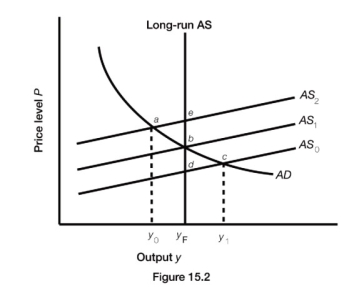 -Refer to Figure 15.2. A decrease in wages is represented by a movement from point ________ to point ________.
 (Multiple Choice)
4.8/5 (74)
(74) Figure 15.4
 -Refer to Figure 15.4. Suppose that the economy is originally in equilibrium at point a. In the long run, as the supply of money increases, the economy moves to point
 (Multiple Choice)
4.8/5 (84)
(84) Recall the Application about Fed Chairman Ben Bernanke's views on how to fight a liquidity trap to answer the following question(s).
-Suppose a politician stimulates the economy before an election to improve the chances she is reelected. This is known as
(Multiple Choice)
5.0/5 (78)
(78) 
Filters
- Essay(0)
- Multiple Choice(0)
- Short Answer(0)
- True False(0)
- Matching(0)