



 Chat with AI
Exam 15: Modern Macroeconomics: From the Short Run to the Long Run

Exam 1: Introduction: What Is Economics?118 Questions
Exam 2: The Key Principles of Economics144 Questions
Exam 3: Exchange and Markets111 Questions
Exam 4: Demand, Supply, and Market Equilibrium172 Questions
Exam 5: Measuring a Nation's Production and Income152 Questions
Exam 6:Unemployment and Inflation155 Questions
Exam 7:The Economy at Full Employment148 Questions
Exam 8: Why Do Economies Grow?167 Questions
Exam 9: Aggregate Demand and Aggregate Supply160 Questions
Exam 10: Fiscal Policy133 Questions
Exam 11: The Income-Expenditure Model193 Questions
Exam 12: Investment and Financial Markets150 Questions
Exam 13: Money and the Banking System170 Questions
Exam 14: The Federal Reserve and Monetary Policy149 Questions
Exam 15: Modern Macroeconomics: From the Short Run to the Long Run152 Questions
Exam 16: The Dynamics of Inflation and Unemployment149 Questions
Exam 17: Macroeconomic Policy Debates147 Questions
Exam 18: International Trade and Public Policy155 Questions
Exam 19: The World of International Finance150 Questions
Select questions type


Explain what is meant by the "wage-price spiral." Does it always work in one direction?
(Essay)
4.9/5  (70)
(70) Figure 15.5
 -Refer to Figure 15.5. An increase in the price level, ceteris paribus, is represented by movement from point ________ to point ________.
 (Multiple Choice)
4.7/5 (71)
(71) Recall the Application about Fed Chairman Ben Bernanke's views on how to fight a liquidity trap to answer the following question(s).
-Recall the Application. If nominal interest rates are ________ and the inflation rate is expected to be ________, the result will be negative real interest rates.
(Multiple Choice)
4.8/5 (89)
(89) In ________, monetary policy can change the level of output.
(Multiple Choice)
4.8/5 (76)
(76) 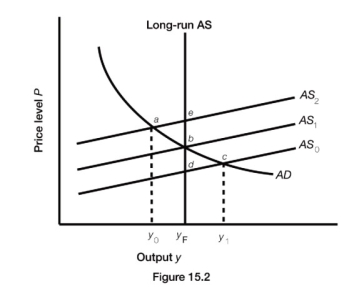 -Refer to Figure 15.2. An increase in wages is represented by a movement from point ________ to point ________.
 (Multiple Choice)
4.8/5 (97)
(97) Figure 15.3
 -Explain the "crowding out" criticism of Keynesian policies of increasing government spending to stimulate the economy.
 (Essay)
4.8/5 (67)
(67) How long do economists think it takes the U.S. economy to move from the short run to the long run?
(Multiple Choice)
4.7/5 (65)
(65)
-Refer to Figure 15.2. Adjustment from a short-run equilibrium to the long-run equilibrium is represented by a movement from point ________ to point ________.
-Refer to Figure 15.2. Adjustment from a short-run equilibrium to the long-run equilibrium is represented by a movement from point ________ to point ________. (Multiple Choice)
5.0/5 (83)
(83) Figure 15.5
-Refer to Figure 15.5. If GDP exceeds potential output, the effect on the money market is represented by movement from point ________ to point ________.
-Refer to Figure 15.5. If GDP exceeds potential output, the effect on the money market is represented by movement from point ________ to point ________. (Multiple Choice)
4.9/5 (81)
(81) The "long-run neutrality of money" is when the increase of the supply of money has no effect on the real interest rates, investment or output.
(True/False)
4.7/5 (73)
(73) Suppose that GDP is ________ potential output. We would expect prices to rise, money demand to rise, interest rates to rise, and total demand to ________.
(Multiple Choice)
4.8/5 (81)
(81) Classical economics is often associated with Say's law, the doctrine that "supply creates its own demand."
(True/False)
4.9/5 (88)
(88) Assuming an upward-sloping short-run aggregate supply curve, a decrease in taxes results in ________ in output and ________ in prices in the short run.
(Multiple Choice)
4.8/5 (81)
(81) Money demand increases as the price level decreases in the economy.
(True/False)
5.0/5 (83)
(83) A liquidity trap refers to a situation when interest rates are so high, they cannot legally go any higher.
(True/False)
4.8/5 (77)
(77) 
Filters
- Essay(0)
- Multiple Choice(0)
- Short Answer(0)
- True False(0)
- Matching(0)