



 Chat with AI
Exam 15: Non-Current Liabilities

Exam 1: Accounting in Action162 Questions
Exam 2: The Recording Process163 Questions
Exam 3: Adjusting the Accounts179 Questions
Exam 4: Completion of the Accounting Cycle151 Questions
Exam 5: Accounting for Merchandising Operations201 Questions
Exam 6: Inventory Costing176 Questions
Exam 7: Internal Control and Cash130 Questions
Exam 9: Long-Lived Assets243 Questions
Exam 10: Current Liabilities98 Questions
Exam 11: Accounting Principles116 Questions
Exam 12: Accounting for Partnerships153 Questions
Exam 13: Introduction to Corporations195 Questions
Exam 14: Corporations: Additional Topics and Ifrs136 Questions
Exam 15: Non-Current Liabilities139 Questions
Exam 16: The Cash Flow Statement158 Questions
Exam 17: Financial Statement Analysis155 Questions
Exam 18: Investments68 Questions
Select questions type


$5 million, 5%, 10-year bonds are issued at face value. Interest will be paid semi-annually. When calculating the market price of the bond, the present value of
(Multiple Choice)
4.9/5  (75)
(75) Most companies choose to issue debt because earnings per share and return on equity may be higher.
(True/False)
4.9/5 (79)
(79) On January 1, 2014, Edwards Corporation issued $300,000, 5%, 10-year bonds dated January 1, 2014, to yield 4%. The bonds pay semi-annual interest on January 1 and July 1.
Instructions
Calculate the selling price of the bond and prepare the journal entry to record the issue of the bond.
(Essay)
4.8/5 (88)
(88) Shareholders of a company may be reluctant to finance expansion through issuing more equity because
(Multiple Choice)
4.9/5 (73)
(73) The board of directors of Finley Corporation is considering two plans for financing the purchase of new plant equipment. Plan #1 would require the issue of $4,000,000, 6%, 20-year bonds at face value. Plan #2 would require the issue of 200,000 common shares for $20 per share. Finley Corporation currently has 100,000 common shares issued at a book value of $20 each and retained earnings of $750,000. The income tax rate is expected to be 30%. Assume that income before interest and income taxes is expected to be $800,000 if the new factory equipment is purchased. Assume that the debt or equity will be issued at the beginning of the year.
Instructions
a. Prepare a schedule which shows the expected profit, earnings per share, and return on equity under each of the plans that the board of directors is considering.
b. If the board of directors' stated goal is to maximize the common shareholders' return, which alternative is preferable? If the board's stated goal is to maximize solvency, which alternative is preferable?
(Essay)
4.7/5 (78)
(78) A corporation issued $200,000, 10%, 5-year bonds on January 1, 2013 for $216,222 which reflects an effective interest rate of 8%. Interest is paid semi-annually on January 1 and July 1. The amount of bond interest expense to be recognized on July 1, 2013, is
(Multiple Choice)
5.0/5 (83)
(83) Kirby Limited issued $200,000, 6%, 10-year bonds on December 31, 2013, for $190,000. Interest is payable semi-annually on June 30 and December 31. Kirby has a December 31 year end. Amortization for the first semi-annual interest period is $360.
Instructions
Prepare the appropriate journal entries on
a. December 31, 2013.
b. June 30, 2014.
(Essay)
4.9/5 (76)
(76) Butler Holdings Inc. issued $400,000 of 20-year, 5% bonds payable on July 1, 2014 providing an effective interest rate of 4.75%, for proceeds of $412,820. Interest is payable semi-annually on December 31 and June 30. Butler's year end is June 30 and the effective-interest method is used in accounting for bonds payable.
Instructions
a. Record the issuing of the bonds on July 1, 2014.
b. Prepare an amortization table for the first year (two payments).
c. Record the payments on December 31, 2014 and June 30, 2015.
d. Show how the bond payable would be presented on Butler's June 30, 2015 balance sheet.
(Essay)
4.8/5 (83)
(83) If bonds sell at a premium, the interest expense recognized each year will be greater than the contractual rate of interest.
(True/False)
4.7/5 (96)
(96) United Health is considering two alternatives for the financing of some high technology medical equipment. These two alternatives are:
1. Issue 50,000 common shares at $50 per share.
2. Issue $2,500,000, 5%, 10-year bonds at face value.
It is estimated that the company will earn $900,000 before interest and taxes as a result of acquiring the medical equipment. The company has an estimated tax rate of 30% and has 100,000 common shares issued prior to the new financing.
Instructions
Determine the effect on profit and earnings per share for these two methods of financing.
(Essay)
4.8/5 (74)
(74) The contractual interest rate and the market interest rate on the bond will always be equal if the bond's present value equals the face value of the bond.
(True/False)
4.9/5 (66)
(66) On January 1, 2013, Andrews Corporation issued $900,000, 8%, 5-year bonds dated January 1, 2013, to yield 9%. The bonds pay semi-annual interest on January 1 and July 1. The company has a December 31 year end.
Instructions
a. Calculate the selling price of the bond (round final answer to the nearest $1,000).
b. Prepare all the journal entries that Andrews Corporation would make related to this bond issue from issue date through to January 1, 2014.
(Essay)
4.8/5 (85)
(85) Which is one of the main differences between a note payable and a bond payable?
(Multiple Choice)
4.7/5 (91)
(91) Bond issuances are more common in the first quarter of a company's fiscal year.
(True/False)
4.9/5 (67)
(67) If the market rate of interest is 5%, a $10,000, 6%, 10-year bond that pays interest semi-annually would sell at an amount
(Multiple Choice)
4.7/5 (88)
(88) Southern Merchandising Inc. is considering new financing to pay out $2,500,000 of existing 10% bonds payable at the beginning of the next fiscal year. The company wants to maximize ROE in the new year. They are considering two alternative ways of financing the payout:
1. Do not pay out existing bonds;
2. Issue a 5% bond payable at face value, or issue 250,000 common shares at $10.
Other information about Southern:
Southern's tax rate is 25%.
Southern currently has $4,000,000 in shareholder equity prior to any new share issue.
Southern's average profit before financing costs and taxes is $800,000.
A one-time penalty of $150,000 will be incurred to pay out the 10% bonds early, which is fully tax deductible.
Instructions
Calculate the following amounts for Southern, compare the two alternatives to the current bonds payable, and make a recommendation on refinancing, assuming the goal is to maximize return on equity for the next year. 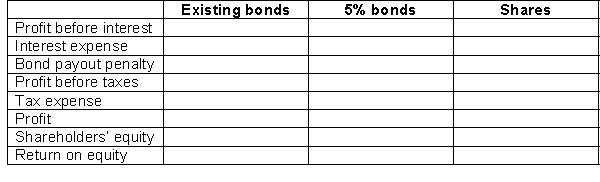
(Essay)
4.9/5 (83)
(83) Non-current liabilities such as bonds payable and instalment notes payable are financial liabilities because there is a contract between two or more parties to pay cash in the future.
(True/False)
4.9/5 (85)
(85) The face value of a bond is the amount of cash that the borrower receives at the start of the bond.
(True/False)
4.9/5 (84)
(84) 
Filters
- Essay(0)
- Multiple Choice(0)
- Short Answer(0)
- True False(0)
- Matching(0)