



 Chat with AI
Exam 14: Money and the Economy

Exam 1: What Economics Is About174 Questions
Exam 2: Production Possibilities Frontier Framework156 Questions
Exam 3: Supply and Demand Theory224 Questions
Exam 4: Prices Free Controlled and Relative122 Questions
Exam 5: Supply Demand and Price Applications76 Questions
Exam 6: Macroeconomic Measurements Part I Prices and Unemployment151 Questions
Exam 7: Macroeconomic Measurements Part II Gdp and Real Gdp150 Questions
Exam 8: Aggregate Demand and Aggregate Supply204 Questions
Exam 9: Classical Macroeconomics and the Self Regulating Economy172 Questions
Exam 10: Keynesian Macroeconomics and Economic Instability a Critique of the Self Regulating Economy200 Questions
Exam 11: Fiscal Policy and the Federal Budget167 Questions
Exam 12: Money Banking and the Financial System150 Questions
Exam 13: The Federal Reserve System180 Questions
Exam 14: Money and the Economy150 Questions
Exam 15: Monetary Policy185 Questions
Exam 16: Expectations Theory and the Economy150 Questions
Exam 17: Economic Growth Resources Technology Ideas and Institutions103 Questions
Exam 18: Debates in Macroeconomics Over the Role and Effects of Government100 Questions
Exam 19: Elasticity204 Questions
Exam 20: Consumer Choice and Behavioral Economics179 Questions
Exam 21: Production and Costs245 Questions
Exam 22: Perfect Competition187 Questions
Exam 23: Monopoly195 Questions
Exam 24: Monopolistic Competition Oligopoly and Game Theory172 Questions
Exam 25: Government and Product Markets Antitrust and Regulation158 Questions
Exam 26: Factor Markets With Emphasis on the Labor Market184 Questions
Exam 27: Wages Unions and Labor138 Questions
Exam 28: The Distribution of Income and Poverty99 Questions
Exam 29: Interest Rent and Profit198 Questions
Exam 30: Market Failure Externalities Public Goods and Asymmetric Information187 Questions
Exam 31: Public Choice and Special Interest Group Politics135 Questions
Exam 32: Building Theories to Explain Everyday Life From Observations to Questions to Theories to Predictions62 Questions
Exam 33: International Trade152 Questions
Exam 34: International Finance122 Questions
Exam 35: The Economic Case for and Against Government Five Topics Considered87 Questions
Exam 36: Stocks Bonds Futures and Options110 Questions
Select questions type


Exhibit 14-1
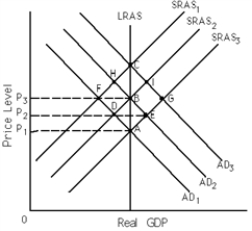 -Refer to Exhibit 14-1. What sequence of points shows the short- and long-run consequences of a fall in the money supply under monetarist assumptions?
 (Multiple Choice)
4.7/5  (76)
(76) Exhibit 14-1
-Refer to Exhibit 14-1. Starting from point A, a one-shot, demand-side-induced inflation raises the price level in the economy to P2. Assuming no other changes, in the long run the economy is likely to settle at point
-Refer to Exhibit 14-1. Starting from point A, a one-shot, demand-side-induced inflation raises the price level in the economy to P2. Assuming no other changes, in the long run the economy is likely to settle at point (Multiple Choice)
4.9/5 (73)
(73) The economy is initially in long-run equilibrium. The AD curve shifts to the right and the price level rises. Assuming that the economy is self-regulating, the SRAS curve will shift to the left and the price level will rise even further. If the price level now remains constant, what have we witnessed?
(Multiple Choice)
4.8/5 (62)
(62) If the Fed increases its open market purchases of government securities, it exerts a downward pressure on the interest rate. Such a phenomenon is usually referred to as the ___________________ effect.
(Multiple Choice)
4.7/5 (76)
(76) When Milton Friedman said that "inflation is always and everywhere a monetary phenomenon," he was referring to
(Multiple Choice)
4.8/5 (82)
(82) The California gold rush resulted in an increase in the amount of money in circulation and an increase in prices across the country.
(True/False)
4.8/5 (83)
(83) If Real GDP is $9,000, the money supply is $12,000, and velocity is 3, then the price level is
(Multiple Choice)
4.8/5 (82)
(82) One-shot inflation is always caused by a decrease in short-run aggregate supply.
(True/False)
4.9/5 (64)
(64) "The money supply multiplied by velocity must equal GDP" is a statement of the
(Multiple Choice)
4.8/5 (84)
(84) The liquidity, income, price-level, and expectations effects help to explain how changes in the money supply can affect the interest rate.
(True/False)
4.8/5 (85)
(85) Which of the following variables is capable of continually increasing aggregate demand with no offsetting influence on any of the components of total spending?
(Multiple Choice)
4.8/5 (90)
(90) Explain how a change in the money supply can affect the following in the short run:
a.The supply of loanable funds
b.Real GDP
c.The price level
d.The expected inflation rate
(Essay)
5.0/5 (79)
(79) 
Filters
- Essay(0)
- Multiple Choice(0)
- Short Answer(0)
- True False(0)
- Matching(0)