



 Chat with AI
Exam 30: Market Failure Externalities Public Goods and Asymmetric Information

Exam 1: What Economics Is About174 Questions
Exam 2: Production Possibilities Frontier Framework156 Questions
Exam 3: Supply and Demand Theory224 Questions
Exam 4: Prices Free Controlled and Relative122 Questions
Exam 5: Supply Demand and Price Applications76 Questions
Exam 6: Macroeconomic Measurements Part I Prices and Unemployment151 Questions
Exam 7: Macroeconomic Measurements Part II Gdp and Real Gdp150 Questions
Exam 8: Aggregate Demand and Aggregate Supply204 Questions
Exam 9: Classical Macroeconomics and the Self Regulating Economy172 Questions
Exam 10: Keynesian Macroeconomics and Economic Instability a Critique of the Self Regulating Economy200 Questions
Exam 11: Fiscal Policy and the Federal Budget167 Questions
Exam 12: Money Banking and the Financial System150 Questions
Exam 13: The Federal Reserve System180 Questions
Exam 14: Money and the Economy150 Questions
Exam 15: Monetary Policy185 Questions
Exam 16: Expectations Theory and the Economy150 Questions
Exam 17: Economic Growth Resources Technology Ideas and Institutions103 Questions
Exam 18: Debates in Macroeconomics Over the Role and Effects of Government100 Questions
Exam 19: Elasticity204 Questions
Exam 20: Consumer Choice and Behavioral Economics179 Questions
Exam 21: Production and Costs245 Questions
Exam 22: Perfect Competition187 Questions
Exam 23: Monopoly195 Questions
Exam 24: Monopolistic Competition Oligopoly and Game Theory172 Questions
Exam 25: Government and Product Markets Antitrust and Regulation158 Questions
Exam 26: Factor Markets With Emphasis on the Labor Market184 Questions
Exam 27: Wages Unions and Labor138 Questions
Exam 28: The Distribution of Income and Poverty99 Questions
Exam 29: Interest Rent and Profit198 Questions
Exam 30: Market Failure Externalities Public Goods and Asymmetric Information187 Questions
Exam 31: Public Choice and Special Interest Group Politics135 Questions
Exam 32: Building Theories to Explain Everyday Life From Observations to Questions to Theories to Predictions62 Questions
Exam 33: International Trade152 Questions
Exam 34: International Finance122 Questions
Exam 35: The Economic Case for and Against Government Five Topics Considered87 Questions
Exam 36: Stocks Bonds Futures and Options110 Questions
Select questions type


Suppose the production of a good results in negative externalities. If all costs are taken into account, then
(Multiple Choice)
4.8/5  (80)
(80) When a positive externality exists, the market is said to fail because it overproduces the good associated with the positive externality.
(True/False)
4.8/5 (82)
(82) The free rider problem is the main source of market failure in the provision of nonexcludable public goods.
(True/False)
4.9/5 (82)
(82) When an insurance company specifies certain precautions that an insured person must take it is trying to control for moral hazard.
(True/False)
4.8/5 (81)
(81) Suppose the production of a good results in negative externalities. If all costs are taken into account, then
(Multiple Choice)
4.8/5 (94)
(94) Which of these goods may be considered rivalrous in consumption and nonexcludable?
(Multiple Choice)
4.9/5 (77)
(77) Which of the following situations probably would not yield a negative externality?
(Multiple Choice)
4.7/5 (70)
(70) Exhibit 30-4
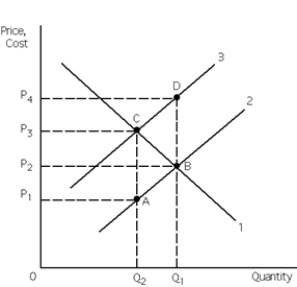 -Refer to Exhibit 30-4. If a negative externality exists, then curve __________ represents the marginal social cost curve and the area __________ represents the market failure.
 (Multiple Choice)
4.9/5 (74)
(74) Exhibit 30-3
 -Refer to Exhibit 30-3. What is the cost to Firm B of eliminating 2 tons of pollution?
 (Multiple Choice)
4.7/5 (65)
(65) Exhibit 30-2
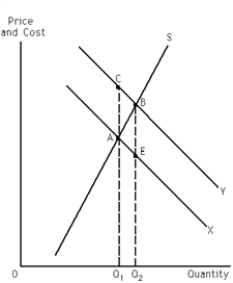 -Refer to Exhibit 30-2. If the exhibit represents a positive externality situation, the social benefit of expanding output from Q1 to Q2 is the area of
 (Multiple Choice)
4.8/5 (85)
(85) If fewer cigarettes are consumed with symmetric information than asymmetric information, it follows that
(Multiple Choice)
4.9/5 (73)
(73) Which of the following situations is clearly and unambiguously descriptive of a positive externality?
(Multiple Choice)
4.9/5 (70)
(70) When negative externalities are involved, the market is said to
(Multiple Choice)
4.9/5 (91)
(91) Some pollution may be preferable to zero pollution because
(Multiple Choice)
4.9/5 (79)
(79) In which of the following situations would a negative externality most likely be involved?
(Multiple Choice)
4.7/5 (75)
(75) Exhibit 30-4
-Refer to Exhibit 30-4. If a negative externality exists, then the socially optimal output is
-Refer to Exhibit 30-4. If a negative externality exists, then the socially optimal output is (Multiple Choice)
4.7/5 (76)
(76) 
Filters
- Essay(0)
- Multiple Choice(0)
- Short Answer(0)
- True False(0)
- Matching(0)