



 Chat with AI
Exam 34: International Finance

Exam 1: What Economics Is About174 Questions
Exam 2: Production Possibilities Frontier Framework156 Questions
Exam 3: Supply and Demand Theory224 Questions
Exam 4: Prices Free Controlled and Relative122 Questions
Exam 5: Supply Demand and Price Applications76 Questions
Exam 6: Macroeconomic Measurements Part I Prices and Unemployment151 Questions
Exam 7: Macroeconomic Measurements Part II Gdp and Real Gdp150 Questions
Exam 8: Aggregate Demand and Aggregate Supply204 Questions
Exam 9: Classical Macroeconomics and the Self Regulating Economy172 Questions
Exam 10: Keynesian Macroeconomics and Economic Instability a Critique of the Self Regulating Economy200 Questions
Exam 11: Fiscal Policy and the Federal Budget167 Questions
Exam 12: Money Banking and the Financial System150 Questions
Exam 13: The Federal Reserve System180 Questions
Exam 14: Money and the Economy150 Questions
Exam 15: Monetary Policy185 Questions
Exam 16: Expectations Theory and the Economy150 Questions
Exam 17: Economic Growth Resources Technology Ideas and Institutions103 Questions
Exam 18: Debates in Macroeconomics Over the Role and Effects of Government100 Questions
Exam 19: Elasticity204 Questions
Exam 20: Consumer Choice and Behavioral Economics179 Questions
Exam 21: Production and Costs245 Questions
Exam 22: Perfect Competition187 Questions
Exam 23: Monopoly195 Questions
Exam 24: Monopolistic Competition Oligopoly and Game Theory172 Questions
Exam 25: Government and Product Markets Antitrust and Regulation158 Questions
Exam 26: Factor Markets With Emphasis on the Labor Market184 Questions
Exam 27: Wages Unions and Labor138 Questions
Exam 28: The Distribution of Income and Poverty99 Questions
Exam 29: Interest Rent and Profit198 Questions
Exam 30: Market Failure Externalities Public Goods and Asymmetric Information187 Questions
Exam 31: Public Choice and Special Interest Group Politics135 Questions
Exam 32: Building Theories to Explain Everyday Life From Observations to Questions to Theories to Predictions62 Questions
Exam 33: International Trade152 Questions
Exam 34: International Finance122 Questions
Exam 35: The Economic Case for and Against Government Five Topics Considered87 Questions
Exam 36: Stocks Bonds Futures and Options110 Questions
Select questions type


If, under a fixed exchange rate system, the dollar price of a Mexican peso is above its equilibrium level, then the
(Multiple Choice)
4.9/5  (79)
(79) The proponents of fixed exchange rates argue that flexible exchange rates
(Multiple Choice)
4.8/5 (69)
(69) Suppose that an increase in a nation's income causes the nation's residents to buy more domestic and foreign goods. Given this, if U.S. residents experience an increase in income, but Mexican residents do not, it is likely that, ceteris paribus,
(Multiple Choice)
4.9/5 (86)
(86) According to the textbook, the _______________ is currently the primary reserve currency.
(Multiple Choice)
4.9/5 (77)
(77) Exhibit 34-5
U.S. $ Equivalent Foreign Currency per U.S. $

-Refer to Exhibit 34-5. Based on the information provided in this table, between Monday and Tuesday, the U.S. dollar ____________ against the Japanese yen and the yen _____________ against the U.S. dollar.
-Refer to Exhibit 34-5. Based on the information provided in this table, between Monday and Tuesday, the U.S. dollar ____________ against the Japanese yen and the yen _____________ against the U.S. dollar. (Multiple Choice)
4.7/5 (92)
(92) When exports of American goods increase, this __________ the demand for U.S. dollars and at the same time __________ foreign currencies.
(Multiple Choice)
5.0/5 (89)
(89) Suppose that the exchange rate between the U.S. dollar and the Mexican peso starts out at $0.12 per peso, and then changes to $0.09 per peso. The result will be that Americans will buy __________ pesos because Mexican goods become relatively __________ expensive.
(Multiple Choice)
4.8/5 (82)
(82) Economist Charles Kindleberger (a proponent of fixed exchange rates mentioned in the text) would agree with which of the following statements?
(Multiple Choice)
4.8/5 (73)
(73) An American computer is priced at $1,350. If the exchange rate between the U.S. dollar and the Japanese yen is $0.009 per yen, the equivalent price of the computer in yen is approximately __________ yen.
(Multiple Choice)
4.9/5 (77)
(77) Exhibit 34-4
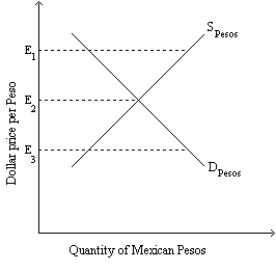 -Refer to Exhibit 34-4. Under a fixed exchange rate system, at the exchange rate of E1, the peso is __________ and there is a __________.
 (Multiple Choice)
4.8/5 (77)
(77) There is a flexible exchange rate system and only two countries in the world, the United States and Mexico. An increase in income growth in Mexico relative to income growth in the United States will cause the
(Multiple Choice)
4.9/5 (78)
(78) When the official dollar price of a foreign currency is lowered, the dollar is being
(Multiple Choice)
4.8/5 (60)
(60) Some economists have found that U.S. imports of Chinese goods and resources
(Multiple Choice)
4.7/5 (84)
(84) Suppose that prices in France increase by 8 percent while prices in the United States remain relatively stable. We would expect that (on the foreign exchange market) the demand for U.S. dollars will __________ and the supply of U.S. dollars will __________.
(Multiple Choice)
4.9/5 (75)
(75) There is demand for and supply of dollars and a demand for and supply of pesos. Under a flexible exchange rate system, if income growth in the United States is greater than income growth in Mexico, then
(Multiple Choice)
4.8/5 (84)
(84) Exhibit 34-4
-Refer to Exhibit 34-4. Under a fixed exchange rate system, at the exchange rate of E3, the peso is __________ and there is a __________.
-Refer to Exhibit 34-4. Under a fixed exchange rate system, at the exchange rate of E3, the peso is __________ and there is a __________. (Multiple Choice)
4.8/5 (77)
(77) Advocates of a fixed exchange rate system argue that fixed exchange rates promote international trade.
(True/False)
5.0/5 (95)
(95) Which of the following points would not be used as an argument in support of the current international monetary system?
(Multiple Choice)
4.8/5 (85)
(85) 
Filters
- Essay(0)
- Multiple Choice(0)
- Short Answer(0)
- True False(0)
- Matching(0)