



 Chat with AI
Exam 36: Stocks Bonds Futures and Options

Exam 1: What Economics Is About174 Questions
Exam 2: Production Possibilities Frontier Framework156 Questions
Exam 3: Supply and Demand Theory224 Questions
Exam 4: Prices Free Controlled and Relative122 Questions
Exam 5: Supply Demand and Price Applications76 Questions
Exam 6: Macroeconomic Measurements Part I Prices and Unemployment151 Questions
Exam 7: Macroeconomic Measurements Part II Gdp and Real Gdp150 Questions
Exam 8: Aggregate Demand and Aggregate Supply204 Questions
Exam 9: Classical Macroeconomics and the Self Regulating Economy172 Questions
Exam 10: Keynesian Macroeconomics and Economic Instability a Critique of the Self Regulating Economy200 Questions
Exam 11: Fiscal Policy and the Federal Budget167 Questions
Exam 12: Money Banking and the Financial System150 Questions
Exam 13: The Federal Reserve System180 Questions
Exam 14: Money and the Economy150 Questions
Exam 15: Monetary Policy185 Questions
Exam 16: Expectations Theory and the Economy150 Questions
Exam 17: Economic Growth Resources Technology Ideas and Institutions103 Questions
Exam 18: Debates in Macroeconomics Over the Role and Effects of Government100 Questions
Exam 19: Elasticity204 Questions
Exam 20: Consumer Choice and Behavioral Economics179 Questions
Exam 21: Production and Costs245 Questions
Exam 22: Perfect Competition187 Questions
Exam 23: Monopoly195 Questions
Exam 24: Monopolistic Competition Oligopoly and Game Theory172 Questions
Exam 25: Government and Product Markets Antitrust and Regulation158 Questions
Exam 26: Factor Markets With Emphasis on the Labor Market184 Questions
Exam 27: Wages Unions and Labor138 Questions
Exam 28: The Distribution of Income and Poverty99 Questions
Exam 29: Interest Rent and Profit198 Questions
Exam 30: Market Failure Externalities Public Goods and Asymmetric Information187 Questions
Exam 31: Public Choice and Special Interest Group Politics135 Questions
Exam 32: Building Theories to Explain Everyday Life From Observations to Questions to Theories to Predictions62 Questions
Exam 33: International Trade152 Questions
Exam 34: International Finance122 Questions
Exam 35: The Economic Case for and Against Government Five Topics Considered87 Questions
Exam 36: Stocks Bonds Futures and Options110 Questions
Select questions type


The term after the bell means after the closing of the stock market.
(True/False)
4.9/5  (83)
(83) The Wilshire 5000 stock index is made up of the stocks of 5,000 of the largest U.S. companies.
(True/False)
4.8/5 (80)
(80) Which of the following companies was part of the original Dow Jones Industrial Average?
(Multiple Choice)
4.8/5 (77)
(77) If you thought the share price of a stock was going to rise, would you be more likely to buy a call option or a put option?
(Multiple Choice)
4.9/5 (80)
(80) You turn to the bond market page of a newspaper and look under the column headed "Net Chg" and see that it says, "-1/4" this indicates that
(Multiple Choice)
4.9/5 (86)
(86) Exhibit 36-1
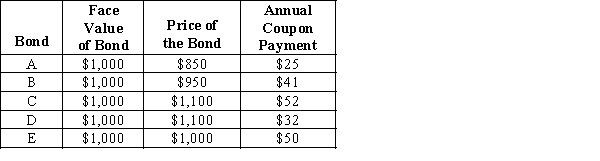 -Refer to Exhibit 36-1. The yield on bond B is approximately
 (Multiple Choice)
5.0/5 (93)
(93) Jessica paid $5,300 for a bond with a face value of $5,000. She will be paid $300 annually as long as she holds on to the bond, until the bond's maturity date. The coupon rate of the bond is
(Multiple Choice)
4.9/5 (70)
(70) If the bid value of a Treasury bond is listed as "112:16", it means that the buyer is willing to pay $1,125 for the bond.
(True/False)
4.8/5 (83)
(83) You turn to the bond market page of a newspaper and look under the column headed "Bonds" and see that it says, "Gemco 5 3/4 13" this indicates that
(Multiple Choice)
4.9/5 (74)
(74) You turn to the Treasury bond market page of a newspaper and look under the column headed "Bid" and see that it says, "125:8" this indicates that
(Multiple Choice)
4.9/5 (82)
(82) The federal government began issuing inflation-indexed Treasury bonds in
(Multiple Choice)
4.8/5 (61)
(61) A bond purchaser bought a bond from which she receives $800 a year from the issuer. If the face value of the bond is __________ then the coupon rate is __________.
(Multiple Choice)
4.8/5 (77)
(77) The beginnings of the New York Stock Exchange can be traced back to a small group of men who bought and sold stock in New York in
(Multiple Choice)
4.9/5 (77)
(77) Applied to any investment, the phrase "there's no such thing as a free lunch" means that higher returns come with lower risks, and lower returns come with higher risks.
(True/False)
4.7/5 (95)
(95) 
Filters
- Essay(0)
- Multiple Choice(0)
- Short Answer(0)
- True False(0)
- Matching(0)