



 Chat with AI
Exam 16: Retained Earnings and Earnings Per Share

Exam 1: The Demand for and Supply of Financial Accounting Information85 Questions
Exam 2: Financial Reporting: Its Conceptual Framework83 Questions
Exam 3: Review of a Company S Accounting System148 Questions
Exam 4: The Balance Sheet and the Statement of Shareholders Equity127 Questions
Exam 5: The Income Statement and the Statement of Cash Flows Time Value of Money Module136 Questions
Exam 6: Cash and Receivables172 Questions
Exam 7: Inventories: Cost Measurement and Flow Assumptions114 Questions
Exam 8: Inventories: Special Valuation Issues141 Questions
Exam 9: Current Liabilities and Contingent Obligations125 Questions
Exam 10: Property, Plant, and Equipment: Acquisition and Subsequent Investments111 Questions
Exam 11: Depreciation, Depletion, Impairment, and Disposal136 Questions
Exam 12: Intangibles136 Questions
Exam 13: Investments and Long-Term Receivables135 Questions
Exam 14: Financing Liabilities: Bonds and Long-Term Notes Payable192 Questions
Exam 15: Contributed Capital153 Questions
Exam 16: Retained Earnings and Earnings Per Share110 Questions
Exam 17: Advanced Issues in Revenue Recognition103 Questions
Exam 18: Accounting for Income Taxes113 Questions
Exam 19: Accounting for Post-Retirement Benefits94 Questions
Exam 20: Accounting for Leases116 Questions
Exam 21: The Statement of Cash Flows103 Questions
Exam 22: Accounting for Changes and Errors130 Questions
Exam 23: Understanding Time Value of Money Formulas and Concepts142 Questions
Select questions type


A simple capital structure is one that consists of common stock outstanding and possibly convertible preferred stock.
(True/False)
4.7/5  (83)
(83) Under the if-converted method, the impact of various convertible securities on the diluted earnings per share calculation are ranked from
(Multiple Choice)
4.9/5 (80)
(80) The Norman Corporation's stockholders' equity accounts have the following balances as of January 1, 2016:  Norman engaged in the following dividend transactions during 2016:
March 1: Declared a 50% stock dividend on the common stock, distributable on April 10.
The market price per share for the common stock was $35 on March 1.
April 10: Distributed the stock dividend declared on March 1.
June 30: Declared a 10% stock dividend on the common stock, distributable on August 5.
The market price for the common stock was $38 per share on June 30.
August 5: Distributed the stock dividend declared on June 30.
December 1: A $.60 per share cash dividend was declared on the common stock, payable on
January 20, 2017.
Required:
Prepare the entries to record the dividend transactions for 2016. Do not record the cash dividend payment in 2017.)
Norman engaged in the following dividend transactions during 2016:
March 1: Declared a 50% stock dividend on the common stock, distributable on April 10.
The market price per share for the common stock was $35 on March 1.
April 10: Distributed the stock dividend declared on March 1.
June 30: Declared a 10% stock dividend on the common stock, distributable on August 5.
The market price for the common stock was $38 per share on June 30.
August 5: Distributed the stock dividend declared on June 30.
December 1: A $.60 per share cash dividend was declared on the common stock, payable on
January 20, 2017.
Required:
Prepare the entries to record the dividend transactions for 2016. Do not record the cash dividend payment in 2017.) (Essay)
4.9/5 (67)
(67) Dual presentation of the basic and diluted earnings per share amounts is
(Multiple Choice)
4.9/5 (83)
(83) As of December 31, 2017, the Russell Corporation has 10,000 shares of 10% preferred stock issued and outstanding with a total par value of $250,000. In addition, as of this date, Russell has 75,000 shares of common stock issued and outstanding with a total par value of $750,000. Dividends for 2015 and 2016 have not been paid. As of December 31,
2017, the Russell Corporation declared total cash dividends of $290,000 to be paid to both the preferred stockholders and the common stockholders.
Required:
How much cash will be distributed to both the preferred stockholders and the common stockholders, respectively, on
December 31, 2017, under each of the following independent situations?
a. The preferred stock is noncumulative and nonparticipating.
b. The preferred stock is cumulative and nonparticipating.
c. The preferred stock is cumulative and fully participating.
d. The preferred stock is cumulative and partially participating up to 15% of its par value.
(Essay)
4.8/5 (68)
(68) List 4 factors that management may consider prior to declaring a dividend.
(Essay)
4.8/5 (79)
(79) Exhibit 16-1
The Zeller Corporation's stockholders' equity accounts have the following balances as of December 31, 2016:
Common stock, $10 par 30,000 shares issued  -Refer to Exhibit 16-1. On January 2, 2017, the board of directors of Zeller declared a 5% stock dividend to be distributed on January 31, 2017. The market price per share of Zeller's common stock was $30 on January 2 and $32 on January 31. As a result of this stock dividend, the retained earnings account should be decreased by
 (Multiple Choice)
4.9/5 (77)
(77) In calculating earnings per share, a company uses the treasury stock method when
(Multiple Choice)
4.9/5 (90)
(90) The retained earnings statement is a required separate financial statement that discloses all changes in retained earnings during the accounting period.
(True/False)
4.8/5 (83)
(83) On January 1, 2016, Wade Corporation had 24,000 shares of common stock outstanding. On April 1, it reacquired 2,400 shares; on July 1, it issued 10,800 shares; on October 1, it issued another 9,600 shares; and on December 1, it reacquired 900 shares. What was the weighted average number of common shares outstanding for 2016?
(Multiple Choice)
4.8/5 (84)
(84) Reporting basic earnings per share is required for which type of corporate capital structure?
(Multiple Choice)
4.9/5 (83)
(83) Smith Corporation had 30,000 shares of common stock outstanding during the year. In addition, there were compensatory share options to purchase 3,000 shares of common stock at $20 a share outstanding the entire year. The average market price for the common stock during the year was $36 a share. The unrecognized compensation cost net of tax) relating to these options was $4 a share. What is the denominator to compute the diluted earnings per share?
(Multiple Choice)
5.0/5 (86)
(86) A board of directors may decide to restrict retained earnings to meet legal requirements or to meet a contractual restriction.
(True/False)
4.8/5 (89)
(89) During 2016, Stewart, Inc. had the following convertible securities outstanding:
A. $220,000 of 10%, $100 par, cumulative preferred stock. Each share is convertible into 5 shares of common stock.
B. $200,000 of 9.5% convertible bonds. Each $1,000 bond is convertible into 45 shares of common stock.
C. $100,000 of 8% convertible bonds. Each $1,000 bond is convertible into 32 shares of
common stock.
D. $150,000 of 11%, $100 par, cumulative preferred stock. Each share is convertible into 5 shares of common stock.
Stewart, Inc. has an income tax rate of 40%. Its reported net income for 2016 was $88,000, and it had 22,000 shares of common stock outstanding all year.
Required:
Calculate basic and diluted earnings per share for Stewart.
(Essay)
4.8/5 (87)
(87) When reporting basic and diluted earnings per share, companies are required to include a schedule or note identifying and reconciling the numerators and denominators used in their calculations. What other information must be included in the schedule or note in the financial statements?
(Essay)
4.9/5 (84)
(84) On January 1, 2016, Samuel Company had 21,000 shares of common stock outstanding and issued an additional 4,500 shares on May 1. The company declared and paid a cash dividend of $45,000 and earned $375,000 net income. What was the basic earnings per share for the year?
(Multiple Choice)
4.7/5 (90)
(90) In 2016, Cunningham Company determined that it did not accrue $15,000 of interest expense in 2015, which caused a material overstatement of income. Assuming a 35% tax rate, which of the following presents the journal entries that would correct the error?
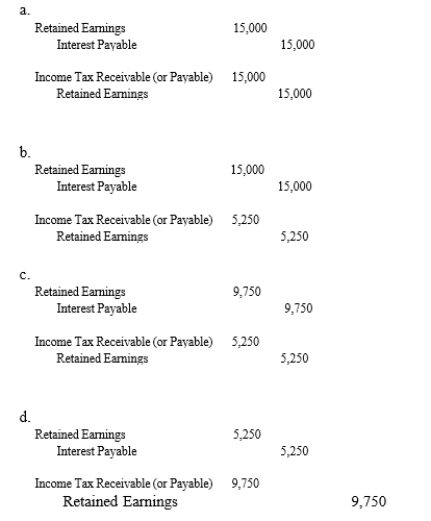
(Short Answer)
4.8/5 (76)
(76) Which statement best represents the relationship between date of declaration, date of record and ex-dividend date, and date of payment, for a cash dividend.
(Multiple Choice)
5.0/5 (89)
(89) The Frank Company has issued 10%, fully participating, cumulative preferred stock with a total par value of $300,000 and common stock with a total par value of $900,000. Dividends for one previous year are in arrears. How much cash will be paid to the preferred stockholders and the common stockholders, respectively, if cash dividends of
$222,000 are distributed at the end of the current year?
(Multiple Choice)
4.8/5 (61)
(61) The following information is provided for the Jacob Company: 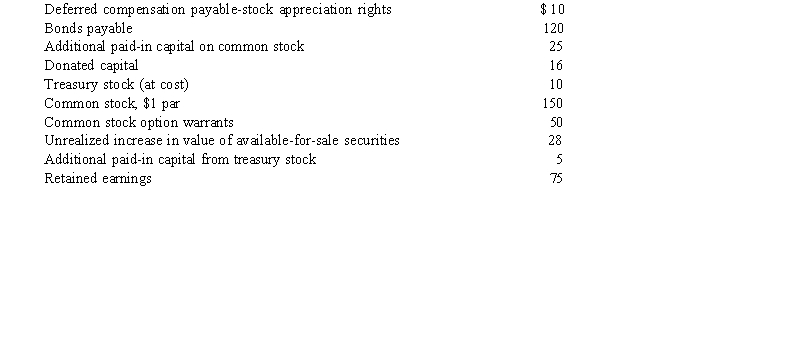 What is the total stockholders' equity of Jacob Company?
 (Multiple Choice)
5.0/5 (83)
(83) 
Filters
- Essay(0)
- Multiple Choice(0)
- Short Answer(0)
- True False(0)
- Matching(0)