



 Chat with AI
Exam 21: Cost Management

Exam 1: Introduction to Management Accounting49 Questions
Exam 2: An Introduction to Cost Terms and Concepts64 Questions
Exam 3: Cost Assignment29 Questions
Exam 4: Accounting Entries for a Job Costing System15 Questions
Exam 5: Process Costing29 Questions
Exam 6: Joint and By-Product Costing61 Questions
Exam 7: Income Effects of Alternative Cost Accumulation Systems45 Questions
Exam 8: Cost-Volume-Profit Analysis60 Questions
Exam 9: Measuring Relevant Costs and Revenues for Decision-Making81 Questions
Exam 10: Activity-Based Costing40 Questions
Exam 11: Pricing Decisions and Profitability Analysis59 Questions
Exam 12: Decision-Making Under Conditions of Risk and Uncertainty29 Questions
Exam 13: Capital Investment Decisions: Appraisal Methods77 Questions
Exam 14: Capital Investment Decisions: the Impact of Capital Rationing, Taxation, Inflation and Risk25 Questions
Exam 15: The Budgeting Process86 Questions
Exam 16: Management Control Systems64 Questions
Exam 17: Standard Costing and Variance Analysis 181 Questions
Exam 18: Standard Costing and Variance Analysis 2: Further Aspects12 Questions
Exam 19: Divisional Financial Performance Measures51 Questions
Exam 20: Transfer Pricing in Divisionalized Companies50 Questions
Exam 21: Cost Management95 Questions
Exam 22: Strategic Management Accounting32 Questions
Exam 23: Cost Estimation and Cost Behaviour63 Questions
Exam 24: Quantitative Models for the Planning and Control of Stocks42 Questions
Exam 25: The Application of Linear Programming to Management Accounting30 Questions
Select questions type


____ is an effort to reduce costs of existing products and processes.
(Multiple Choice)
4.9/5  (85)
(85) ____ are costs of activities performed because contaminants and waste have been produced but not discharged into the environment.
(Multiple Choice)
4.7/5 (89)
(89) The majority of the product cost is "locked in" during which of the following life-cycle stages?
(Multiple Choice)
4.8/5 (67)
(67) Figure 21-1
A company keeps 20 days of materials inventory on hand to avoid shutdowns due to materials shortages. Carrying costs average £4,000 per day. A competitor keeps 10 days of inventory on hand, and the competitor's carrying costs average £2,000 per day.
-Refer to Figure 21-1. The value-added costs are
(Multiple Choice)
4.7/5 (94)
(94) Which of the following is a reason for managerial activity to be considered a value-added activity?
(Multiple Choice)
4.8/5 (85)
(85) Costs incurred to determine whether products and services are conforming to requirements are called
(Multiple Choice)
4.8/5 (77)
(77) Figure 21-5
At the beginning of this year, Sammie Company installed a JIT purchasing and manufacturing system. The following information has been gathered about one of the company's products:  -Refer to Figure 21-5. Sammie's defective units as a percentage of total units produced would be
 (Multiple Choice)
4.9/5 (77)
(77) Which of the following is not an objective of activity-based management?
(Multiple Choice)
4.8/5 (93)
(93) Which of the following is an example of a value-added activity?
(Multiple Choice)
4.8/5 (76)
(76) ____ is the process of identifying, describing, and evaluating the activities an organization performs.
(Multiple Choice)
4.7/5 (104)
(104) Figure 21-1
A company keeps 20 days of materials inventory on hand to avoid shutdowns due to materials shortages. Carrying costs average £4,000 per day. A competitor keeps 10 days of inventory on hand, and the competitor's carrying costs average £2,000 per day.
-Refer to Figure 21-2. The value-added costs would be
(Multiple Choice)
4.9/5 (80)
(80) ____ are the costs of activities performed after discharging contaminants and waste into the environment.
(Multiple Choice)
5.0/5 (95)
(95) Figure 21-8
At the beginning of the year, Grant Company initiated a quality improvement program. The program was successful in reducing scrap and rework costs. To help assess the impact of the quality improvement program, the following data were collected for the current and preceding years: 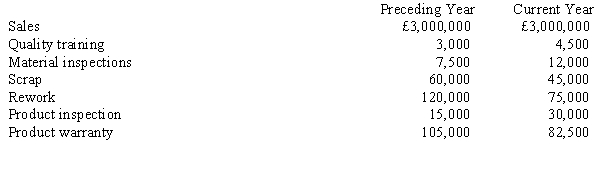 -Palms, SA., sells one of its products for £80 each. Sales volume averages 2,000 units per year. Recently, its main competitor reduced the price of its product to £56. Palms expects its sales to drop dramatically unless it matches the competitor's price. In addition, the current profit per unit must be maintained.
Information about the product (for production of 2,000) is as follows:
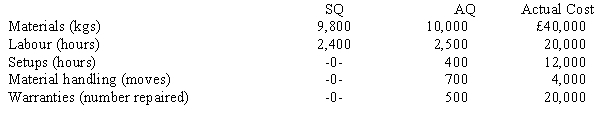 Required:
a.
Calculate the target cost for maintaining current market share and profitability.
b.
Calculate the nonvalue-added cost per unit.
c.
If nonvalue-added costs can be reduced to zero, can the target cost be achieved?
-Palms, SA., sells one of its products for £80 each. Sales volume averages 2,000 units per year. Recently, its main competitor reduced the price of its product to £56. Palms expects its sales to drop dramatically unless it matches the competitor's price. In addition, the current profit per unit must be maintained.
Information about the product (for production of 2,000) is as follows: Required:
a.
Calculate the target cost for maintaining current market share and profitability.
b.
Calculate the nonvalue-added cost per unit.
c.
If nonvalue-added costs can be reduced to zero, can the target cost be achieved? (Essay)
4.8/5 (90)
(90) 
Filters
- Essay(0)
- Multiple Choice(0)
- Short Answer(0)
- True False(0)
- Matching(0)