



 Chat with AI
Exam 7: Income Effects of Alternative Cost Accumulation Systems

Exam 1: Introduction to Management Accounting49 Questions
Exam 2: An Introduction to Cost Terms and Concepts64 Questions
Exam 3: Cost Assignment29 Questions
Exam 4: Accounting Entries for a Job Costing System15 Questions
Exam 5: Process Costing29 Questions
Exam 6: Joint and By-Product Costing61 Questions
Exam 7: Income Effects of Alternative Cost Accumulation Systems45 Questions
Exam 8: Cost-Volume-Profit Analysis60 Questions
Exam 9: Measuring Relevant Costs and Revenues for Decision-Making81 Questions
Exam 10: Activity-Based Costing40 Questions
Exam 11: Pricing Decisions and Profitability Analysis59 Questions
Exam 12: Decision-Making Under Conditions of Risk and Uncertainty29 Questions
Exam 13: Capital Investment Decisions: Appraisal Methods77 Questions
Exam 14: Capital Investment Decisions: the Impact of Capital Rationing, Taxation, Inflation and Risk25 Questions
Exam 15: The Budgeting Process86 Questions
Exam 16: Management Control Systems64 Questions
Exam 17: Standard Costing and Variance Analysis 181 Questions
Exam 18: Standard Costing and Variance Analysis 2: Further Aspects12 Questions
Exam 19: Divisional Financial Performance Measures51 Questions
Exam 20: Transfer Pricing in Divisionalized Companies50 Questions
Exam 21: Cost Management95 Questions
Exam 22: Strategic Management Accounting32 Questions
Exam 23: Cost Estimation and Cost Behaviour63 Questions
Exam 24: Quantitative Models for the Planning and Control of Stocks42 Questions
Exam 25: The Application of Linear Programming to Management Accounting30 Questions
Select questions type


Figure 7-3
Eastwood Company has the following information for 2011: 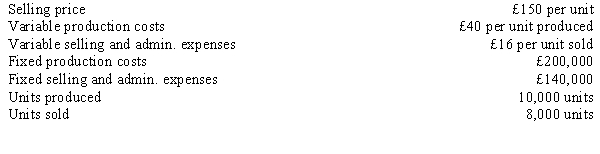 There were no beginning inventories.
-Refer to Figure 7-3. What is the ending inventory for Eastwood using the variable costing method?
There were no beginning inventories.
-Refer to Figure 7-3. What is the ending inventory for Eastwood using the variable costing method? (Multiple Choice)
4.9/5  (77)
(77) Assuming sales prices and cost behaviour remain unchanged, when variable costing is used, when does net income change in response to changes in unit sales?
(Multiple Choice)
4.9/5 (73)
(73) Ramon Company reported the following units of production and sales for June and July 2011:  Net income under absorption costing for June was £40,000; net income under variable costing for July was £50,000. Fixed manufacturing costs were £600,000 for each month. How much was net income for July using absorption costing?
 (Multiple Choice)
4.9/5 (72)
(72) Figure 7-2
Steele Ltd. has the following information for January, February, and March 2011:  Production costs per unit (based on 10,000 units) are as follows:
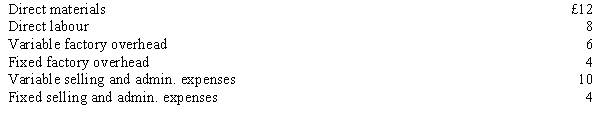 There were no beginning inventories for January 2011, and all units were sold for £50. Costs are stable over the three months.
-Toshi Company incurred the following costs in manufacturing desk calculators:
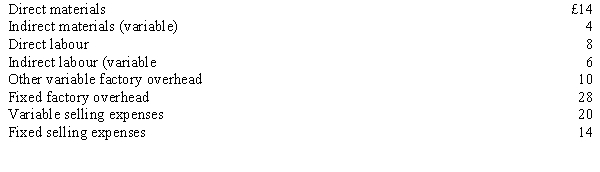 During the period, the company produced and sold 1,000 units. What is the inventory cost per unit using variable costing?
Production costs per unit (based on 10,000 units) are as follows: There were no beginning inventories for January 2011, and all units were sold for £50. Costs are stable over the three months.
-Toshi Company incurred the following costs in manufacturing desk calculators: During the period, the company produced and sold 1,000 units. What is the inventory cost per unit using variable costing? (Multiple Choice)
4.8/5 (75)
(75) 
Filters
- Essay(0)
- Multiple Choice(0)
- Short Answer(0)
- True False(0)
- Matching(0)