



 Chat with AI
Exam 9: Measuring Relevant Costs and Revenues for Decision-Making

Exam 1: Introduction to Management Accounting49 Questions
Exam 2: An Introduction to Cost Terms and Concepts64 Questions
Exam 3: Cost Assignment29 Questions
Exam 4: Accounting Entries for a Job Costing System15 Questions
Exam 5: Process Costing29 Questions
Exam 6: Joint and By-Product Costing61 Questions
Exam 7: Income Effects of Alternative Cost Accumulation Systems45 Questions
Exam 8: Cost-Volume-Profit Analysis60 Questions
Exam 9: Measuring Relevant Costs and Revenues for Decision-Making81 Questions
Exam 10: Activity-Based Costing40 Questions
Exam 11: Pricing Decisions and Profitability Analysis59 Questions
Exam 12: Decision-Making Under Conditions of Risk and Uncertainty29 Questions
Exam 13: Capital Investment Decisions: Appraisal Methods77 Questions
Exam 14: Capital Investment Decisions: the Impact of Capital Rationing, Taxation, Inflation and Risk25 Questions
Exam 15: The Budgeting Process86 Questions
Exam 16: Management Control Systems64 Questions
Exam 17: Standard Costing and Variance Analysis 181 Questions
Exam 18: Standard Costing and Variance Analysis 2: Further Aspects12 Questions
Exam 19: Divisional Financial Performance Measures51 Questions
Exam 20: Transfer Pricing in Divisionalized Companies50 Questions
Exam 21: Cost Management95 Questions
Exam 22: Strategic Management Accounting32 Questions
Exam 23: Cost Estimation and Cost Behaviour63 Questions
Exam 24: Quantitative Models for the Planning and Control of Stocks42 Questions
Exam 25: The Application of Linear Programming to Management Accounting30 Questions
Select questions type


WJE Company has only 4,000 machine hours available each month. The following information on the company's three products is available:  If demand exceeds the available capacity, in what sequence should orders be filled to maximize the company's profits?
 (Multiple Choice)
4.9/5  (69)
(69) Which of the following costs is relevant to a make-or-buy decision?
(Multiple Choice)
4.9/5 (84)
(84) A decision that focuses on whether a specially priced order should be accepted or rejected is a
(Multiple Choice)
5.0/5 (78)
(78) Figure 9-4
The following information pertains to Ewing Company's three products: 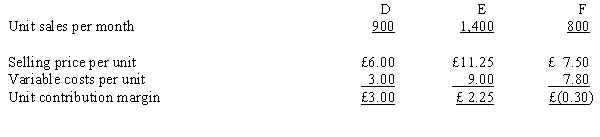 -Refer to Figure 9-4. Assume that product F is discontinued and the space is used to produce E. Product E's production is increased to 2,200 units per month, but E's selling price of all units of E is reduced to £10.20. Monthly profits will
 (Multiple Choice)
4.8/5 (92)
(92) Figure 9-4
The following information pertains to Ewing Company's three products:
-Refer to Figure 9-4. Assume that product F is discontinued and the space used to produce product F is rented for £600 per month. Monthly profits will
-Refer to Figure 9-4. Assume that product F is discontinued and the space used to produce product F is rented for £600 per month. Monthly profits will (Multiple Choice)
4.8/5 (74)
(74) Bonilla Ltd., which produces one product, had the following income statement for a recent month: 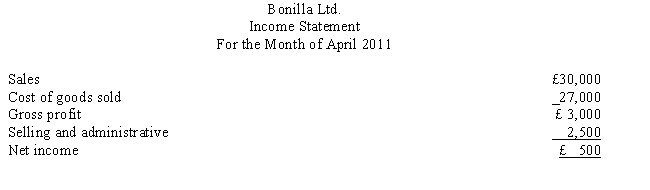 There were no beginning or ending inventories of work-in-process or finished goods. Bonilla's manufacturing costs were as follows:
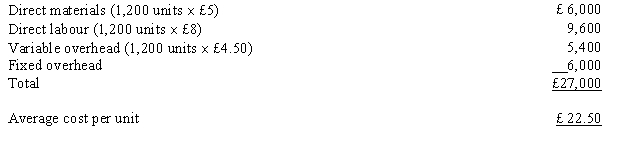 Selling and administrative expenses are all fixed.
Bonilla has just received a special order from a firm in Canada to purchase 800 units at £20 each. The order will not affect the selling price to regular customers.
Required:
a.
Prepare a differential analysis of the relevant costs and revenues associated with the decision to accept or reject the special order, assuming Bonilla has excess capacity.
b.
Determine the net advantage or disadvantage (profit increase or decrease) of accepting the order, assuming Bonilla does not have excess capacity.
There were no beginning or ending inventories of work-in-process or finished goods. Bonilla's manufacturing costs were as follows: Selling and administrative expenses are all fixed.
Bonilla has just received a special order from a firm in Canada to purchase 800 units at £20 each. The order will not affect the selling price to regular customers.
Required:
a.
Prepare a differential analysis of the relevant costs and revenues associated with the decision to accept or reject the special order, assuming Bonilla has excess capacity.
b.
Determine the net advantage or disadvantage (profit increase or decrease) of accepting the order, assuming Bonilla does not have excess capacity. (Essay)
4.7/5 (79)
(79) Zandy Beverage Company plans to eliminate a branch that has a contribution margin of £50,000 and fixed costs of £75,000. Of the fixed costs, £55,000 cannot be eliminated. The effect of eliminating this branch on net income would be a(n)
(Multiple Choice)
4.9/5 (71)
(71) Bridge Industries manufactures a product with the following costs per unit at the expected production of 78,000 units:  The company has the capacity to produce 80,000 units. The product regularly sells for £90. A wholesaler has offered to pay £75 each for 2,000 units. If Bridge's special order is accepted, the effect on operating income would be a
 (Multiple Choice)
4.8/5 (70)
(70) Figure 9-9
Boone Products had the following unit costs:  -Refer to Figure 9-9. A one-time customer has offered to buy 2,000 units at a special price of £48 per unit. Because of capacity constraints, 1,000 units will need to be produced during overtime. Overtime premium is £8 per unit. How much additional profit (loss) will be generated by accepting the special order?
 (Multiple Choice)
4.7/5 (77)
(77) If there is excess capacity, the minimum acceptable price for a special order must cover
(Multiple Choice)
4.9/5 (87)
(87) If there is excess capacity, the minimum acceptable price for a special order must cover
(Multiple Choice)
4.9/5 (74)
(74) The management of James Industries has been evaluating whether the company should continue manufacturing a component or buy it from an outside supplier. A £200 cost per component was determined as follows:  James Industries uses 4,000 components per year. After Light, SA., submitted a bid of £80 per component, some members of management felt they could reduce costs by buying from outside and discontinuing production of the component. If the component is obtained from Light, SA., James's unused production facilities could be leased to another company for £50,000 per year.
Required:
a.
Determine the maximum amount per unit James should pay an outside supplier.
b.
Indicate if the company should make or buy the component and the total monetary difference in favor of that alternative.
c.
Assume the company could eliminate production supervisors with salaries totaling £30,000 if the component is purchased from an outside supplier. Indicate if the company should make or buy the component and the total monetary difference in favor of that alternative.
James Industries uses 4,000 components per year. After Light, SA., submitted a bid of £80 per component, some members of management felt they could reduce costs by buying from outside and discontinuing production of the component. If the component is obtained from Light, SA., James's unused production facilities could be leased to another company for £50,000 per year.
Required:
a.
Determine the maximum amount per unit James should pay an outside supplier.
b.
Indicate if the company should make or buy the component and the total monetary difference in favor of that alternative.
c.
Assume the company could eliminate production supervisors with salaries totaling £30,000 if the component is purchased from an outside supplier. Indicate if the company should make or buy the component and the total monetary difference in favor of that alternative. (Essay)
4.8/5 (78)
(78) Rippey Ltd. manufactures a single product with the following unit costs for 5,000 units: 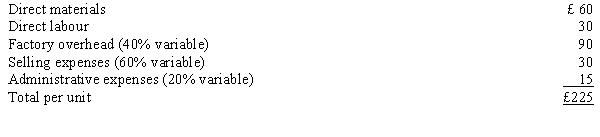 Recently, a company approached Rippey Ltd. about buying 1,000 units for £225. Currently, the models are sold to dealers for £412.50. Rippey's capacity is sufficient to produce the extra 1,000 units. No additional selling expenses would be incurred on the special order.
Required:
a.
What is the profit earned by Rippey Ltd. on the original 5,000 units?
b.
Should Rippey accept the special order if its goal is to maximize short-run profits? How much will income be affected?
c.
Determine the minimum price Rippey would want to receive in order to increase profits by £7,500 on the special order.
d.
When making a special order decision, what nonquantitative aspects of the decision should Rippey Ltd. consider?
Recently, a company approached Rippey Ltd. about buying 1,000 units for £225. Currently, the models are sold to dealers for £412.50. Rippey's capacity is sufficient to produce the extra 1,000 units. No additional selling expenses would be incurred on the special order.
Required:
a.
What is the profit earned by Rippey Ltd. on the original 5,000 units?
b.
Should Rippey accept the special order if its goal is to maximize short-run profits? How much will income be affected?
c.
Determine the minimum price Rippey would want to receive in order to increase profits by £7,500 on the special order.
d.
When making a special order decision, what nonquantitative aspects of the decision should Rippey Ltd. consider? (Essay)
4.9/5 (71)
(71) Figure 9-7
Meco Company produces a product that has a regular selling price of £360 per unit. At a typical monthly production volume of 2,000 units, the product's average unit cost of goods sold amounts to £270. Included in this average is £120,000 of fixed manufacturing costs. All selling and administrative costs are fixed and amount to £30,000 per month.
Meco Company has just received a special order for 1,000 units at £240 per unit. The buyer will pay transportation, and the regular selling price will not be affected if Meco accepts the order.
-Refer to Figure 9-7. Assuming Meco Company is operating at capacity and accepting the order would require an offsetting reduction in regular sales, the effect on profits of accepting the order would be a
(Multiple Choice)
5.0/5 (82)
(82) If a cost is identical under each alternative under consideration within a given decision context, the cost is considered:
(Multiple Choice)
4.9/5 (91)
(91) Qualitative factors that should be considered when evaluating a make-or-buy decision are
(Multiple Choice)
5.0/5 (97)
(97) Which of the following costs is NOT relevant to a special-order decision?
(Multiple Choice)
4.8/5 (71)
(71) Figure 9-5
Reggie Ltd. manufactures a single product with the following unit costs for 1,000 units: 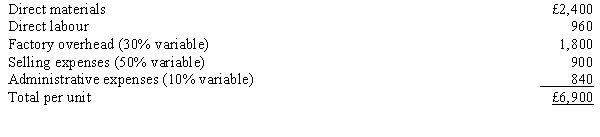 Recently, a company approached Reggie Ltd. about buying 100 units for £5,100 each. Currently, the models are sold to dealers for £7,800. Reggie Ltd.'s capacity is sufficient to produce the extra 100 units. No additional selling expenses would be incurred on the special order.
-Refer to Figure 9-5. What is the profit earned by Reggie Ltd. on the original 1,000 units?
Recently, a company approached Reggie Ltd. about buying 100 units for £5,100 each. Currently, the models are sold to dealers for £7,800. Reggie Ltd.'s capacity is sufficient to produce the extra 100 units. No additional selling expenses would be incurred on the special order.
-Refer to Figure 9-5. What is the profit earned by Reggie Ltd. on the original 1,000 units? (Multiple Choice)
4.9/5 (77)
(77) Which of the following costs is NOT relevant to a make-or-buy decision?
(Multiple Choice)
4.9/5 (71)
(71) 
Filters
- Essay(0)
- Multiple Choice(0)
- Short Answer(0)
- True False(0)
- Matching(0)